
June 2022 Paper 3 Mechanics Q2
2.
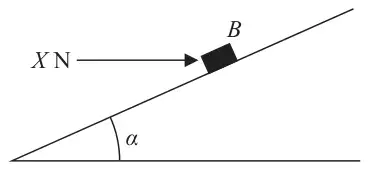
A rough plane is inclined to the horizontal at an angle \(\alpha\), where \(\tan\alpha = \dfrac{3}{4}\)
A small block \(B\) of mass 5 kg is held in equilibrium on the plane by a horizontal force of magnitude \(X\) newtons, as shown in Figure 1.
The force acts in a vertical plane which contains a line of greatest slope of the inclined plane.
The block \(B\) is modelled as a particle.
The magnitude of the normal reaction of the plane on \(B\) is 68.6 N.
Using the model,
The horizontal force of magnitude \(X\) newtons is now removed and \(B\) moves down the plane.
Given that the coefficient of friction between \(B\) and the plane is 0.5
| Scheme | Marks | AO |
|---|---|---|
| (i) Resolve vertically | M1 | 3.1b |
| \(F\) acting UP the plane: \((\uparrow)\ F\sin\alpha + 68.6\cos\alpha = 5g\) OR \(F\) acting DOWN the plane: \(-F\sin\alpha + 68.6\cos\alpha = 5g\) Other possible equations from which \(X\) would need to be eliminated to give an equation in \(F\) only to earn the M mark are shown below. The equation in \(F\) only must then be correct to earn the A mark. Possible equations: \((\nwarrow)\ 68.6 = X\sin\alpha + 5g\cos\alpha\) (leads to \(X = 49\) with \(g = 9.8\)) \(F\) acting UP the plane: \((\nearrow)\ F + X\cos\alpha = 5g\sin\alpha\) \((\rightarrow)\ F\cos\alpha + X = 68.6\sin\alpha\) OR \(F\) acting DOWN the plane: \(-F + X\cos\alpha = 5g\sin\alpha\) \(-F\cos\alpha + X = 68.6\sin\alpha\) | A1 | 1.1b |
| 9.8 (N) (49/5 is A0) N.B. If sin and cos are interchanged in all equations, this leads to an answer of 9.8 in the wrong direction and can only score (a) (i)M1A0A0 (ii) A0 | A1 | 1.1b |
| (3) | ||
| (ii) Down the plane (Allow down or downwards or an arrow \(\swarrow\), but must appear as the answer to (a) (ii) not just on the diagram.) | A1 | 2.2a |
| (1) |
Notes
(a)(i)
M1: Complete method to obtain an equation in \(F\) only.
For each equation used, correct no. of terms, dimensionally correct, condone sin/cos confusion and sign errors, each term that needs to be resolved must be resolved.
A1: Correct equation in \(F\) only, trig does not need to be substituted
A1: cao (must be positive)
(a)(ii)
A1: cao. Note that this mark is dependent on an answer of 9.8 or -9.8 for (a)(i) from a fully correct solution unless they have used \(g = 9.81\), in which case the answer will be 9.7 or – 9.7 (2sf) see SC2 below.
N.B. Allow this mark, if their answer to (a)(i) is fully correct apart from a small error due to use of inaccurate trig i.e using an angle \(36.9^\circ\)
SC 1: If they use \(\mu R\) at any point (with an unknown \(\mu\)) for \(F\) in part (a), can score
(a)(i) max M1A1A0
(a) (ii) A1, where they must have obtained \(\mu R = 9.8\) or \(-9.8\), from correct working.
SC 2:
If \(g = 9.81\) is used consistently throughout 2(a), (leading to \(X = 48.9\ldots\) and \(F = 9.7\) (2sf)) can score max (a)(i) M1A1A0 (a)(ii) A1
| Scheme | Marks | AO |
|---|---|---|
| N.B. If they use \(R = 68.6\) in this part, the maximum they can score is M1A1M0A0M0A0 If they use \(F = 9.8\) or their \(F\) from (a) in this part, the maximum they can score is M1A1M0A0M0A0 | ||
| Equation of motion down the plane | M1 | 2.1 |
| \(5g\sin\alpha - F = 5a\) Allow (\(-a\)) instead of \(a\) | A1 | 1.1b |
| Resolve perpendicular to the plane | M1 | 3.1b |
| \(R = 5g\cos\alpha\) | A1 | 1.1b |
| \(F = 0.5R\) seen | M1 | 3.4 |
| \(a = 1.96\) or 2.0 or 2 \((\text{m s}^{-2})\) or \(\dfrac{1}{5}g\) | A1 | 1.1b |
| (6) | ||
| (10 marks) |
Notes
M1: Correct no.of terms, dimensionally correct, condone sin/cos confusion and sign errors, each term that needs to be resolved must be resolved.
A1: Correct equation for their F.
M1: Correct no. of terms, dimensionally correct, condone sin/cos confusion and sign errors, each term that needs to be resolved must be resolved.
(N.B. M0 if \(R = 68.6\) (N) is used in this equation)
A1: Correct equation
M1: Could be seen on a diagram (N.B. M0 if \(R = 68.6\) (N) is used)
A1: Cao. Must be positive.