
June 2023 Paper 3 Q7
7 A wire, 10 cm long, is bent to form the perimeter of a sector of a circle, as shown in the diagram. The radius is \(r\) cm and the angle at the centre is \(\theta\) radians.
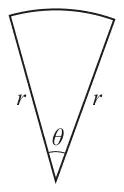
Determine the maximum possible area of the sector, showing that it is a maximum. [6]
| Scheme | Marks | AO |
|---|---|---|
| [Perimeter =] \(2r + r\theta = 10\) | M1 | 1.1 |
| \(\theta = \dfrac{10 - 2r}{r}\) | B1 | 3.1a |
| \(A = \dfrac{1}{2}r^2\theta\) so \(A = \dfrac{r(10 - 2r)}{2} = 5r - r^2\) | M1 | 3.1a |
| \(A = 2.5^2 - (2.5 - r)^2\) | M1 | 3.1a |
| This has a max when \(2.5 - r = 0\) | B1 | 2.4 |
| Max = 6.25 [cm2] | A1 | 2.2a |
| [6] |
Notes
B1: OR \(r = \dfrac{10}{2 + \theta}\)
Expression for one of \(r\), \(\theta\) in terms of the other
M1: OR \(A = \dfrac{100\theta}{2(2+\theta)^2} = \dfrac{50\theta}{(2+\theta)^2}\)
Area in terms of either their \(r\) or their \(\theta\). Need not expand brackets.
M1: Completing the square
B1: Convincing explanation that there is a max
Alternative method 1
| Scheme | Marks |
|---|---|
| \(\dfrac{\mathrm{d}A}{\mathrm{d}r} = 5 - 2r\) | M1 |
| \(\dfrac{\mathrm{d}^2A}{\mathrm{d}r^2} = -2\) so max | B1 |
| \(\dfrac{\mathrm{d}A}{\mathrm{d}r} = 0 \Rightarrow r = 2.5\); Max = 6.25 [cm2] | A1 |
Alternative method 2
| Scheme | Marks |
|---|---|
| \(\dfrac{\mathrm{d}A}{\mathrm{d}\theta} = \dfrac{50(2+\theta)^2 - 100\theta(2+\theta)}{(2+\theta)^4} = \dfrac{100 - 50\theta}{(2+\theta)^3}\) | M1 |
| \(\dfrac{\mathrm{d}A}{\mathrm{d}\theta} = 0 \Rightarrow \theta = 2\); \(A = 6.25\) [cm2] | A1 |
| \(\theta = 1.5 \Rightarrow \dfrac{\mathrm{d}A}{\mathrm{d}\theta} > 0\), \(\theta = 2.5 \Rightarrow \dfrac{\mathrm{d}A}{\mathrm{d}\theta} < 0\) so max | B1 |
M1: Reasonable attempt at quotient rule
For information: \(\dfrac{\mathrm{d}^2A}{\mathrm{d}\theta^2} = -\dfrac{200}{256} = -0.78125\) at \(\theta = 2\)