
June 2023 Paper 3 Q6
6
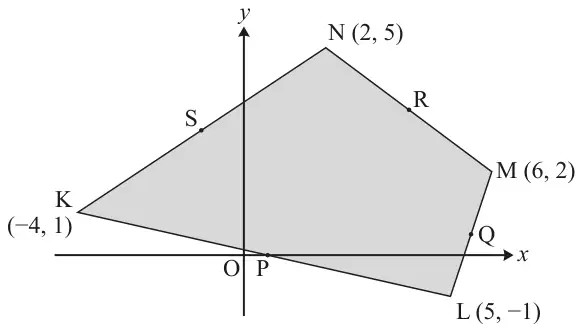
- P, the midpoint of KL
- Q, the midpoint of LM
- R, the midpoint of MN
- S, the midpoint of NK
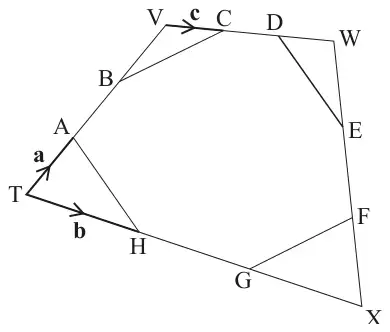
Points A and B divide side TV into 3 equal parts. Points C and D divide side VW into 3 equal parts. Points E and F divide side WX into 3 equal parts. Points G and H divide side TX into 3 equal parts.
\(\overrightarrow{\mathrm{TA}} = \mathbf{a}\), \(\overrightarrow{\mathrm{TH}} = \mathbf{b}\), \(\overrightarrow{\mathrm{VC}} = \mathbf{c}\).
| Scheme | Marks | AO |
|---|---|---|
| (i) P \((0.5, 0)\) | B1 | 1.1 |
| Q \((5.5, 0.5)\) R \((4, 3.5)\) S \((-1, 3)\) | B1 | 1.1 |
| [2] | ||
| (ii) Gradient PQ \(= 0.1\) or length of PQ \(= \dfrac{\sqrt{101}}{2}\) or vector \(\overrightarrow{\mathrm{PQ}} = \begin{pmatrix} 5 \\ 0.5 \end{pmatrix}\) | B1 | 1.1 |
| Gradient SR is \(\dfrac{0.5}{5} = 0.1 =\) gradient PQ or length of SR \(= \sqrt{0.5^2 + 5^2} = \dfrac{\sqrt{101}}{2}\) or vector \(\overrightarrow{\mathrm{SR}} = \begin{pmatrix} 4 - -1 \\ 3.5 - 3 \end{pmatrix} = \begin{pmatrix} 5 \\ 0.5 \end{pmatrix}\) Gradient PS \(= -2\) or length of PS \(= \dfrac{3\sqrt{5}}{2}\) or vector \(\overrightarrow{\mathrm{PS}} = \begin{pmatrix} -1.5 \\ 3 \end{pmatrix}\) Gradient QR is \(\dfrac{3}{-1.5} = -2\) or length of QR \(= \sqrt{1.5^2 + 3^2} = \dfrac{3\sqrt{5}}{2}\) or vector \(\overrightarrow{\mathrm{QR}} = \begin{pmatrix} 4 - 5.5 \\ 3.5 - 0.5 \end{pmatrix} = \begin{pmatrix} -1.5 \\ 3 \end{pmatrix}\) | M1 | 2.2a |
| Repeat process (as above) for other pair of opposite sides and conclude it’s a parallelogram | E1 | 2.4 |
| [3] |
Notes
(i) B1: Any midpoint correct
(i) B1: All midpoints correct
If no labels BOD for 1 or 2 marks
(ii) B1: Gradient, length or vector of any one side of PQRS
Or SC1 if KLMN used
(ii) M1: Gradient of opposite side of PQRS shown to be equal
or length or vector of opposite side shown to be equal.
ie some working must be seen
(ii) E1: Convincing completion dep on M1
Condone confusion of labels (eg length for gradient etc) for M1/B1
Watch out for valid alternatives e.g. 2 sides equal length and equal gradient
| Scheme | Marks | AO |
|---|---|---|
| (i) \(\overrightarrow{\mathrm{WX}} = -3\mathbf{c} - 3\mathbf{a} + 3\mathbf{b}\) \(\qquad = 3(-\mathbf{a} + \mathbf{b} - \mathbf{c})\) | B1 | 2.2a |
| [1] | ||
| (ii) \(\overrightarrow{\mathrm{AH}} = -\mathbf{a} + \mathbf{b}\) | B1 | 1.1 |
| \(\overrightarrow{\mathrm{WX}} = -3\mathbf{c} - 3\mathbf{a} + 3\mathbf{b}\) \(\overrightarrow{\mathrm{WE}} = -\mathbf{c} - \mathbf{a} + \mathbf{b}\) \(\overrightarrow{\mathrm{DE}} = \mathbf{c} - \mathbf{c} - \mathbf{a} + \mathbf{b} = -\mathbf{a} + \mathbf{b}\) So AH is parallel to DE | E1 | 2.4 |
| [2] | ||
| (iii) \(\overrightarrow{\mathrm{BC}} = \mathbf{a} + \mathbf{c}\) \(\overrightarrow{\mathrm{GF}} = \mathbf{b} - (-\mathbf{c} - \mathbf{a} + \mathbf{b}) = \mathbf{c} + \mathbf{a}\) | B1 | 2.2a |
| \(\overrightarrow{\mathrm{BC}} = \overrightarrow{\mathrm{GF}}\) so they are parallel | E1 | 2.4 |
| [2] |
Notes
(i) B1: Convincing completion
\(\overrightarrow{\mathrm{WX}} = \overrightarrow{\mathrm{WV}} + \overrightarrow{\mathrm{VT}} + \overrightarrow{\mathrm{TX}}\)
(ii) E1: \(\overrightarrow{\mathrm{DE}}\) from any correct route, must be shown
Convincing completion with conclusion
(iii) B1: \(\overrightarrow{\mathrm{GF}}\) from any correct route, must be shown
(iii) E1: Convincing completion with conclusion