The questions in this section refer to the article on the Insert. You should read the article before attempting the questions.
The relevant parts of the article “Approximating the sine function” are reproduced below; the line numbers are those printed on the Insert.
Line 22 A better approximation
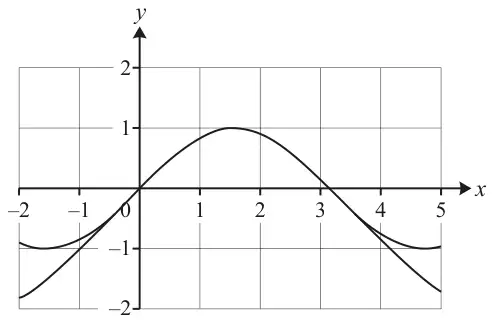
Lines 23–28 The approximation \(\sin x \approx \dfrac{16x(\pi - x)}{5\pi^2 - 4x(\pi - x)}\) was discovered by an Indian mathematician named Bhaskara in the 7th century. It is not known how Bhaskara derived the formula but it can be seen that the curve \(y = \dfrac{16x(\pi - x)}{5\pi^2 - 4x(\pi - x)}\) is symmetrical about \(x = \frac{\pi}{2}\) and goes through the points \((0, 0)\), \(\left(\frac{\pi}{2}, 1\right)\) and \((\pi, 0)\). Fig. C4 shows the curves \(y = \sin x\) and \(y = \dfrac{16x(\pi - x)}{5\pi^2 - 4x(\pi - x)}\). Radians were not in use until the 18th century; Bhaskara gave the formula for an angle \(\theta\) degrees as \(\sin\theta \approx \dfrac{4\theta(180 - \theta)}{40500 - \theta(180 - \theta)}\).
Fig. C4
Show that, for the angle \(45^\circ\), the formula \(\sin\theta \approx \dfrac{4\theta(180 - \theta)}{40500 - \theta(180 - \theta)}\) given in line 28 gives the same approximation for the sine of the angle as the formula \(\sin x \approx \dfrac{16x(\pi - x)}{5\pi^2 - 4x(\pi - x)}\) given in line 23. [3]