10In this question you must show detailed reasoning.
The questions in this section refer to the article on the Insert. You should read the article before attempting the questions.
The relevant parts of the article “Approximating the sine function” are reproduced below; the line numbers are those printed on the Insert.
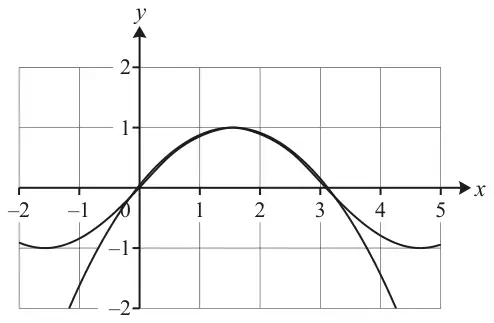
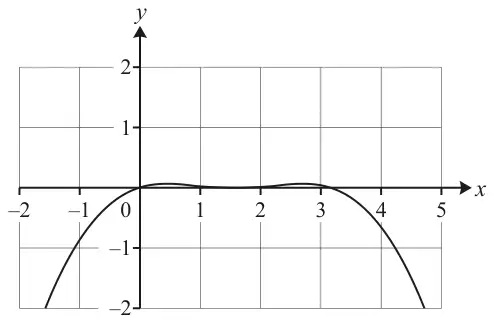
Lines 12–14 Fig. C2.1 shows the curve \(y = \sin x\) and the quadratic curve which goes through the points \((0, 0)\), \(\left(\frac{\pi}{2}, 1\right)\) and \((\pi, 0)\). The equation of this curve is \(y = \dfrac{4x(\pi - x)}{\pi^2}\). Fig. C2.2 shows the curve \(y = \dfrac{4x(\pi - x)}{\pi^2} - \sin x\).
Fig. C2.1Fig. C2.2
Fig. C2.2 indicates that the curve \(y = \dfrac{4x(\pi - x)}{\pi^2} - \sin x\) has a stationary point near \(x = 3\).
Verify that the \(x\)-coordinate of this stationary point is between 2.6 and 2.7.
Show that this stationary point is a maximum turning point. [5]
Mark scheme
Scheme
Marks
AO
DR \(\dfrac{\mathrm{d}y}{\mathrm{d}x} = \dfrac{4}{\pi} - \dfrac{8x}{\pi^2} - \cos x\)
M1: Attempt to differentiate. Both an \(x\) term and a cos term needed condone other errors. If \(\pi^2\) is treated as a variable and incorrectly differentiated eg to \(2\pi\) then M0. Similarly with \(\pi\).
M1: At least one substitution into their expression
A1: Both correct (at least 2d.p., rounded or truncated)
E1: Can be implied by ‘sign change’ or sketch Dependent on M2 but can be earned following M2A0
B1: Allow 2nd derivative used at turning point found BC (\(x = 2.67\), 2nd deriv \(= -0.356\)) or 2 relevant values eg \(-0.295\) and \(-0.383\) seen and stated as \(< 0\) therefore max