
June 2022 Paper 3 Q7
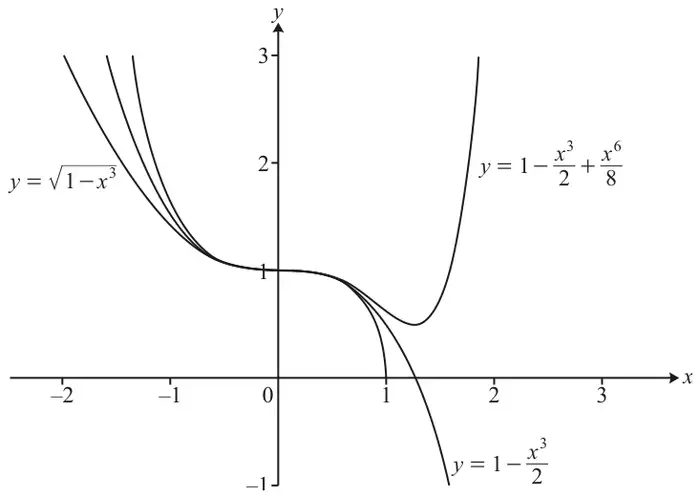
7 A student is trying to find the binomial expansion of \(\sqrt{1 - x^3}\).
She gets the first three terms as \(1 - \dfrac{x^3}{2} + \dfrac{x^6}{8}\).
She draws the graphs of the curves \(y = \sqrt{1 - x^3}\), \(y = 1 - \dfrac{x^3}{2}\) and \(y = 1 - \dfrac{x^3}{2} + \dfrac{x^6}{8}\) using software.
The end of a bus shelter is modelled by the area between the curve \(y = 2.5\sqrt{1 - x^3}\), the lines \(x = -0.75\), \(x = 0.75\) and the \(x\)-axis. Lengths are in metres.
Calculate, using your answer to part (c), an approximation for the area of the end of the bus shelter as given by this model. [4]
| Scheme | Marks | AO |
|---|---|---|
| \(\dfrac{x^6}{8} \geqslant 0\) or \(x^6 \geqslant 0\) | B1 | 2.4 |
| [1] |
Notes
B1: Do not accept \(\dfrac{x^6}{8}\) is always positive (ie \(> 0\))
| Scheme | Marks | AO |
|---|---|---|
| The expansion with two terms is a better approximation than the one with three terms but it should be the other way round. | E1 | 2.3 |
| [1] |
Notes
E1: O.E.
See exemplars
Exemplars for 7b
Accept (eg)
The 3-term expansion is further away than the one with 2 terms
The 3-term expansion moves away from the 2-term expansion
The 3-term expansion is on the wrong side of the graph of the 2-term expansion
The 3-term expansion goes up at the end
The 3-term expansion should be more accurate than a 2-term expansion [and it isn’t]
The 3-term expansion moves away from the other 2
Do not accept (eg)
They don’t follow the same shape
| Scheme | Marks | AO |
|---|---|---|
| \(1 + \frac{1}{2}(-x^3) + \frac{1}{2}\left(-\frac{1}{2}\right)\dfrac{(-x^3)^2}{2!} + \frac{1}{2}\left(-\frac{1}{2}\right)\left(-\frac{3}{2}\right)\dfrac{(-x^3)^3}{3!} + \ldots\) | M1 | 1.1a |
| \(1 - \dfrac{x^3}{2} - \dfrac{x^6}{8} - \dfrac{x^9}{16} \ldots\) | A2 | 1.1 1.1 |
| [3] |
Notes
M1: Working for 3rd or 4th term correct
Must see the negative \(x^3\)
A2: A2 all terms correct or A1 for three terms correct
| Scheme | Marks | AO |
|---|---|---|
| \(|x| < 1\) oe | B1 | 1.1 |
| [1] |
| Scheme | Marks | AO |
|---|---|---|
| Goes through 2.5 on \(y\)-axis and \((1, 0)\) | B1 | 2.2a |
| Right shape for values of \(x\) from \(-1\) to 1 | B1 | 1.1 |
| [2] |
Notes
B1: Curve reaches between \((-1, 3)\) to \((-1, 4.5)\)
| Scheme | Marks | AO |
|---|---|---|
| DR \(\displaystyle 2.5\int_{-0.75}^{0.75}\left(1 - \frac{x^3}{2} - \frac{x^6}{8} - \frac{x^9}{16}\right)\mathrm{d}x\) | M1 | 3.1b |
| \(\displaystyle [2.5]\left[x - \frac{x^4}{8} - \frac{x^7}{56} - \frac{x^{10}}{160}\right]_{-0.75}^{0.75}\) | M1 | 1.1 |
| \([2.5]\Big[\left(0.75 - \dfrac{0.75^4}{8} - \dfrac{0.75^7}{56} - \dfrac{0.75^{10}}{160}\right)\) \(\qquad - \left(-0.75 - \dfrac{(-0.75)^4}{8} - \dfrac{(-0.75)^7}{56} - \dfrac{(-0.75)^{10}}{160}\right)\Big]\) | M1 | 1.1 |
| \(3.74\ \mathrm{m}^2\) | A1 | 3.2a |
| [4] |
Notes
M1: For their expression from 7(c) in an integration. Condone \(\mathrm{d}x\) missing.
2.5 and limits needed but may be seen later
M1: For integrating their expression (3 terms or more) allow one error
Limits could be wrong or missing here
M1: For attempt at their limits substituted into their integrand.
Substitution must be seen.
A1: AWRT 3.74 from correct working. Must include units.
1.495 will probably get either M2 or M3
Annotate final page
Special Case
If trapezium rule used on original function allow M1 A1 maximum
Likely answers
If 2 strips used: \(3.71\ \mathrm{m}^2\)
If 3 strips used: \(3.72\ \mathrm{m}^2\)
If 6 strips used: \(3.73\ \mathrm{m}^2\)