
June 2022 Paper 1 Q10
10 A triangle ABC is made from two thin rods hinged together at A and a piece of elastic which joins B and C. AB is a 30 cm rod and AC is a 15 cm rod. The angle BAC is \(\theta\) radians as shown in the diagram.
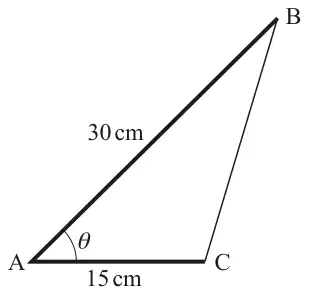
The angle \(\theta\) increases at a rate of 0.1 radians per second.
Determine the rate of change of the length BC when \(\theta = \frac{1}{3}\pi\). [8]
| Scheme | Marks | AO |
|---|---|---|
| Length BC: \(l^2 = 30^2 + 15^2 - 2 \times 30 \times 15\cos\theta\) | M1 | 3.1a |
| \(l^2 = 1125 - 900\cos\theta\) \(l = (1125 - 900\cos\theta)^{\frac{1}{2}}\) | A1 | 1.1b |
| \(\dfrac{\mathrm{d}l}{\mathrm{d}\theta} = \frac{1}{2}(1125 - 900\cos\theta)^{-\frac{1}{2}} \times 900\sin\theta\) | M1 A1 | 3.1a 1.1b |
| \(\dfrac{\mathrm{d}\theta}{\mathrm{d}t} = 0.1\) | B1 | 1.2 |
| \(\dfrac{\mathrm{d}l}{\mathrm{d}t} = \dfrac{\mathrm{d}l}{\mathrm{d}\theta} \times \dfrac{\mathrm{d}\theta}{\mathrm{d}t} = \dfrac{450\sin\theta}{(1125 - 900\cos\theta)^{\frac{1}{2}}} \times 0.1\) | M1 | 1.1a |
| When \(\theta = \dfrac{\pi}{3}\) \(\dfrac{\mathrm{d}l}{\mathrm{d}t} = \dfrac{45\sin\frac{\pi}{3}}{\left(1125 - 900\cos\frac{\pi}{3}\right)^{\frac{1}{2}}} = \left[\dfrac{45\sqrt{3}}{2 \times 15\sqrt{3}} = \dfrac{3}{2}\right]\) | M1 | 1.1a |
| \(1.5\ \mathrm{cm\,s^{-1}}\) | A1 | 3.2a |
| [8] |
Notes
M1: If M0 awarded here allow SC1 for \(BC = \sqrt{675} = 15\sqrt{3}\) found using \(\theta = \dfrac{\pi}{3}\)
A1: Soi Allow equivalent in metres
If working in metres \(l^2 = 0.1125 - 0.0900\cos\theta\)
M1: Attempt to use the chain rule
A1: Any form
B1: Soi eg from \(\theta = 0.1t\)
M1: Using the chain rule to find \(\frac{\mathrm{d}l}{\mathrm{d}t}\)
M1: Substitute \(\theta = \dfrac{\pi}{3}\) into their \(\dfrac{\mathrm{d}l}{\mathrm{d}\theta}\)
A1: Must have correct unit for the value
Allow written as cm per second oe
\(0.015\ \mathrm{m\,s^{-1}}\)
Alternative method
| Scheme | Marks |
|---|---|
| \(l^2 = 30^2 + 15^2 - 2 \times 30 \times 15\cos\theta\) | M1 |
| \(l^2 = 1125 - 900\cos\theta\) | A1 |
| \(2l\dfrac{\mathrm{d}l}{\mathrm{d}\theta} = 900\sin\theta\) | M1 A1 |
| \(\dfrac{\mathrm{d}\theta}{\mathrm{d}t} = 0.1\) | B1 |
| \(\dfrac{\mathrm{d}l}{\mathrm{d}t} = \dfrac{\mathrm{d}l}{\mathrm{d}\theta} \times \dfrac{\mathrm{d}\theta}{\mathrm{d}t} = \dfrac{450\sin\theta}{l} \times 0.1\) | M1 |
| When \(\theta = \dfrac{\pi}{3}\), \(\dfrac{\mathrm{d}l}{\mathrm{d}t} = \dfrac{45\sin\frac{\pi}{3}}{15\sqrt{3}} = \dfrac{3}{2}\) | M1 |
| \(1.5\ \mathrm{cm\,s^{-1}}\) | A1 |
A1: If working in metres \(= 0.1125 - 0.0900\cos\theta\)
M1 A1: Attempt to use the implicit differentiation. Any form
B1: soi
M1: Using the chain rule to find \(\frac{\mathrm{d}l}{\mathrm{d}t}\)
M1: Substitute \(\theta = \dfrac{\pi}{3}\) into their \(\dfrac{\mathrm{d}l}{\mathrm{d}\theta}\)
A1: Must have correct unit for the value
Allow written as cm per second oe
\(0.015\ \mathrm{m\,s^{-1}}\)