
June 2024 Paper 3 Mechanics Q4
4.
In this question you must show all stages of your working.
Solutions relying entirely on calculator technology are not acceptable.
[In this question, \(\mathbf{i}\) is a unit vector due east and \(\mathbf{j}\) is a unit vector due north. Position vectors are given relative to a fixed origin \(O\).]
At time \(t\) seconds, \(t \geqslant 1\), the position vector of a particle \(P\) is \(\mathbf{r}\) metres, where
\[\mathbf{r} = ct^{\frac{1}{2}}\mathbf{i} - \frac{3}{8}t^2\mathbf{j}\]and \(c\) is a constant.
When \(t = 4\), the bearing of \(P\) from \(O\) is \(135^\circ\)
When \(t = T\), \(P\) is accelerating in the direction of \((-\mathbf{i} - 27\mathbf{j})\).
| Scheme | Marks | AO |
|---|---|---|
| ALTERNATIVES when \(t = 4\) is substituted at the beginning. | ||
| \(2c\mathbf{i} - 6\mathbf{j}\) or as a column vector, seen or implied. | B1 | 1.1b |
ALT 1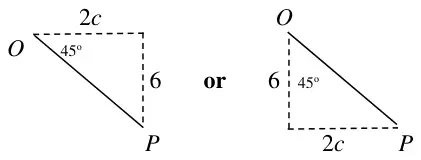 AND either \(\tan 45^\circ = \dfrac{2c}{6} \Rightarrow 2c = 6\) or states isosceles triangle so \(2c = 6\) N.B. In both of the above, we must see the justification for the equation. ALT 2 \(\tan 135^\circ = \dfrac{2c}{-6} \Rightarrow 2c = 6\) N.B. M0 if they are using the wrong bearing. | M1 | 3.1a |
| \(c = 3\) * | A1* | 2.2a |
| SC 1 M1A0: no right-angled triangle \(2c\mathbf{i} - 6\mathbf{j} = k(\mathbf{i} - \mathbf{j}) \Rightarrow 2c = 6\) or \(\mathbf{i}\)-cpt \(= -\,\mathbf{j}\)-cpt \(\Rightarrow 2c = 6\) N.B. In both of the above, we must see the justification for the equation. SC 2 M1A0: no right-angled triangle \(\tan 45^\circ = \dfrac{2c}{6}\) or \(\dfrac{6}{2c} \Rightarrow 2c = 6\) N.B. In the above, we must see the justification for the equation. | ||
| ALTERNATIVES when \(t = 4\) is substituted at the end: | ||
| \(ct^{\frac{1}{2}} = 2c\) and \((-)\dfrac{3t^2}{8} = (-)6\) when \(t = 4\), seen or implied | B1 | |
ALT 3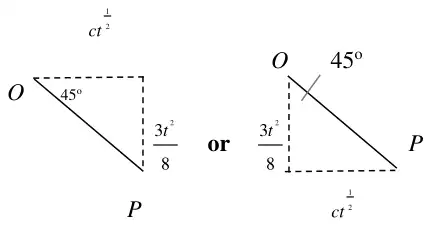 AND either \(\tan 45^\circ = \dfrac{\frac{3t^2}{8}}{ct^{\frac{1}{2}}} \Rightarrow 2c = 6\) when \(t = 4\) or states isosceles triangle, so \(ct^{\frac{1}{2}} = \dfrac{3t^2}{8} \Rightarrow 2c = 6\) when \(t = 4\) N.B. In both of the above, we must see the justification for the equation. N.B. M0 if they are using the wrong bearing. | M1 | |
| \(c = 3\) | A1* | |
| SC 3 M1A0: no right-angled triangle \(\left(ct^{\frac{1}{2}}\mathbf{i} - \dfrac{3t^2}{8}\mathbf{j}\right) = k(\mathbf{i} - \mathbf{j}) \Rightarrow 2c = 6\) when \(t = 4\) or \(\mathbf{i}\)-cpt \(= -\,\mathbf{j}\)-cpt \(\Rightarrow ct^{\frac{1}{2}} = \dfrac{3t^2}{8} \Rightarrow 2c = 6\) when \(t = 4\) N.B. In both of the above, we must see the justification for the equation. SC 4 M1A0: no right-angled triangle \(\tan 45^\circ = \dfrac{\frac{3t^2}{8}}{ct^{\frac{1}{2}}} \Rightarrow 2c = 6\) when \(t = 4\) | ||
| N.B. Allow a verification: i.e. use \(c = 3\) and \(t = 4\) to show that \(P\) is on a bearing of \(135^\circ\) from \(O\). \(6\mathbf{i} - 6\mathbf{j}\) | B1 | |
then a diagram: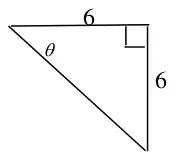 N.B. In the above, we must see the justification for the equation. | M1 | |
| bearing \(= 45^\circ + 90^\circ = 135^\circ\) | A1* | |
| (3) |
Notes
Accept column vectors throughout
B1: \(2c\mathbf{i} - 6\mathbf{j}\) seen or implied. B0 for \(\mathbf{r} = 2c - 6\) if no evidence of components.
M1: ALT 1: Use the bearing to obtain a CORRECT diagram showing a right-angled triangle with at least one \(45^\circ\) angle marked or clearly explained (i.e. \(135^\circ\) marked on the diagram and either \(135^\circ - 90^\circ = 45^\circ\) or \(180^\circ - 135^\circ = 45^\circ\)), and \(2c\) and \(\pm 6\) marked AND use of isosceles triangle or tan or (sin/cos and Pythag) to obtain \(2c = 6\)
ALT 2: No diagram required Use \(\tan 135^\circ = \dfrac{2c}{-6} \Rightarrow 2c = 6\)
A1*: Given answer correctly obtained
ALTERNATIVE when \(t = 4\) is substituted at the end:
B1: \(ct^{\frac{1}{2}} = 2c\) and \((-)\dfrac{3t^2}{8} = (-)6\) when \(t = 4\), seen or implied
M1: ALT 3: Use the bearing to obtain a CORRECT diagram showing a right-angled triangle with at least one \(45^\circ\) angle marked or clearly explained (i.e. \(135^\circ\) marked on the diagram and either \(135^\circ - 90^\circ = 45^\circ\) or \(180^\circ - 135^\circ = 45^\circ\)), and \(ct^{\frac{1}{2}}\) and \(\pm\dfrac{3t^2}{8}\) marked AND use of isosceles triangle or tan or (sin/cos and Pythag) to obtain \(2c = 6\) when \(t = 4\)
A1*: Given answer correctly obtained
| Scheme | Marks | AO |
|---|---|---|
| Differentiate \(\mathbf{r}\) wrt \(t\) to obtain \(\mathbf{v}\) | M1 | 2.1 |
| \(\mathbf{v} = 3 \times \dfrac{1}{2}t^{-\frac{1}{2}}\mathbf{i} - \dfrac{3}{8} \times 2t\mathbf{j} = \dfrac{3}{2}t^{-\frac{1}{2}}\mathbf{i} - \dfrac{3}{4}t\mathbf{j}\) oe | A1 | 1.1b |
| Put \(t = 4\) into both components and use Pythagoras: \(\sqrt{\left(\dfrac{3}{4}\right)^2 + (-3)^2}\) | M1 | 3.1a |
| \(\sqrt{\dfrac{153}{16}}\) or \(\dfrac{\sqrt{153}}{4}\) or \(\dfrac{3\sqrt{17}}{4}\) or \(3\sqrt{\dfrac{17}{16}} = 3.0923\ldots\) \((\text{m s}^{-1})\) | A1 | 1.1b |
| (4) |
Notes
Accept column vectors throughout
M1: Both powers of \(t\) decreasing by 1 (M0 if \(\mathbf{i}\) or \(\mathbf{j}\) is missing but allow recovery or working with components only)
N.B. This mark is available if \(c\) has not been substituted for.
A1: Correct unsimplified derivative or two correct components
M1: Put \(t = 4\) in their \(\mathbf{v}\) (must be using an attempted derivative of \(\mathbf{r}\)) and then use Pythagoras with the root, allow a missing \(-\) sign
N.B. If they state \(t = 4\), allow a slip when they substitute in, for this M mark.
This mark is available if \(c\) has not been substituted for.
A1: Accept 3.1 or better
| Scheme | Marks | AO |
|---|---|---|
| Differentiate their \(\mathbf{v}\) wrt \(t\) to obtain \(\mathbf{a}\) | M1 | 3.4 |
| \(\mathbf{a} = -\dfrac{3}{4}t^{-\frac{3}{2}}\mathbf{i} - \dfrac{3}{4}\mathbf{j}\) | A1 | 1.1b |
| \(\dfrac{-\frac{3}{4}T^{-\frac{3}{2}}}{-\frac{3}{4}} = \dfrac{-1}{-27}\) oe | M1 | 2.1 |
| \((T =)\ 9\) | A1 | 1.1b |
| (4) | ||
| (11 marks) |
Notes
Accept column vectors throughout
M1: Both powers of \(t\) decreasing by 1
N.B. This mark is available if \(c\) has not been substituted for
(M0 if \(\mathbf{i}\) or \(\mathbf{j}\) is missing but allow recovery or working with components only).
A1: Correct unsimplified derivative
M1: Use of an appropriate ratio (must be using an attempted derivative of their \(\mathbf{v}\)), condone sign error and the reciprocal, to obtain an equation in \(t\) or \(T\) only.
N.B. If they state that \(-\dfrac{3}{4}T^{-\frac{3}{2}}\mathbf{i} - \dfrac{3}{4}\mathbf{j} = k(-\mathbf{i} - 27\mathbf{j})\) and then equate coefficients to give two simultaneous equations in \(k\) and \(T\), these need to be used to produce an equation in \(T\) only, before the M mark is earned.
A1: cao (allow \(t\) instead of \(T\))