
June 2025 Paper 1 Q10
10 A researcher working for a frozen-food manufacturer uses the formula
\[\theta = 21 - A\mathrm{e}^{-kt}\]to model the temperature of a dessert once it is taken out of a freezer.
In this model:
- \(\theta\) is the temperature of the dessert in \(^\circ\)C
- \(t\) is the time in hours since the dessert was removed from the freezer
- \(A\) and \(k\) are positive constants.
(a) Show how\[\theta = 21 - A\mathrm{e}^{-kt}\]can be rearranged to obtain\[\ln(21 - \theta) = -kt + \ln A\] [3 marks]
(b) The researcher uses measurements they have recorded to plot the graph of \(\ln(21 - \theta)\) against \(t\) as shown in the diagram below.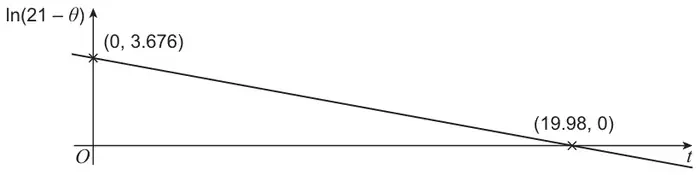
(i) Use the information on the graph to find the value of \(A\)
Give your answer to three significant figures.
[2 marks](ii) Use the information on the graph to find the value of \(k\)
Give your answer to three significant figures.
[2 marks](iii) Find the temperature of the dessert when it is initially removed from the freezer.
Give your answer to three significant figures.
[2 marks](c) The dessert is ready to be eaten when its temperature reaches 4\(^\circ\)C
Use the model to determine the time, after being removed from the freezer, for the dessert to reach this temperature.
Give your answer to the nearest 10 minutes.
[3 marks]| Scheme | Marks | AO |
|---|---|---|
| Obtains \(\ln A\mathrm{e}^{-kt} = \ln(21 \pm \theta)\) or \(\ln \mathrm{e}^{-kt} = \ln\dfrac{21 \pm \theta}{A}\) or \(-kt = \ln\dfrac{21 \pm \theta}{A}\) | M1 | 3.1a |
| Obtains \(\ln A\mathrm{e}^{-kt} = \ln A + \ln \mathrm{e}^{-kt}\) or \(\ln\dfrac{21 \pm \theta}{A} = \ln(21 \pm \theta) - \ln A\) | M1 | 1.1a |
| Completes reasoned argument to obtain \(\ln(21 - \theta) = -kt + \ln A\) AG | R1 | 2.1 |
| (3) |
Typical solution
\[\theta = 21 - A\mathrm{e}^{-kt}\]\[A\mathrm{e}^{-kt} = 21 - \theta\]\[\ln A\mathrm{e}^{-kt} = \ln(21 - \theta)\]\[\ln A + \ln \mathrm{e}^{-kt} = \ln(21 - \theta)\]\[\ln A - kt = \ln(21 - \theta)\]| Scheme | Marks | AO |
|---|---|---|
| (i) States \(\ln A = 3.676\) | M1 | 3.4 |
| Obtains AWRT 39.5 | A1 | 1.1b |
| (2) | ||
| (ii) Obtains \(\pm\dfrac{3.676}{19.98}\) Or Substitutes their value of \(A\) or \(\ln A = 3.676\), \(t = 19.98\) and \(\ln(21 - \theta) = 0\) to form an equation for \(k\) | M1 | 3.4 |
| Obtains AWRT \(k = 0.184\) | A1 | 1.1b |
| (2) | ||
| (iii) Uses the model \(\theta = 21 - A\mathrm{e}^{-kt}\) with their \(A\) or \(\ln A = 3.676\) and \(t = 0\) Or Equates \(\ln(21 - \theta)\) to 3.676 | M1 | 3.4 |
| Obtains AWRT \(-18.5\,{}^\circ C\) Condone missing units CAO | A1 | 1.1b |
| (2) |
Typical solution
(b)(i)
\[\ln A = 3.676\]\[A = \mathrm{e}^{3.676} = 39.5\](b)(ii)
\[-k = -\frac{3.676}{19.98}\]\[k = 0.1839\ldots = 0.184\](b)(iii)
\[\theta = 21 - 39.5\mathrm{e}^{0} = -18.5\,{}^\circ C\]| Scheme | Marks | AO |
|---|---|---|
| Uses either version of the model with their \(A\) from (b)(i) or \(\ln A = 3.676\), and their \(k\) from their (b)(ii) and \(\theta = 4\) | M1 | 3.4 |
| Obtains AWRT 4.58 PI by 4 hrs 30 mins (270min) or 4 hrs 40 mins (280 min) | A1 | 1.1b |
| Obtains 4 hrs 30 mins or 4 hrs 40 mins Accept 270 min or 280 min Answer must not come from an incorrect value of \(t\) | A1 | 3.2a |
| (3) | ||
| (12 marks) |
Typical solution
\[4 = 21 - 39.5\mathrm{e}^{-0.184t}\]\[t = 4.581996\ldots\]Time = 4 hrs 30 mins