(a) The equation\[x^3 = \mathrm{e}^{6 - 2x}\]has a single solution, \(x = \alpha\)
By considering a suitable change of sign, show that \(\alpha\) lies between 0 and 4 [2 marks]
(b) Show that the equation \(x^3 = \mathrm{e}^{6 - 2x}\) can be rearranged to give\[x = 3 - \frac{3}{2}\ln x\] [3 marks]
(c)
(i) Use the iterative formula\[x_{n+1} = 3 - \frac{3}{2}\ln x_n\]with \(x_1 = 4\), to find \(x_2\), \(x_3\) and \(x_4\)
Give your answers to three decimal places. [2 marks]
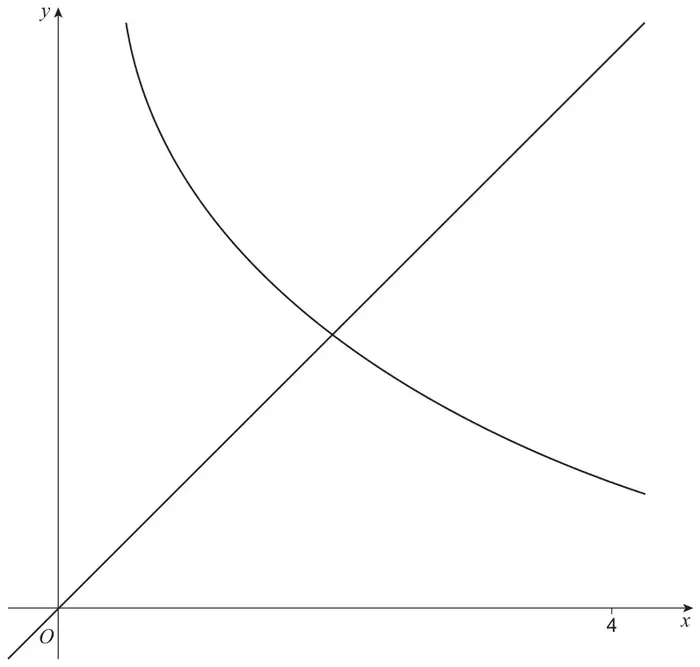
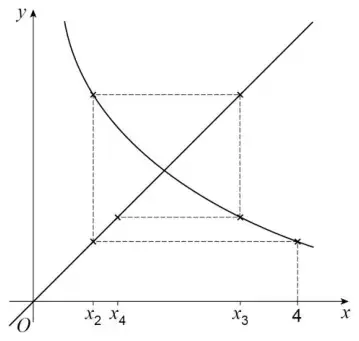
(ii)Figure 1 below shows a sketch of parts of the graphs of\[y = 3 - \frac{3}{2}\ln x \text{ and } y = x\]On Figure 1, draw a staircase or cobweb diagram to show how convergence takes place.
Label, on the \(x\)-axis, the positions of \(x_2\), \(x_3\) and \(x_4\) [2 marks]
Figure 1
(iii) Explain why the iterative formula\[x_{n+1} = 3 - \frac{3}{2}\ln x_n\]fails to converge to \(\alpha\) when the starting value is \(x_1 = 0\) [1 mark]
Mark scheme (a)
Scheme
Marks
AO
Rearranges the given equation to equal zero and evaluates their non-zero expression in the interval [0,4] at least once. Must have equated to zero.
M1
1.1a
Completes argument with two correct evaluations of their correct expression in the interval [0,4] either side of the solution, with comparison to zero or a comment about change of sign.
AND concludes that the solution \(\alpha\) lies between 0 and 4
Evaluations must be correct to at least two significant figures rounded or truncated. Accept exact evaluation at \(x = 0\).
(i) Obtains any correct value to at least 3 decimal places, ignoring labels.
M1
1.1a
Obtains \(x_2\), \(x_3\) and \(x_4\) correct to at least 3 decimal places If no labels only accept the three correct answers in the correct order with no extras seen beyond \(x_4\) \(x_2 = 0.92055\ldots\) \(x_3 = 3.12416\ldots\) \(x_4 = 1.29125\ldots\)
A1
1.1b
(2)
(ii) Draws correct cobweb diagram Condone missing vertical line at \(x = 4\)
M1
1.1a
Shows positions of \(x_2\), \(x_3\) and \(x_4\) on the \(x\)-axis Accept correct values in place of \(x_n\) AWRT 0.92, 3.12 and 1.29 Do not accept labels on \(y = x\) without indication on \(x\)-axis
A1
1.1b
(2)
(iii) Explains that (it is not possible to evaluate \(x_2\) as) ln 0 has no value or that \(y\) is undefined OE
E1
2.4
(1)
(10 marks)
Typical solution
(i)
\[x_2 = 0.921\]\[x_3 = 3.124\]\[x_4 = 1.291\]
(ii)
(iii)
It is not possible to evaluate \(x_2\) as ln 0 has no value
We'd like to use Google Analytics cookies to count visits and see which pages help most. They're optional, and the site works exactly the same either way. Privacy policy