
June 2024 Paper 2 Q11
11.
In this question you must show all stages of your working.
Solutions relying entirely on calculator technology are not acceptable.
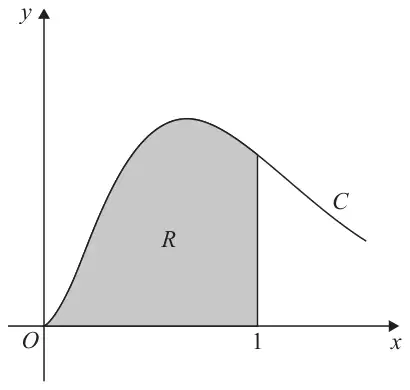
Figure 5 shows a sketch of part of the curve \(C\) with equation
\[y = 8x^2\mathrm{e}^{-3x} \qquad x \geqslant 0\]The finite region \(R\), shown shaded in Figure 5, is bounded by
- the curve \(C\)
- the line with equation \(x = 1\)
- the \(x\)-axis
Find the exact area of \(R\), giving your answer in the form\[A + B\mathrm{e}^{-3}\]where \(A\) and \(B\) are rational numbers to be found. (5)
| Scheme | Marks | AO |
|---|---|---|
| \(\displaystyle\int 8x^2\mathrm{e}^{-3x}\,\mathrm{d}x = -\frac{8x^2}{3}\mathrm{e}^{-3x} + \int \frac{16x}{3}\mathrm{e}^{-3x}\,\mathrm{d}x\) | M1 A1 | 2.1 1.1b |
| \(\displaystyle= -\frac{8x^2}{3}\mathrm{e}^{-3x} - \frac{16x}{9}\mathrm{e}^{-3x} + \int \frac{16}{9}\mathrm{e}^{-3x}\,\mathrm{d}x\) | dM1 | 1.1b |
| \(\left[-\dfrac{8x^2}{3}\mathrm{e}^{-3x} - \dfrac{16x}{9}\mathrm{e}^{-3x} - \dfrac{16}{27}\mathrm{e}^{-3x}\right]_0^1\) \(= -\dfrac{8}{3}\mathrm{e}^{-3} - \dfrac{16}{9}\mathrm{e}^{-3} - \dfrac{16}{27}\mathrm{e}^{-3} - \left(-0 - 0 - \dfrac{16}{27}\right)\) | M1 | 2.1 |
| \(= \dfrac{16}{27} - \dfrac{136}{27}\mathrm{e}^{-3}\) | A1 | 1.1b |
| (5) | ||
| (5 marks) |
Notes
Mark positively in this question and do not penalise poor notation such as a missing “\(\mathrm{d}x\)” or spurious integral signs, “\(+\,c\)” etc. as long as the intention is clear.
M1: Obtains \(\displaystyle\pm\alpha x^2\mathrm{e}^{-3x} \pm \beta\int x\,\mathrm{e}^{-3x}\,\mathrm{d}x\)
(you do not need to be concerned about how they arrive at this)
A1: Correct expression simplified or unsimplified. E.g. allow \(\displaystyle-\frac{8x^2}{3}\mathrm{e}^{-3x} - \int -\frac{16x}{3}\mathrm{e}^{-3x}\,\mathrm{d}x\)
Note that we condone the “8” missing for this mark so allow e.g. \(\displaystyle-\frac{x^2}{3}\mathrm{e}^{-3x} - \int -\frac{2x}{3}\mathrm{e}^{-3x}\,\mathrm{d}x\)
Note that notation may be poor here but the intention clear e.g. if they obtain \(-\dfrac{8x^2}{3}\mathrm{e}^{-3x} + \left[\dfrac{16x}{3}\mathrm{e}^{-3x}\right]\) and then attempt to integrate \(\dfrac{16x}{3}\mathrm{e}^{-3x}\) both marks can be implied.
dM1: Attempts parts again on \(\displaystyle\pm\beta\int x\,\mathrm{e}^{-3x}\,\mathrm{d}x\) to obtain \(\displaystyle\pm Ax\mathrm{e}^{-3x} \pm B\int \mathrm{e}^{-3x}\,\mathrm{d}x\)
This may be seen in isolation and does not need to be seen as part of the complete integration. Depends on the first method mark.
Watch for the DI method (with or without the 8):
| D | I | |
|---|---|---|
| + | \(8x^2\) | \(\mathrm{e}^{-3x}\) |
| – | \(16x\) | \(-\frac{1}{3}\mathrm{e}^{-3x}\) |
| + | \(16\) | \(\frac{1}{9}\mathrm{e}^{-3x}\) |
| – | \(0\) | \(-\frac{1}{27}\mathrm{e}^{-3x}\) |
(In the mark scheme, arrows join each entry in the D column to the entry in the I column one row below.)
Giving the correct integration e.g. \(\displaystyle\int 8x^2\mathrm{e}^{-3x}\,\mathrm{d}x = -\frac{8x^2}{3}\mathrm{e}^{-3x} - \frac{16x}{9}\mathrm{e}^{-3x} - \frac{16}{27}\mathrm{e}^{-3x}\)
In such cases score M1dM1 for obtaining \(\pm px^2\mathrm{e}^{-3x} \pm qx\mathrm{e}^{-3x} \pm r\mathrm{e}^{-3x},\ \ p, q, r \neq 0\) and then A1 for the correct first 2 terms, with or without the factor of 8.
Note that for this approach M1A1dM0 is not possible.
M1: Substitutes the limits 1 and 0 into an expression of the form \(\pm\alpha x^2\mathrm{e}^{-3x} \pm \beta x\mathrm{e}^{-3x} \pm \gamma\mathrm{e}^{-3x},\ \ \alpha, \beta, \gamma \neq 0\) and subtracts the right way round.
Must see evidence of the use of both limits and subtraction and use of \(\mathrm{e}^0 = 1\).
Note that some candidates apply the limits as they go e.g. to the \(\left[-\dfrac{8x^2}{3}\mathrm{e}^{-3x}\right]\) which is acceptable but you will need to check carefully that overall they are satisfying the conditions above.
Condone not realising that the first 2 terms evaluate to 0 when substituting \(x = 0\) e.g.
condone \(-\dfrac{8}{3}\mathrm{e}^{-3} - \dfrac{16}{9}\mathrm{e}^{-3} - \dfrac{16}{27}\mathrm{e}^{-3} - \left(-\dfrac{8}{3} - \dfrac{16}{9} - \dfrac{16}{27}\right)\) as we have evidence of \(\mathrm{e}^0 = 1\)
Note that e.g. \(-\dfrac{8}{3}\mathrm{e}^{-3} - \dfrac{16}{9}\mathrm{e}^{-3} - \dfrac{16}{27}\mathrm{e}^{-3} - \left(-\dfrac{16}{27}\mathrm{e}^0\right) = -\dfrac{136}{27}\mathrm{e}^{-3} - \dfrac{16}{27}\) scores M0 as it suggests that \(\mathrm{e}^0 = -1\) not \(+1\).
A1: Correct answer of \(\dfrac{16}{27} - \dfrac{136}{27}\mathrm{e}^{-3}\) but allow equivalent exact fractions and condone \(\dfrac{16}{27} - \dfrac{136}{27\mathrm{e}^3}\). Isw once the correct answer is seen.
Candidates who consistently misread \(8x^2\mathrm{e}^{-3x}\) as \(8x^2\mathrm{e}^{3x}\):
\[\begin{gathered}\int 8x^2\mathrm{e}^{3x}\,\mathrm{d}x = \frac{8x^2}{3}\mathrm{e}^{3x} - \int \frac{16x}{3}\mathrm{e}^{3x}\,\mathrm{d}x\\= \frac{8x^2}{3}\mathrm{e}^{3x} - \frac{16x}{9}\mathrm{e}^{3x} + \int \frac{16}{9}\mathrm{e}^{3x}\,\mathrm{d}x\\\left[\frac{8x^2}{3}\mathrm{e}^{3x} - \frac{16x}{9}\mathrm{e}^{3x} + \frac{16}{27}\mathrm{e}^{3x}\right]_0^1\\= \frac{8}{3}\mathrm{e}^3 - \frac{16}{9}\mathrm{e}^3 + \frac{16}{27}\mathrm{e}^3 - \left(\frac{16}{27}\right) = \frac{40}{27}\mathrm{e}^3 - \frac{16}{27}\end{gathered}\]Scores a maximum of M1A0dM1M1A0
The main scheme can be applied similarly e.g.
M1: Attempts parts to obtain \(\displaystyle\alpha x^2\mathrm{e}^{3x} - \beta\int x\,\mathrm{e}^{3x}\,\mathrm{d}x,\ \ \alpha, \beta \gt 0\)
A0: Not available
dM1: Attempts parts again on \(\displaystyle\beta\int x\,\mathrm{e}^{3x}\,\mathrm{d}x\) to obtain \(\displaystyle Cx\mathrm{e}^{3x} - D\int \mathrm{e}^{3x}\,\mathrm{d}x,\ \ C, D \gt 0\)
M1: Substitutes the limits 1 and 0 into an expression of the form \(\pm\lambda x^2\mathrm{e}^{3x} \pm \mu x\mathrm{e}^{3x} \pm \gamma\mathrm{e}^{3x},\ \ \lambda, \mu, \gamma \neq 0\) and subtracts the right way round.
Must see evidence of the use of both limits and subtraction and use of \(\mathrm{e}^0 = 1\).
A0: Not available
But note, do not allow mixing of \(3x\)’s and \(-3x\)’s. If there are a mixture, apply the main scheme.