
June 2024 Paper 2 Q10
10.
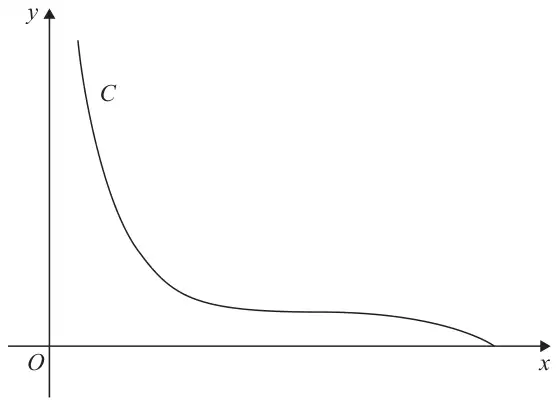
Figure 4 shows a sketch of the curve \(C\) with parametric equations
\[x = (t+3)^2 \qquad y = 1 - t^3 \qquad -2 \leqslant t \leqslant 1\]The point \(P\) with coordinates \((4, 2)\) lies on \(C\).
The curve \(C\) is used to model the profile of a slide at a water park.
Units are in metres, with \(y\) being the height of the slide above water level.
| Scheme | Marks | AO |
|---|---|---|
| \(x = 4, y = 2 \Rightarrow t = -1\) | B1 | 2.2a |
| \(\dfrac{\mathrm{d}y}{\mathrm{d}x} = \dfrac{\mathrm{d}y}{\mathrm{d}t} \times \dfrac{\mathrm{d}t}{\mathrm{d}x} = -3t^2 \times \dfrac{1}{2(t+3)}\) | M1 | 1.1b |
| \(\dfrac{\mathrm{d}y}{\mathrm{d}x} = -3(-1)^2 \times \dfrac{1}{2(-1+3)} = -\dfrac{3}{4}\) | M1 | 1.1b |
| \(\Rightarrow y - 2 = -\dfrac{3}{4}(x-4)\) or \(\Rightarrow y = -\dfrac{3}{4}x + c \rightarrow 2 = -\dfrac{3}{4} \times 4 + c \Rightarrow c\ldots\) | ddM1 | 2.1 |
| \(y - 2 = -\dfrac{3}{4}(x-4) \Rightarrow 4y - 8 = -3x + 12\) or \(c = 5 \Rightarrow y = -\dfrac{3}{4}x + 5\) \(\Rightarrow 3x + 4y = 20\ *\) | A1* | 1.1b |
| (5) |
Notes
(a) If parametric differentiation is not used in part (a) (e.g. uses Cartesian form) then only the B mark is available but see alternative below.
B1: Uses the given Cartesian coordinates to deduce the correct value for \(t\).
If more than one value for \(t\) e.g. \(t = -5\) is given and \(t = -1\) is not “selected” score B0 but if just \(t = -1\) is used subsequently allow recovery and score B1
M1: Attempts to use \(\dfrac{\mathrm{d}y}{\mathrm{d}x} = \dfrac{\mathrm{d}y}{\mathrm{d}t} \times \dfrac{\mathrm{d}t}{\mathrm{d}x}\) or equivalent with their differentiated equations.
There must be an attempt to differentiate both parameters, however poor, and divide or multiply correctly so using \(\dfrac{\mathrm{d}y}{\mathrm{d}x} = \dfrac{y}{x}\) scores M0. Both parameters must be “changed”.
Condone confusion with the variables e.g. referring to \(\dfrac{\mathrm{d}y}{\mathrm{d}t}\) as \(\dfrac{\mathrm{d}y}{\mathrm{d}x}\) if the intention is clear.
This may be implied by e.g. \(\dfrac{\mathrm{d}y}{\mathrm{d}t} = -3t^2,\ \dfrac{\mathrm{d}x}{\mathrm{d}t} = 2(t+3), t = -1,\ \dfrac{\mathrm{d}y}{\mathrm{d}t} = -3,\ \dfrac{\mathrm{d}x}{\mathrm{d}t} = 4 \Rightarrow \dfrac{\mathrm{d}y}{\mathrm{d}x} = -\dfrac{3}{4}\)
M1: Uses their numerical value of \(t\) (not 4) in their \(\dfrac{\mathrm{d}y}{\mathrm{d}x}\) to obtain a value.
Condone attempts with different values of \(t\) e.g. \(t = -1\) and \(t = -5\)
ddM1: Applies a correct straight line method with their value of \(\dfrac{\mathrm{d}y}{\mathrm{d}x}\) which has come from an attempt to use parametric differentiation with their value of \(t\) (not 4) and with \(x = 4\) and \(y = 2\) correctly placed. An attempt at the equation of the normal is M0.
If using \(y = mx + c\) they must reach as far as \(c = \ldots\)
Depends on both previous M marks.
A1*: Correct equation as printed with no errors but condone \(4y + 3x = 20\ *\)
Allow equivalents e.g. \(20 = 4y + 3x\ *\) or \(3x + 4y = 20\ *\)
This is a printed answer so there must be at least one intermediate step as shown in the main scheme.
Alternative for (a) using parametric differentiation but avoids the need for a value for \(t\):
\[\begin{gathered}\frac{\mathrm{d}y}{\mathrm{d}x} = \frac{\mathrm{d}y}{\mathrm{d}t} \times \frac{\mathrm{d}t}{\mathrm{d}x} = -3t^2 \times \frac{1}{2(t+3)}\\-3t^2 \times \frac{1}{2(t+3)} = -3(1-y)^{\frac{2}{3}} \times \frac{1}{2\sqrt{x}} = -3(1-2)^{\frac{2}{3}} \times \frac{1}{2\sqrt{4}} = -\frac{3}{4}\\\text{or}\\-3t^2 \times \frac{1}{2(t+3)} = -3\left(\sqrt{x} - 3\right)^2 \times \frac{1}{2\sqrt{x}} = -3(2-3)^2 \times \frac{1}{2\sqrt{4}} = -\frac{3}{4}\\\text{or}\\-3t^2 \times \frac{1}{2(t+3)} = -3(1-y)^{\frac{2}{3}} \times \frac{1}{2\left((1-y)^{\frac{1}{3}} + 3\right)} = -3(1-2)^2 \times \frac{1}{2 \times 2} = -\frac{3}{4}\\\Rightarrow y - 2 = -\frac{3}{4}(x-4) \Rightarrow 3x + 4y = 20\ *\end{gathered}\]B1: Either a correct expression for \(\dfrac{\mathrm{d}y}{\mathrm{d}x}\) in terms of \(x\) and/or \(y\) following a correct \(\dfrac{\mathrm{d}y}{\mathrm{d}x}\) in terms of \(t\) or for \(t = -1\) seen anywhere.
M1: Attempts to use \(\dfrac{\mathrm{d}y}{\mathrm{d}x} = \dfrac{\mathrm{d}y}{\mathrm{d}t} \times \dfrac{\mathrm{d}t}{\mathrm{d}x}\) with their differentiated equations.
There must be an attempt to differentiate both parameters, however poor, and divide or multiply correctly so using \(\dfrac{\mathrm{d}y}{\mathrm{d}x} = \dfrac{y}{x}\) scores M0
Condone confusion with the variables e.g. referring to \(\dfrac{\mathrm{d}y}{\mathrm{d}t}\) as \(\dfrac{\mathrm{d}y}{\mathrm{d}x}\) if the intention is clear.
This may be implied by e.g. \(\dfrac{\mathrm{d}y}{\mathrm{d}t} = -3t^2,\ \dfrac{\mathrm{d}x}{\mathrm{d}t} = 2(t+3), t = -1,\ \dfrac{\mathrm{d}y}{\mathrm{d}t} = -3,\ \dfrac{\mathrm{d}x}{\mathrm{d}t} = 4 \Rightarrow \dfrac{\mathrm{d}y}{\mathrm{d}x} = -\dfrac{3}{4}\)
M1: Attempts to express their \(\dfrac{\mathrm{d}y}{\mathrm{d}x}\) which is in terms of \(t\), in terms of \(x\) and/or \(y\) and uses \(x = 4\) and \(y = 2\) correctly placed in an attempt to find the gradient of the tangent.
ddM1: Applies a correct straight line method with their value of \(\dfrac{\mathrm{d}y}{\mathrm{d}x}\) which has come from an attempt to use parametric differentiation with their gradient and with \(x = 4\) and \(y = 2\) correctly placed.
If using \(y = mx + c\) they must reach as far as \(c = \ldots\)
Depends on both previous M marks.
A1*: Correct equation as printed with no errors.
This is a printed answer so there must be at least one intermediate step as shown in the main scheme.
| Scheme | Marks | AO |
|---|---|---|
| Maximum height is 9m | B1 | 3.4 |
| (1) | ||
| (6 marks) |
Notes
B1: 9m or equivalent including correct units. Accept e.g. 9 metres, 900cm etc.