13This question refers to the article on the Insert, “Tangents and normals to a quadratic curve”. The relevant extract (lines 1 to 10) is reproduced here.
Tangents
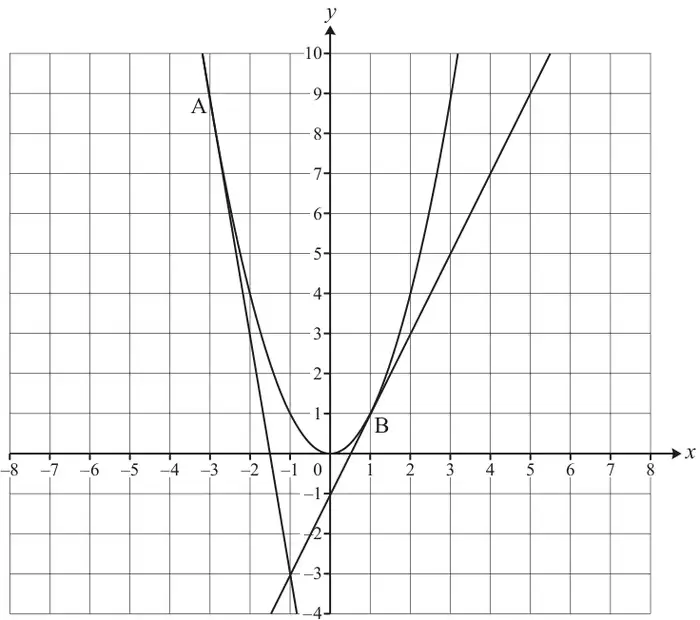
Fig. C1 shows the curve \(y = x^2\) together with tangents to the curve at points A \((-3, 9)\) and B \((1, 1)\). The tangents cross at the point \((-1, -3)\). This has \(x\)-coordinate \(-1\), which is the mean of the \(x\)-coordinates of points A and B.
Fig. C1
For the curve \(y = x^2\), the equation of the tangent at a general point \((t, t^2)\) is \(y = 2tx - t^2\). So the equation of the tangent at the point \((t_1, t_1^2)\) is \(y = 2t_1x - t_1^2\). There is a similar equation for the tangent at the point \((t_2, t_2^2)\), and these two tangents cross where \(2t_1x - t_1^2 = 2t_2x - t_2^2\).
This gives \(2x(t_1 - t_2) = t_1^2 - t_2^2\) so \(2x(t_1 - t_2) = (t_1 - t_2)(t_1 + t_2)\) hence \(x = \dfrac{t_1 + t_2}{2}\). The \(y\)-coordinate of the point of intersection is \(t_1t_2\).
Substitute appropriate values of \(t_1\) and \(t_2\) to verify that \(t_1t_2\) gives the correct value for the \(y\)-coordinate of the point of intersection of the tangents at the points A and B in Fig. C1. [1]
Mark scheme
Scheme
Marks
AO
\(t_1t_2 = 1 \times -3 = -3\)
B1
2.5
[1]
Notes
B1: Convincingly showing that the formula gives \(-3\)
Additional guidance
Candidates must use \(t_1\) and \(t_2\) with values 1 and -3 to show \(t_1t_2 = -3\) for the B1. Using -1 and 3 is not correct and scores B0.
We'd like to use Google Analytics cookies to count visits and see which pages help most. They're optional, and the site works exactly the same either way. Privacy policy