The questions in this section refer to the article on the Insert. You should read the article before attempting the questions.
The relevant parts of the article “The trisectrix of Maclaurin” are reproduced below; the line numbers are those printed on the Insert.
Lines 6–7 In 1742, Colin Maclaurin first studied a curve which can be used to trisect an angle. The curve is called the Trisectrix of Maclaurin.
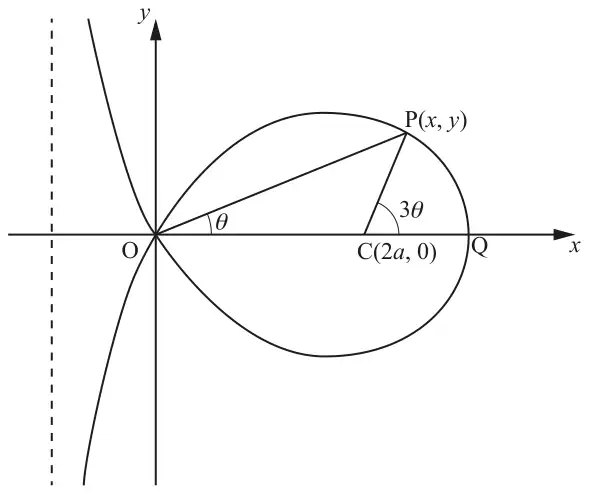
Lines 8–9 The equation of the curve in cartesian form is \(y^2 = \dfrac{x^2(3a-x)}{a+x}\), where \(a\) is a constant. The curve is shown in Fig. C2 below. Only values of \(a > 0\) are considered in this article.
Lines 10–11 It can be shown that everywhere on the curve \(\dfrac{3a-x}{a+x} \geqslant 0\). It follows that \(3a - x \geqslant 0\) and \(a + x > 0\).
Line 12 The curve has the trisection property illustrated in Fig. C2.
Fig. C2
Lines 14–16 The point C has coordinates \((2a, 0)\) and Q is the point where the curve crosses the positive \(x\)-axis. The point P is a general point \((x, y)\) on the loop of the curve. The origin of the coordinate system is denoted by O.
Line 17 The dashed line is an asymptote to the curve.
Lines 18–19 If the line CP makes an angle \(3\theta\) with the positive \(x\)-axis then the line OP makes an angle \(\theta\) with the positive \(x\)-axis. Angles are measured anticlockwise from the positive \(x\)-axis.
(a) Show that for the point on the curve where \(x = 0\), \(\dfrac{3a-x}{a+x} \geqslant 0\) as given in line 10. [1]
(b) Use the equation of the curve given in line 8 to show that for all points on the curve where \(x \neq 0\), \(\dfrac{3a-x}{a+x} \geqslant 0\) as given in line 10. [1]
(c) Show that it follows that \(3a - x \geqslant 0\) and \(a + x > 0\), as given in lines 10 and 11, for values of \(a > 0\). [3]
(d) Hence find, in terms of \(a\) where \(a > 0\), the range of values of \(x\) for points on the curve \(y^2 = \dfrac{x^2(3a-x)}{a+x}\). [1]
(e) Find the equation of the asymptote to the curve. [1]
B1: AG Or complete argument e.g. \(a > 0\) so \(\frac{3a}{a} \geqslant 0\) Condone \(3 > 0\) or \(\frac{3a}{a} > 0\) No wrong working seen
Mark scheme (b)
Scheme
Marks
AO
\(y^2 \geqslant 0\) and \(x^2 > 0\) Since \(y^2 = \frac{x^2(3a-x)}{a+x}\) then \(\frac{(3a-x)}{a+x} \geqslant 0\)
B1
2.1
[1]
Notes
B1: AG Clear explanation, must be based on \(y^2\) non-negative (\(\geqslant 0\)) and \(x^2\) positive (\(> 0\)) Condone \(\frac{y^2}{x^2} \geqslant 0\) then \(\frac{(3a-x)}{a+x} \geqslant 0\) from rearranging
Mark scheme (c)
Scheme
Marks
AO
\(x + a\) cannot be 0 [as then the value of \(y^2\) is undefined]
B1
2.2a
\(3a - x \leqslant 0\) and \(a + x < 0\) (\(3a - x \geqslant 0\) and \(a + x > 0\))
B1
2.2a
If \(3a - x \leqslant 0\) and \(a + x < 0\) then \(3a \leqslant x\) and \(x < -a\) These cannot both be true when \(a\) is positive so \(3a - x \geqslant 0\) and \(a + x > 0\)
B1
2.3
[3]
Notes
B1: Dismissing zero value for \(x + a\) Allow e.g. \(x + a > 0\) and \(x + a < 0\) Condone e.g. “\(x + a > 0\) as denominator cannot be 0”
B1: Condone “both positive or both negative” Considering negative case Condone e.g. \(3a - x < 0\) and \(a + x < 0\) for this mark
B1: AG Dismissing the “both negative” case Dep on previous two B1 marks Inequality signs must be correct
Alternative method for 3rd B1
Scheme
Marks
If \(3a - x \leqslant 0\) and \(a + x < 0\) then \(3a - x + a + x < 0 \Rightarrow 4a < 0\) but this is impossible as \(a > 0\) so \(3a - x \geqslant 0\) and \(a + x > 0\)
B1
B1: AG Dismissing the “both negative” case Dep on previous two B1 marks Inequality signs must be correct
Mark scheme (d)
Scheme
Marks
AO
\(3a \geqslant x\) and \(x > -a\) OR \(-a < x \leqslant 3a\)
B1
3.1a
[1]
Notes
B1: Any equivalent inequality/inequalities with \(x\) as a subject Both inequality signs must be correct Condone e.g. comma for ‘and’
Mark scheme (e)
Scheme
Marks
AO
(Asymptote is) \(x = -a\)
B1
2.2a
[1]
Notes
B1: \(-a\) alone is insufficient. oe e.g. \(x + a = 0\)