
June 2025 Paper 3 Q5
5 The diagram shows the curve with equation \(y = x^4 - 2^x\), for values of \(x\) close to zero.
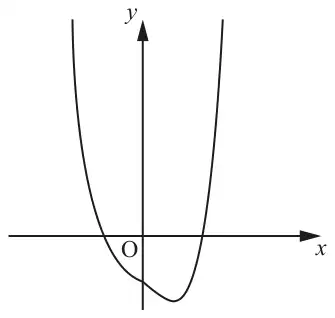
Show that the equation \(x^4 - 2^x = 0\) has a root which lies between 1 and 2. [2]
Sketch a cobweb or staircase diagram, on the diagram in the Printed Answer Booklet, for the iterative formula \(x_{n+1} = 2^{0.25x_n}\) starting with \(x_0 = 0.4\). Show at least two iterations. [2]
Show that the iteration \(x_{n+1} = 4\log_2 x_n\), with \(x_0 = 1\), will not find a root of \(x^4 - 2^x = 0\). [2]
| Scheme | Marks | AO |
|---|---|---|
| DR \(1^4 - 2^1\ \ (= -1 < 0)\) and \(2^4 - 2^2\ \ (= 12 > 0)\) | M1 | 1.1 |
| Values are \(-1\) and 12 so there is a change of sign (and hence a root between 1 and 2) | A1 | 2.4 |
| [2] |
Notes
DR: This question included the instruction: In this question you must show detailed reasoning.
M1: See appendix
Allow \(1^4 - 2^1\) or 1 – 2 and \(2^4 - 2^2\) or 16 – 4
Ignore ‘= 0’
Condone \(-1\) and 12 only provided clearly linked to \(x = 1\) and \(x = 2\) e.g. as coordinates or in a table of values
Allow for using two values between 1 and 2 that are either side of 1.24 e.g. 1.2 and 1.3
A1: Correct values of function and comment on change of sign, allow e.g. \(-1 < 0\) and \(12 > 0\)
Condone no mention of function being sufficiently well-behaved (or continuous)
e.g. 1.2 and 1.3 leading to \(-0.22\) and 0.39 (2 s.f. is sufficient)
Appendix: exemplar responses for Q5(a)
REMEMBER: It is not possible to have an award of M0A1
| Response | Mark |
|---|---|
| After M1 has been awarded the following comments would earn A1 | |
| There is a sign change therefore the curve crosses the \(x\)-axis therefore a root is between 1 and 2 | A1 |
| Change of sign and root must be between 1 and 2 | A1 |
| \(-1 < 0\) and \(12 > 0\) | A1 |
| \(-1\) is negative and 12 is positive | A1 |
| Change of sign then there is a root between 1.2 and 1.3, which also lies between 1 and 2 | A1 |
| After M1 has been awarded the following comments would earn A0 | |
| \(x = 1, y = -1\) and \(x = 2, y = 8\), sign change suggests a root between these values | A0 as \(y = 8\) is incorrect |
| There is a root between 1 and 2 | A0 as no mention of sign change |
| Scheme | Marks | AO |
|---|---|---|
| \(x^4 = 2^x\) \(x = (2^x)^{\frac{1}{4}}\) \(\quad = 2^{0.25x}\) | B1 | 2.1 |
| [1] |
Notes
B1: AG
Convincing rearrangement to given result
Must show one step of working and no incorrect work seen
Must not work backwards
e.g. \(4\log_2(x) - x = 0\) is B0 as not convincingly from a correct process unless \(4\log_2(x) = x\) is seen first
| Scheme | Marks | AO |
|---|---|---|
| \(x_1 = 1.07\ldots\) | M1 | 1.1 |
| 1.24 | A1 | 2.2a |
| [2] |
Notes
M1: \(x_1 =\) awrt 1.07 (= 1.07177...).
soi by any of these values: 1.204…, 1.232…, 1.237…
A1: cao
Must have shown at least one iteration e.g. \(x_1 = 1.07\)
| Scheme | Marks | AO |
|---|---|---|
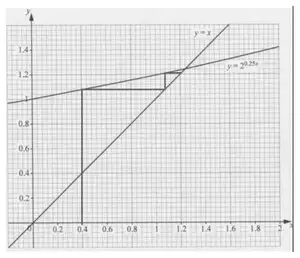 | B1 B1 | 1.1 1.1 |
| [2] |
Notes
B1: Vertical line \(x = 0.4\) drawn to meet the curve, could start line from \(y = x\)
B1: Correct completion of staircase diagram to head towards root with at least two vertical and two horizontal lines seen (lines need not extend beyond region between line and curve)
Condone good freehand lines, mark intent
SC B1B0 for using a different starting value e.g. \(x = 0\) with at least two vertical and two horizontal lines seen. Correct staircase diagram converging to root from their starting value.
| Scheme | Marks | AO |
|---|---|---|
| \(x^4 = 2^x\) \(x = \log_2(x^4)\) \(\quad = 4\log_2 x\) | B1 | 2.1 |
| [1] |
Notes
B1: AG
Convincing rearrangement to given result
Must show at least one step of working and no incorrect work seen
e.g. \(\log_2(x^4) - \log_2(2^x) = 0\) is B0 as not convincingly from a correct process unless \(\log_2(x^4) = \log_2(2^x)\) is seen first
Must not work backwards
| Scheme | Marks | AO |
|---|---|---|
| DR \(x_1 = 0\) | M1 | 1.1 |
| Not possible to find log of zero | A1 | 2.4 |
| [2] |
Notes
DR: This question included the instruction: In this question you must show detailed reasoning.
M1: Or \(4\log_2 1 = 0\)
A1: Condone e.g. math error or \(x_2\) is invalid or \(x_2\) has no solution provided log 0 is mentioned