
June 2025 Paper 2 Q14
14 The equation of a curve is \(y = \dfrac{16}{x^2} + \dfrac{3}{x}\).
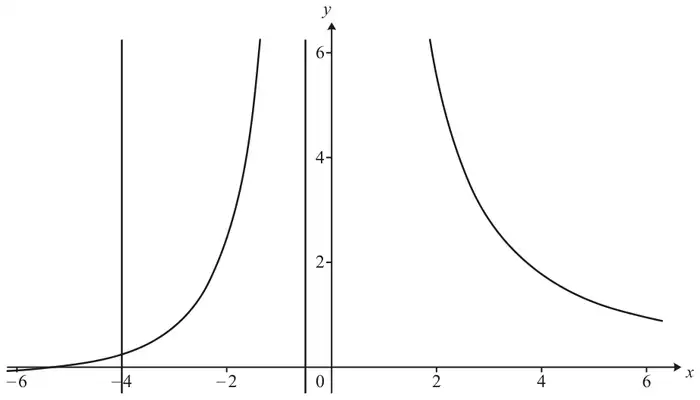
The diagram shows parts of the curve \(y = \dfrac{16}{x^2} + \dfrac{3}{x}\), the line \(x = -4\) and the line \(x = -\dfrac{1}{2}\).
| Scheme | Marks | AO |
|---|---|---|
| \(\dfrac{16}{x^2} + \dfrac{3}{x} = 0\) | M1 | 1.1 |
| \(\left(-\dfrac{16}{3},\ 0\right)\) and no others | A1 | 1.1 |
| [2] |
Notes
M1: sets equal to 0 and obtains value(s) for \(x\)
A1: allow \((-5.3,\ 0)\) or better; allow eg \(x = -5.3,\ y = 0\)
if M0 allow SC1 for exact coordinates unsupported
| Scheme | Marks | AO |
|---|---|---|
| (i) \(\left[\dfrac{\mathrm{d}y}{\mathrm{d}x}\right] = -2\times 16x^{-3} - 3x^{-2}\) oe | M1* | 1.1 |
| \(\left[\dfrac{\mathrm{d}y}{\mathrm{d}x}\right] = -32x^{-3} - 3x^{-2}\) or \(-\dfrac{32}{x^3} - \dfrac{3}{x^2}\) isw | A1 | 1.1 |
| [2] | ||
| (ii) their \(-32x^{-3} - 3x^{-2} = 0\) used to obtain value(s) for \(x\) | M1dep* | 1.1 |
| \(\left(-\dfrac{32}{3},\ -\dfrac{9}{64}\right)\) or \(\left(-10\frac{2}{3},\ -\dfrac{9}{64}\right)\) cao | A1 | 1.1 |
| [2] |
Notes
(i) M1*: allow one sign error in coefficient;
A1: both terms correct and no extras
(ii) A1: allow eg \(-0.140625\); allow eg \(x = -\frac{32}{3},\ y = -\frac{9}{64}\)
| Scheme | Marks | AO |
|---|---|---|
| (i) \(\left[\dfrac{\mathrm{d}^2y}{\mathrm{d}x^2}\right] = 96x^{-4} + 6x^{-3}\) or \(\dfrac{96}{x^4} + \dfrac{6}{x^3}\) | M1 A1 | 1.1 1.1 |
| [2] | ||
| (ii) \(96x^{-4} + 6x^{-3} \lt 0\) | M1 | 2.1 |
| \(x \lt -16\) or \(-16 \gt x\) cao | A1 | 1.1 |
| [2] |
Notes
(i) M1: differentiation of their \(\frac{\mathrm{d}y}{\mathrm{d}x}\), dependent on award of M1 in 14 (b)(i); allow one sign error in coefficient
A1: both terms correct
(ii) M1: putting their expression for \(\frac{\mathrm{d}^2y}{\mathrm{d}x^2} \lt 0\) or \(\frac{\mathrm{d}^2y}{\mathrm{d}x^2} = 0\) or \(\frac{\mathrm{d}^2y}{\mathrm{d}x^2} \leqslant 0\) to find value(s) for \(x\)
| Scheme | Marks | AO |
|---|---|---|
| \(\displaystyle\int \frac{16}{x^2} + \frac{3}{x}\,\mathrm{d}x = -\frac{16}{x} + 3\ln|x|\) oe | M1* A1 | 1.1 2.1 |
| \(\left[\dfrac{-16}{-\frac{1}{2}} + 3\ln\left|-\tfrac{1}{2}\right|\right] - \left[\dfrac{-16}{-4} + 3\ln|-4|\right]\) | M1dep* | 1.1 |
| \(3\ln\left|-\tfrac{1}{2}\right| = 3\ln\frac{1}{2}\) and \(3\ln|-4| = 3\ln 4\) | M1dep* | 2.1 |
| \(28 - 9\ln 2\) cao | A1 | 1.1 |
| [5] |
Notes
M1*: one term correct; allow omission of modulus sign
A1: both terms correct; ignore \(+\,c\); allow omission of modulus sign
M1dep*: allow omission of modulus sign; allow one incorrect sign but do not allow eg \(\mathrm{F}\left[-\frac{1}{2}\right] + \mathrm{F}[-4]\)
M1dep*: oe; modulus seen and used to deal with both terms
A1: may see eg \(32 - 4 - 3\ln 2 - 6\ln 2\) oe as intermediate step
Alternatively
| Scheme | Marks |
|---|---|
| \(\displaystyle\int_{-4}^{-\frac{1}{2}} \frac{16}{x^2} + \frac{3}{x}\,\mathrm{d}x = \int_{\frac{1}{2}}^{4} \frac{16}{x^2} - \frac{3}{x}\,\mathrm{d}x\) | M1* |
| \(\displaystyle\int \frac{16}{x^2} + \frac{3}{x}\,\mathrm{d}x = -\frac{16}{x} - 3\ln x\) oe | M1* A1 |
| \(\left[\dfrac{-16}{4} - 3\ln 4\right] - \left[\dfrac{-16}{\frac{1}{2}} - 3\ln\frac{1}{2}\right]\) | M1dep* |
| \(28 - 9\ln 2\) cao | A1 |
M1*: by reflecting in \(y\)-axis and working with \(\mathrm{f}(-x)\) oe; may be awarded before first M1; condone incorrect reason eg reflection in \(x\)-axis; M0 for use of \(\int_{\frac{1}{2}}^{4} \frac{16}{x^2} + \frac{3}{x}\,\mathrm{d}x\) by symmetry
M1* A1: one term correct; allow omission of modulus sign
both terms correct; ignore \(+\,c\); allow omission of modulus sign
M1dep*: dependent on correct integration and correct transformation
A1: may see eg \(32 - 4 - 3\ln 2 - 6\ln 2\) oe as intermediate step