
June 2025 Paper 1 Q10
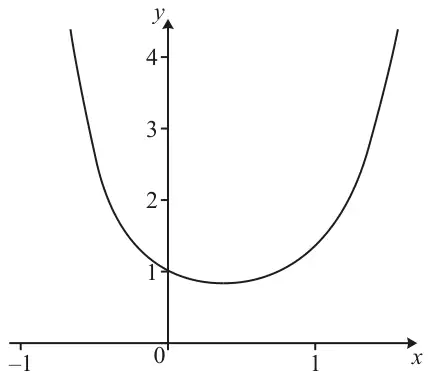
10 The diagram shows part of the graph of the function \(y = \dfrac{\mathrm{e}^{x^2}}{x+1}\) which is defined for \(x \gt -1\).
| Scheme | Marks | AO |
|---|---|---|
| \(\dfrac{\mathrm{d}}{\mathrm{d}x}\left(\mathrm{e}^{x^2}\right) = 2x\mathrm{e}^{x^2}\) | B1 | 1.1 |
| Quotient rule \(u = \mathrm{e}^{x^2}\) and \(v = x+1\) \(\dfrac{\mathrm{d}y}{\mathrm{d}x} = \dfrac{2x\mathrm{e}^{x^2}(x+1) - 1\times \mathrm{e}^{x^2}}{(x+1)^2}\) \(= \dfrac{\mathrm{e}^{x^2}(2x^2 + 2x - 1)}{(x+1)^2}\) | M1 A1 | 1.1 1.1 |
| [3] |
Notes
B1: Correct derivative of \(\mathrm{e}^{x^2}\) seen
M1: Uses quotient rule with their \(\frac{\mathrm{d}u}{\mathrm{d}x}\) and \(\frac{\mathrm{d}v}{\mathrm{d}x}\) oe
A1: Fully correct. Any form
Also allow use of the product rule with \((x+1)^{-1}\) giving \(\dfrac{\mathrm{d}y}{\mathrm{d}x} = \dfrac{2x\mathrm{e}^{x^2}}{x+1} - \dfrac{\mathrm{e}^{x^2}}{(x+1)^2}\)
| Scheme | Marks | AO |
|---|---|---|
| Negative when \(2x^2 + 2x - 1 \lt 0\) as the denominator and \(\mathrm{e}^{x^2}\) are always positive | M1 | 2.1 |
| B1 | 1.1a | |
| So \(-1 \lt x \lt \dfrac{-1+\sqrt{3}}{2}\) | A1 | 2.5 |
| [3] |
Notes
M1: Simplifies the problem to a quadratic inequality
FT their \(\frac{\mathrm{d}y}{\mathrm{d}x}\)
Also allow for algebraic attempt to find the stationary point if used to define a range of values
Allow if their \(\frac{\mathrm{d}y}{\mathrm{d}x}\) leads to linear or cubic inequality
B1: \(\dfrac{-1+\sqrt{3}}{2}\) or 0.366 seen
A1: oe \(-1 \lt x \lt 0.366\ldots\)
Do not allow for \(\leqslant\) used in final answer
| Scheme | Marks | AO |
|---|---|---|
| \(\mathrm{f}(0) + 2\left(\mathrm{f}(0.25) + \mathrm{f}(0.5) + \mathrm{f}(0.75)\right) + \mathrm{f}(1)\) \([= 7.78014\ldots]\) | M1 | 1.1 |
| Area \(\approx \frac{1}{2}\times 0.25\times 7.78014\ldots\) | B1 | 1.1 |
| \(= 0.9725\ldots\) | A1 | 1.1 |
| [3] |
Notes
M1: Uses 5 values in an attempt to find the total for trapezium rule with correct \(x\)-values soi
Also allow for the total area of four trapeziums attempted
See table below for values
B1: \(\frac{h}{2} = \frac{0.25}{2}\) or 0.125 soi
| x | 0 | 0.25 | 0.5 | 0.75 | 1 |
|---|---|---|---|---|---|
| f(x) | 1 | 0.851596 | 0.856017 | 1.002888 | 1.359141 |
| contribution | 1 | 1.703191 | 1.712034 | 2.005777 | 1.359141 |
| Scheme | Marks | AO |
|---|---|---|
| Trapezium rule gives an over-estimate because the curve is concave upwards (or convex downwards, or gradient increasing) | B1 | 2.4 |
| [1] |
Notes
B1: Also allow an explanation that involves extra area under the line that is not in the region.
Condone incorrect description of the curve, if the explanation of additional area is clear.
See appendix
Allow for comparing exact value of area found BC to their estimate and stating over-estimate
Appendix: exemplar responses for Q10(d)
| Response | Mark |
|---|---|
| Overestimate because the curve is convex/concave | B0 |
| Overestimate because the trapeziums would go over the curve line | B1 |
| Overestimate because there are gaps between the trapeziums and the graph | B0 |