June 2024 Paper 1 Q11
11.
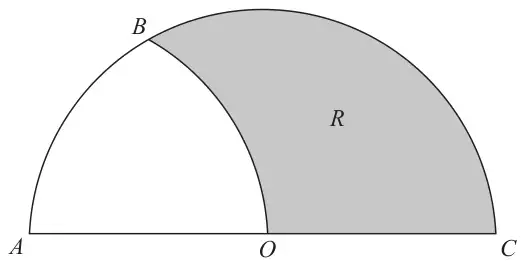
Figure 4 shows the design of a badge.
The shape \(ABCOA\) is a semicircle with centre \(O\) and diameter 10 cm.
\(OB\) is the arc of a circle with centre \(A\) and radius 5 cm.
The region \(R\), shown shaded in Figure 4, is bounded by the arc \(OB\), the arc \(BC\) and the line \(OC\).
Find the exact area of \(R\).
Give your answer in the form \(\left(a\sqrt{3} + b\pi\right)\text{ cm}^2\), where \(a\) and \(b\) are rational numbers. (4)
| Scheme | Marks | AO |
|---|---|---|
| Identifies angle \(BAO = \dfrac{\pi}{3}\) or angle \(BOC = \dfrac{2\pi}{3}\) | B1 | 2.2a |
| \(\text{Area(segment)} = \dfrac{1}{2} \times 5^2 \times \dfrac{\pi}{3} - \dfrac{1}{2} \times 5^2 \sin \dfrac{\pi}{3}\left\{= \dfrac{25\pi}{6} - \dfrac{25\sqrt{3}}{4}\right\}\) or \(\text{Area}(AOB) = 2 \times \dfrac{1}{2} \times 5^2 \times \dfrac{\pi}{3} - \dfrac{1}{2} \times 5^2 \sin \dfrac{\pi}{3}\left\{= \dfrac{25\pi}{3} - \dfrac{25\sqrt{3}}{4}\right\}\) | M1 | 2.1 |
| \(\text{Area of } R = \dfrac{1}{2} \times 5^2 \times \dfrac{2\pi}{3} - \left(\dfrac{1}{2} \times 5^2 \times \dfrac{\pi}{3} - \dfrac{1}{2} \times 5^2 \sin \dfrac{\pi}{3}\right)\) or \(\text{Area of } R = \dfrac{1}{2} \times \pi \times 5^2 - \left(\dfrac{1}{2} \times 5^2 \times \dfrac{\pi}{3} - \dfrac{1}{2} \times 5^2 \sin \dfrac{\pi}{3} + \dfrac{1}{2} \times 5^2 \times \dfrac{\pi}{3}\right)\) | dM1 | 3.1a |
| \(= \dfrac{25}{4}\sqrt{3} + \dfrac{25}{6}\pi\ \left(\text{cm}^2\right)\) | A1 | 1.1b |
| (4) | ||
| (4 marks) |
Notes
Note: Use of degrees, if used in formulae in degrees, can score full marks.
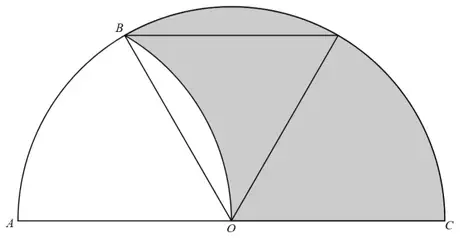
B1: Deduces angle \(BAO\) or angle \(BOA\) is \(\dfrac{\pi}{3}\) radians or \(60^\circ\) or deduces that angle \(BOC\) is \(\dfrac{2\pi}{3}\) radians or \(120^\circ\). May be seen on the diagram or their own sketches or embedded in a formula.
May be implied if they find e.g. \(\dfrac{1}{6} \times \pi \times 5^2\) for the area of the minor sector.
M1: Uses a correct process and an angle of \(\dfrac{\pi}{3}\) radians or \(60^\circ\) to find
- the area of the segment bounded by the arc \(OB\) and straight line \(OB\)
- or the area of the segment bounded by the arc \(AB\) and straight line \(AB\)
- or the area of unshaded region \(AOB\).
Allow decimal values to imply the method (require 3sf rounded or truncated).
Use of \(60^\circ\) must be in a correct formula in degrees. \(0.5 \times 5^2 \times 60\) scores M0.
For reference these are the areas of the regions:
- segment \(= \dfrac{1}{2} \times 5^2 \times \dfrac{\pi}{3} - \dfrac{1}{2} \times 5^2 \times \sin \dfrac{\pi}{3}\left\{= \dfrac{25\pi}{6} - \dfrac{25\sqrt{3}}{4} = 2.26\right\}\) (3 s.f.) scores M1
- \(AOB = \dfrac{1}{2} \times 5^2 \times \dfrac{\pi}{3} + \dfrac{1}{2} \times 5^2 \times \dfrac{\pi}{3} - \dfrac{1}{2} \times 5^2 \times \sin \dfrac{\pi}{3}\left\{= \dfrac{25\pi}{3} - \dfrac{25\sqrt{3}}{4} = 15.35\right\}\) (2 d.p.) scores M1
- Minor sector \(= \dfrac{1}{2} \times 5^2 \times \dfrac{\pi}{3}\left\{= \dfrac{25\pi}{6} = 13.09\right\}\) (2 d.p.) scores M0 on its own
- Major sector \(= \dfrac{1}{2} \times 5^2 \times \dfrac{2\pi}{3}\left\{= \dfrac{25\pi}{3} = 26.18\right\}\) (2 d.p.) scores M0 on its own
- Triangle \(AOB = \dfrac{1}{2} \times 5^2 \times \sin \dfrac{\pi}{3}\left\{= \dfrac{25\sqrt{3}}{4} = 10.8\right\}\) (3 s.f.) scores M0 on its own.
This mark may be implied if seen as part of a correct strategy for the area of \(R\).
Note that the area of triangle \(AOB\) may also be found using Pythagoras and \(\dfrac{1}{2}bh\) but their method must be correct.
dM1: A fully correct strategy for finding the area of \(R\).
Follow through on incorrectly simplified areas but the method must be correct.
Allow decimal values to imply the method (require 3sf rounded or truncated).
For reference, the area is approximately 23.92 (2d.p.) and is likely to imply B1M1dM1 but their work should be checked.
Either:
- major sector – segment \(= \dfrac{1}{2} \times 5^2 \times \dfrac{2\pi}{3} - \left(\dfrac{1}{2} \times 5^2 \times \dfrac{\pi}{3} - \dfrac{1}{2} \times 5^2 \sin \dfrac{\pi}{3}\right)\)
or
- semicircle – \(AOB\) \(= \dfrac{1}{2} \times \pi \times 5^2 - \left(\dfrac{1}{2} \times 5^2 \times \dfrac{\pi}{3} - \dfrac{1}{2} \times 5^2 \sin \dfrac{\pi}{3} + \dfrac{1}{2} \times 5^2 \times \dfrac{\pi}{3}\right)\)
or
- semicircle – 2 × sector \(AOB\) + triangle \(AOB\) \(= \dfrac{1}{2} \times \pi \times 5^2 - 2 \times \dfrac{1}{2} \times 5^2 \times \dfrac{\pi}{3} + \dfrac{1}{2} \times 5^2 \sin \dfrac{\pi}{3}\)
or
- sector \(AOB\) + triangle \(AOB\) \(= \dfrac{1}{2} \times 5^2 \times \dfrac{\pi}{3} + \dfrac{1}{2} \times 5^2 \sin \dfrac{\pi}{3}\) (this also implies the first M1)
If they go straight to one of these expressions then we would imply the first M1 (and the B1).
A1: Correct expression \(\dfrac{25}{4}\sqrt{3} + \dfrac{25}{6}\pi\) o.e. in the correct form e.g. \(\dfrac{50}{8}\sqrt{3} + \dfrac{75}{18}\pi\)
Ignore any reference to (or absence of) units.
Do not apply isw if they go on to add or subtract additional areas.
However, we can condone poor simplification e.g. \(\dfrac{25}{12}\left(\sqrt{3} + \pi\right)\) following a correct answer.
Note: Attempts via integration for the area underneath a circle or polar coordinates are unlikely but if seen then use Review. The schemes for these approaches follow the main scheme but the first M1 may also be scored for finding half of the area of \(AOB\).
You might find the following diagram helpful: