
C2 June 2017 Q10
10.
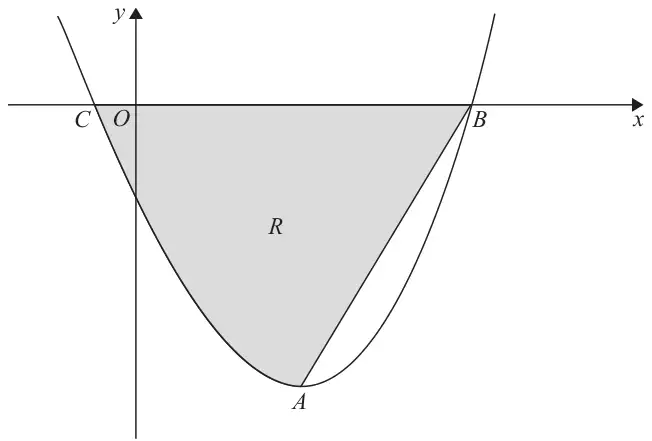
Figure 2 shows a sketch of part of the curve with equation\[y = 4x^3 + 9x^2 - 30x - 8, \quad -0.5 \leqslant x \leqslant 2.2\]The curve has a turning point at the point \(A\).
The curve crosses the \(x\)-axis at the points \(B\,(2, 0)\) and \(C\left(-\dfrac{1}{4}, 0\right)\)
The finite region \(R\), shown shaded in Figure 2, is bounded by the curve, the line \(AB\), and the \(x\)-axis.
| Scheme | Marks |
|---|---|
| \(\dfrac{\mathrm{d}y}{\mathrm{d}x} = 12x^2 + 18x - 30\) | M1 |
| Either Substitute \(x = 1\) to give \(\dfrac{\mathrm{d}y}{\mathrm{d}x} = 12 + 18 - 30 = 0\) Or Solve \(\dfrac{\mathrm{d}y}{\mathrm{d}x} = 12x^2 + 18x - 30 = 0\) to give \(x =\) | A1 |
| Either So turning point (all correct work so far) Or Deduce \(x = 1\) from correct work | A1cso |
| (3) |
Notes
M1: Attempt at differentiation - all powers reduced by 1 with \(8 \to 0\).
A1: the derivative must be correct and uses derivative = 0 to find \(x\) or substitutes \(x = 1\) to give 0. Ignore any reference to the other root \((-5/2)\) for this mark.
A1cso: obtains \(x = 1\) from correct work, or deduces turning point (if substitution used – may be implied by a preamble e.g. \(\mathrm{d}y/\mathrm{d}x = 0\) at T.P.)
N.B. If their factorisation or their second root is incorrect then award A0cso.
If however their factorisation/roots are correct, it is not necessary for them to comment that \(-2.5\) is outside the range given.
| Scheme | Marks |
|---|---|
| Way 1 When \(x = 1,\ y = 4 + 9 - 30 - 8 = -25\) | B1 |
| Area of triangle \(ABP = \tfrac{1}{2} \times 1 \times 25 = 12.5\) (Where \(P\) is at \((1, 0)\)) | B1 |
| Way 1: \(\displaystyle\int (4x^3 + 9x^2 - 30x - 8)\,\mathrm{d}x = x^4 + \frac{9}{3}x^3 - \frac{30x^2}{2} - 8x\ \{+c\}\) or \(x^4 + 3x^3 - 15x^2 - 8x\ \{+c\}\) | M1A1 |
| \(\left[x^4 + 3x^3 - 15x^2 - 8x\right]_{-\frac{1}{4}}^{1} = (1 + 3 - 15 - 8) - \left(\left(-\dfrac{1}{4}\right)^4 + 3\left(-\dfrac{1}{4}\right)^3 - 15\left(-\dfrac{1}{4}\right)^2 - 8\left(-\dfrac{1}{4}\right)\right)\) \(= (-19) - \dfrac{261}{256}\) or \(-19 - 1.02\) | dM1 |
| So Area \(= \text{"}\textit{their } 12.5\text{"} + \text{"}\textit{their } 20\tfrac{5}{256}\text{"}\) or “12.5” + “20.02” or “12.5” + \(\text{"}\textit{their } \dfrac{5125}{256}\text{"}\) | ddM1 |
| \(= 32.52\) (NOT \(-32.52\) ) | A1 |
| (7) | |
| [10] |
Less efficient alternative methods for first two marks in part (b) with Way 1 or 2
| Scheme | Marks |
|---|---|
| For first mark: Finding equation of the line \(AB\) as \(y = 25x - 50\) as this implies the \(-25\) | B1 |
| For second mark: Integrating to find triangle area \(\displaystyle\int_1^2 (25x - 50)\,\mathrm{d}x = \left[\frac{25}{2}x^2 - 50x\right]_1^2 = -50 + 37.5 = -12.5\) so area is 12.5 | B1 |
| Then mark as before if they use Method in original scheme |
Way 2
| Scheme | Marks |
|---|---|
| Way 2: Those who use area for original curve between -1/4 and 2 and subtract area between line and curve between 1 and 2 have a correct (long) method . The first B1 (if \(y = -25\) is not seen) is for equation of straight line \(y = 25x - 50\) | B1 |
| The second B1 may be implied by final answer correct, or 4.5 seen for area of “segment shaped” region between line and curve, or by area between line and axis/triangle found as 12.5 | B1 |
| \(\displaystyle\int (4x^3 + 9x^2 - 55x + 42)\,\mathrm{d}x = x^4 + \frac{9}{3}x^3 - \frac{55x^2}{2} + 42x\ \{+c\}\) (or integration as in Way 1) | M1A1 |
| The dM1 is for correct use of the different correct limits for each of the two areas: i.e. \(\left[x^4 + 3x^3 - 15x^2 - 8x\right]_{-\frac{1}{4}}^{2} = (16 + 24 - 60 - 16) - \left(\left(-\dfrac{1}{4}\right)^4 + 3\left(-\dfrac{1}{4}\right)^3 - 15\left(-\dfrac{1}{4}\right)^2 - 8\left(-\dfrac{1}{4}\right)\right)\) And \(\left[x^4 + \dfrac{9}{3}x^3 - \dfrac{55x^2}{2} + 42x\right]_1^2 = 16 + 24 - 110 + 84 - (1 + 3 - 27.5 + 42)\) | dM1 |
| So Area =their \(\left[x^4 + 3x^3 - 15x^2 - 8x\right]_{-\frac{1}{4}}^{2}\) minus their \(\left[x^4 + \dfrac{9}{3}x^3 - \dfrac{55x^2}{2} + 42x\right]_1^2\) i.e. \(\text{"}\textit{their } 37.0195\text{"} - \text{"}\textit{their } 4.5\text{"}\) (with both sets of limits correct for the integral) | ddM1 |
| Reaching \(= 32.52\) (NOT \(-32.52\) ) | A1 |
| NB: Those who attempt curve – line wrongly with limits \(-1/4\) to 2 may earn M1A1 for correct integration of their cubic. Usually e.g. \(\displaystyle\int (4x^3 + 9x^2 - 55x + 42)\,\mathrm{d}x = x^4 + \frac{9}{3}x^3 - \frac{55x^2}{2} + 42x\ \{+c\}\) (They will not earn any of the last 3 marks) They may also get first B1 mark for the correct equation of the straight line (usually seen but may be implied by correct line −curve equation) and second B1 if they also use limits 1 and 2 to obtain 4.5 (or find the triangle area 12.5). | M1A1 |
Notes
Way 1:
B1: Obtains \(y = -25\) when \(x = 1\) (may be seen anywhere – even in (a)) or finds correct equation of line is \(y = 25x - 50\)
B1: Obtains area of triangle = 12.5 (may be seen anywhere). Allow \(-12.5\). Accept \(\tfrac{1}{2} \times 1 \times 25\)
M1: Attempt at integration of cubic; two correct terms for their integration. No limits needed
A1: completely correct integral for the cubic (may be unsimplified)
dM1: We are looking for the start of a correct method here (dependent on previous M). It is for substituting 1 and -1/4 and subtracting. May use 2 and -1/4 and also 2 and 1 AND subtract (which is equivalent)
ddM1 (depends on both method marks) Correct method to obtain shaded area so adds two positive numbers (areas) together – one is area of triangle, the other is area of region obtained from integration of correct function with correct limits (may add two negatives then makes positive)
Way 2: This is a long method and needs to be a correct method
B1: Finds \(y = -25\) at \(x = 1\) ,or correct equation of line is \(y = 25x - 50\)
B1: May be implied where WAY 2 is used and final correct answer obtained so award of final A1 results in the award of this B1. It may also be implied by correct integration of line equation or of curve minus line expression between limits 1 and 2. So if only slip is final subtraction (giving final A0, this mark may still be awarded) So may be implied by 4.5 seen for area of “segment shaped” region between line and curve.
M1: Attempt at integration of given cubic or after attempt at subtracting their line equation (no limits needed). Two correct terms needed
A1: Completely correct integral for their cubic (may be unsimplified) – may have wrong coefficients of \(x\) and wrong constant term through errors in subtraction
dM1: Use limits for original curve between -1/4 and 2 and use limits of 1 and 2 for area between line and curve– needs completely correct limits– see scheme- this is dependent on two integrations
ddM1: (depends on both method marks) Subtracts \(\text{"}\textit{their } 37.0195\text{"} - \text{"}\textit{their } 4.5\text{"}\) Needs consistency of signs.
A1: 32.52 or awrt 32.52 e.g. \(32\dfrac{133}{256}\) NB: This correct answer implies the second B mark
(Trapezium rule gets no marks after first two B marks) The first two B marks may be given wherever seen. The integration of a cubic gives the following M1 and correct integration of their cubic
\(\displaystyle\int (4x^3 + 9x^2 + Ax + B)\,\mathrm{d}x = x^4 + \frac{9}{3}x^3 + \frac{Ax^2}{2} + Bx\ \{+c\}\) gives the A1