
C2 January 2012 Q8
8.
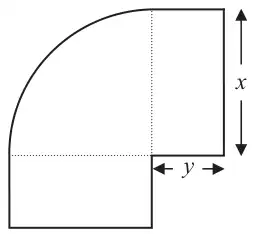
Figure 3 shows a flowerbed. Its shape is a quarter of a circle of radius \(x\) metres with two equal rectangles attached to it along its radii. Each rectangle has length equal to \(x\) metres and width equal to \(y\) metres.
Given that the area of the flowerbed is 4 m2,
Give your answer to the nearest centimetre. (2)
| Scheme | Marks |
|---|---|
| \(kr^2 + cxy = 4\) or \(kr^2 + c[(x + y)^2 - x^2 - y^2] = 4\) | M1 |
| \(\tfrac{1}{4}\pi x^2 + 2xy = 4\) | A1 |
| \(y = \dfrac{4 - \frac{1}{4}\pi x^2}{2x} = \dfrac{16 - \pi x^2}{8x}\) * | B1 cso |
| (3) |
Notes
M1: Putting sum of one or two \(xy\) terms and one \(kr^2\) term equal to 4 (\(k\) and \(c\) may be wrong)
A1: For any correct form of this equation with \(x\) for radius (may be unsimplified)
B1 : Making \(y\) the subject of their formula to give this printed answer with no errors
| Scheme | Marks |
|---|---|
| \(P = 2x + cy + k\pi r\) where \(c = 2\) or 4 and \(k = \tfrac{1}{4}\) or \(\tfrac{1}{2}\) | M1 |
| \(P = \dfrac{\pi x}{2} + 2x + 4\left(\dfrac{4 - \frac{1}{4}\pi x^2}{2x}\right)\) or \(P = \dfrac{\pi x}{2} + 2x + 4\left(\dfrac{16 - \pi x^2}{8x}\right)\) o.e. | A1 |
| \(P = \dfrac{\pi x}{2} + 2x + \dfrac{8}{x} - \dfrac{\pi x}{2}\) so \(P = \dfrac{8}{x} + 2x\) * | A1 |
| (3) |
Notes
M1 : Uses Perimeter formula of the form \(2x + cy + k\pi r\) where \(c = 2\) or 4 and \(k = \tfrac{1}{4}\) or \(\tfrac{1}{2}\)
A1: Correct unsimplified formula with y substituted as shown, i.e. \(c = 4\), \(k = \tfrac{1}{2}\), \(r = x\) and \(y = \dfrac{16 - \pi x^2}{8x}\) or \(y = \left(\dfrac{4 - \frac{1}{4}\pi x^2}{2x}\right)\)
A1: obtains printed answer with at least one line of correct simplification or expansion before giving printed answer or stating result has been shown or equivalent
| Scheme | Marks |
|---|---|
| \(\left(\dfrac{\mathrm{d}P}{\mathrm{d}x} =\right) -\dfrac{8}{x^2} + 2\) | M1 A1 |
| \(-\dfrac{8}{x^2} + 2 = 0 \Rightarrow x^2 = \ldots\) | M1 |
| and so \(x = 2\) o.e. (ignore extra answer \(x = -2\)) | A1 |
| \(P = 4 + 4 = 8\ (\text{m})\) | B1 |
| (5) |
Notes
M1: At least one power of \(x\) decreased by 1 (Allow \(2x\) becomes 2)
A1: accept any equivalent correct answer
M1: Setting \(\dfrac{\mathrm{d}P}{\mathrm{d}x} = 0\) and finding a value for correct power of \(x\) for candidate
A1 : For \(x = 2\). (This mark may be given for equivalent and may be implied by correct \(P\))
B1: 8 (cao) N.B. This may be awarded if seen in part (d)
| Scheme | Marks |
|---|---|
| \(y = \dfrac{4 - \pi}{4}\), (and so width) \(= 21\) (cm) | M1, A1 |
| (2) | |
| 13 |
Notes
M1 : Substitute \(x\) value found in (c) into equation for \(y\) from (a) ( or substitute \(x\) and \(P\) into equation for \(P\) from (b)) and evaluate (may see 0.2146 and correct answer implies M1 or need to see substitution if \(x\) value was wrong.)
A1 is for 21 or 21cm or 0.21m as this is to nearest cm