
C2 June 2010 Q8
8.
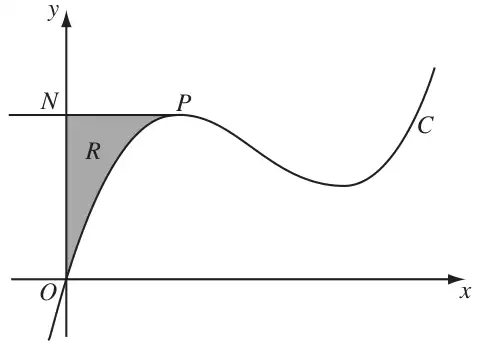
Figure 2 shows a sketch of part of the curve \(C\) with equation\[y = x^3 - 10x^2 + kx,\]where \(k\) is a constant.
The point \(P\) on \(C\) is the maximum turning point.
Given that the \(x\)-coordinate of \(P\) is 2,
The line through \(P\) parallel to the \(x\)-axis cuts the \(y\)-axis at the point \(N\).
The region \(R\) is bounded by \(C\), the \(y\)-axis and \(PN\), as shown shaded in Figure 2.
| Scheme | Marks |
|---|---|
| (a) \(\dfrac{\mathrm{d}y}{\mathrm{d}x} = 3x^2 - 20x + k\) (Differentiation is required) | M1 A1 |
| At \(x = 2\), \(\dfrac{\mathrm{d}y}{\mathrm{d}x} = 0\), so \(12 - 40 + k = 0\qquad k = 28\) (*) N.B. The ‘= 0’ must be seen at some stage to score the final mark. | A1 cso |
| (3) |
Notes
Alternatively: (using \(k = 28\))
\(\dfrac{\mathrm{d}y}{\mathrm{d}x} = 3x^2 - 20x + 28\) (M1 A1)
‘Assuming’ \(k = 28\) only scores the final cso mark if there is justification that \(\dfrac{\mathrm{d}y}{\mathrm{d}x} = 0\) at \(x = 2\) represents the maximum turning point.
(a) M: \(x^n \to cx^{n-1}\) (\(c\) constant, \(c \neq 0\) ) for one term, seen in part (a).
| Scheme | Marks |
|---|---|
| (b) \(\displaystyle\int(x^3 - 10x^2 + 28x)\,\mathrm{d}x = \frac{x^4}{4} - \frac{10x^3}{3} + \frac{28x^2}{2}\) Allow \(\dfrac{kx^2}{2}\) for \(\dfrac{28x^2}{2}\) | M1 A1 |
| \(\left[\dfrac{x^4}{4} - \dfrac{10x^3}{3} + 14x^2\right]_0^2 = \ldots\qquad \left(= 4 - \dfrac{80}{3} + 56 = \dfrac{100}{3}\right)\) (With limits 0 to 2, substitute the limit 2 into a 'changed function') | M1 |
| \(y\)-coordinate of \(P = 8 - 40 + 56 = 24\) Allow if seen in part (a) (The B1 for 24 may be scored by implication from later working) | B1 |
| Area of rectangle \(= 2 \times (\text{their } y\text{-coordinate of } P)\) Area of \(R = (\text{their } 48) - \left(\text{their } \dfrac{100}{3}\right)\quad = \dfrac{44}{3}\quad \left(14\dfrac{2}{3}\ \text{or}\ 14.\dot{6}\right)\) If the subtraction is the ‘wrong way round’, the final A mark is lost. | M1 A1 |
| (6) | |
| 9 |
Notes
(b) 1st M: \(x^n \to cx^{n+1}\) (\(c\) constant, \(c \neq 0\) ) for one term.
Integrating the gradient function loses this M mark.
2ndM: Requires use of limits 0 and 2, with 2 substituted into a ‘changed function’. (It may, for example, have been differentiated).
Final M: Subtract their values either way round. This mark is dependent on the use of calculus and a correct method attempt for the area of the rectangle.
A1: Must be exact, not 14.67 or similar, but isw after seeing, say, \(\dfrac{44}{3}\).
Alternative: (effectively finding area of rectangle by integration)\[\int\left\{24 - (x^3 - 10x^2 + 28x)\right\}\mathrm{d}x = 24x - \left(\frac{x^4}{4} - \frac{10x^3}{3} + \frac{28x^2}{2}\right),\ \text{etc.}\]This can be marked equivalently, with the 1st A being for integrating the same 3 terms correctly. The 3rd M (for subtraction) will be scored at the same stage as the 2nd M. If the subtraction is the ‘wrong way round’, the final A mark is lost.