
C2 June 2007 Q10
10.
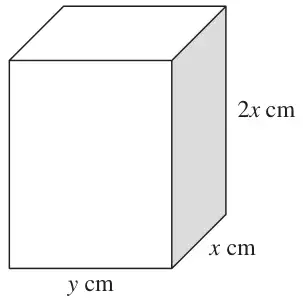
Figure 4 shows a solid brick in the shape of a cuboid measuring \(2x\) cm by \(x\) cm by \(y\) cm.
The total surface area of the brick is \(600\ \mathrm{cm}^2\).
Given that \(x\) can vary,
| Scheme | Marks |
|---|---|
| \(4x^2 + 6xy = 600\) | M1 A1 |
| \(V = 2x^2y = 2x^2\left(\dfrac{600 - 4x^2}{6x}\right) \qquad V = 200x - \dfrac{4x^3}{3}\) (*) | M1 A1cso |
| (4) |
Notes
1st M: Attempting an expression in terms of \(x\) and \(y\) for the total surface area (the expression should be dimensionally correct).
1st A: Correct expression (not necessarily simplified), equated to 600.
2nd M: Substituting their \(y\) into \(2x^2y\) to form an expression in terms of \(x\) only.
(Or substituting \(y\) from \(2x^2y\) into their area equation).
| Scheme | Marks |
|---|---|
| \(\dfrac{\mathrm{d}V}{\mathrm{d}x} = 200 - 4x^2\) | B1 |
| Equate their \(\dfrac{\mathrm{d}V}{\mathrm{d}x}\) to 0 and solve for \(x^2\) or \(x\): \(\;x^2 = 50\) or \(x = \sqrt{50}\) (7.07…) | M1 A1 |
| Evaluate \(V\): \(V = 200(\sqrt{50}) - \dfrac{4}{3}(50\sqrt{50}) = 943\ \mathrm{cm}^3\) Allow awrt | M1 A1 |
| (5) |
Notes
1st A: Ignore \(x = -\sqrt{50}\), if seen.
The 2nd M mark (for substituting their \(x\) value into the given expression for \(V\)) is dependent on the 1st M.
Final A: Allow also exact value \(\dfrac{400\sqrt{50}}{3}\) or \(\dfrac{2000\sqrt{2}}{3}\) or equiv. single term.
| Scheme | Marks |
|---|---|
| \(\dfrac{\mathrm{d}^2V}{\mathrm{d}x^2} = -8x\) Negative, \(\therefore\) Maximum | M1, A1ft |
| (2) | |
| 11 |
Notes
Allow marks if the work for (c) is seen in (b) (or vice-versa).
M: Find second derivative and consider its sign.
A: Second derivative following through correctly from their \(\dfrac{\mathrm{d}V}{\mathrm{d}x}\), and correct reason/conclusion (it must be a maximum, not a minimum).
An actual value of \(x\) does not have to be used… this mark can still be awarded if no \(x\) value has been found or if a wrong \(x\) value is used.
Alternative:
M: Find value of \(\dfrac{\mathrm{d}V}{\mathrm{d}x}\) on each side of “\(x = \sqrt{50}\)” and consider sign.
A: Indicate sign change of positive to negative for \(\dfrac{\mathrm{d}V}{\mathrm{d}x}\), and conclude max.
Alternative:
M: Find value of \(V\) on each side of “\(x = \sqrt{50}\)” and compare with “943”.
A: Indicate that both values are less than 943, and conclude max.