
C2 January 2007 Q8
8. A diesel lorry is driven from Birmingham to Bury at a steady speed of \(v\) kilometres per hour. The total cost of the journey, £\(C\), is given by\[C = \frac{1400}{v} + \frac{2v}{7}.\]
| Scheme | Marks |
|---|---|
| \(\dfrac{\mathrm{d}C}{\mathrm{d}v} = -1400v^{-2} + \dfrac{2}{7}\) | M1, A1 |
| \(-1400v^{-2} + \dfrac{2}{7} = 0\) | M1 |
| \(v^2 = 4900\) | dM1 |
| \(v = 70\) | A1cso |
| (5) |
Notes
M1: Attempt to differentiate \(v^n \to v^{n-1}\). Must be seen and marked in part (a) not part (b).
Must be differentiating a function of the form \(av^{-1} + bv\).
A1: o.e.
(\(-1400v^{-2} + \dfrac{2}{7} + c\) is A0)
M1: Their \(\dfrac{\mathrm{d}C}{\mathrm{d}v} = 0\). Can be implied by their \(\dfrac{\mathrm{d}C}{\mathrm{d}v} = P + Q \ \to\ P = \pm Q\).
dM1: Dependent on both of the previous Ms.
Attempt to rearrange their \(\dfrac{\mathrm{d}C}{\mathrm{d}v}\) into the form \(v^n = \text{number}\) or \(v^n - \text{number} = 0,\ n \neq 0\).
A1cso: \(v = 70\) cso but allow \(v = \pm 70\). \(v = 70\) km per h also acceptable.
Answer only is 0 out of 5.
Method of completing the square: send to review.
8(a) Trial and improvement
| \(\mathrm{f}(v) = \dfrac{1400}{v} + \dfrac{2v}{7}\) Attempts to evaluate \(\mathrm{f}(v)\) for 3 values \(a, b, c\) where (i) \(a \lt 70,\ b = 70\) and \(c \gt 70\) or (ii) \(a, b \lt 70\) and \(c \gt 70\) or (iii) \(a \lt 70\) and \(b, c \gt 70\). | M1 |
| All 3 correct and states \(v = 70\) (exact) | A1 |
| Then 2nd M0, 3rd M0, 2nd A0. |
8(a) Graph
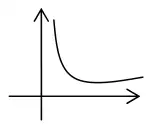 Correct shape (ignore anything drawn for \(v \lt 0\)). | M1 |
| \(v = 70\) (exact) | A1 |
| Then 2nd M0, 3rd M0, 2nd A0. |
| Scheme | Marks |
|---|---|
| \(\dfrac{\mathrm{d}^2C}{\mathrm{d}v^2} = 2800v^{-3}\) | M1 |
| \(v = 70,\ \dfrac{\mathrm{d}^2C}{\mathrm{d}v^2} \gt 0\) \(\{\Rightarrow \text{minimum}\}\) or \(v = 70,\ \dfrac{\mathrm{d}^2C}{\mathrm{d}v^2} = 2800\times 70^{-3}\) \(\left\{= \dfrac{2}{245} = 0.00816...\right\}\) \(\{\Rightarrow \text{minimum}\}\) | A1ft |
| (2) |
Notes
M1: Attempt to differentiate their \(\dfrac{\mathrm{d}C}{\mathrm{d}v}\); \(v^n \to v^{n-1}\) (including \(v^0 \to 0\)).
A1ft: \(\dfrac{\mathrm{d}^2C}{\mathrm{d}v^2}\) must be correct. Ft only from their value of \(v\) and provided their value of \(v\) is +ve.
Must be some (minimal) indication that their value of \(v\) is being used.
Statement: “When \(v =\) their value of \(v\), \(\dfrac{\mathrm{d}^2C}{\mathrm{d}v^2} \gt 0\)” is sufficient provided \(2800v^{-3} \gt 0\) for their value of \(v\).
If substitution of their \(v\) seen: correct substitution of their \(v\) into \(2800v^{-3}\), but, provided evaluation is +ve, ignore incorrect evaluation.
N.B. Parts in mark scheme in { } do not need to be seen.
Examples 8(b)
| \(\dfrac{\mathrm{d}^2C}{\mathrm{d}v^2} = 2800v^{-3}\) \(v = 70,\ \dfrac{\mathrm{d}^2C}{\mathrm{d}v^2} \gt 0\) | M1 A1 |
| \(\dfrac{\mathrm{d}^2C}{\mathrm{d}v^2} = 2800v^{-3}\) \(\gt 0\) | M1 A0 (no indication that a value of \(v\) is being used) |
| Answer from (a): \(v = 30\) \(\dfrac{\mathrm{d}^2C}{\mathrm{d}v^2} = 2800v^{-3}\) \(v = 30,\ \dfrac{\mathrm{d}^2C}{\mathrm{d}v^2} \gt 0\) | M1 A1ft |
| \(\dfrac{\mathrm{d}^2C}{\mathrm{d}v^2} = 2800v^{-3}\) \(v = 70,\ \dfrac{\mathrm{d}^2C}{\mathrm{d}v^2} = 2800\times 70^{-3}\) \(= 8.16\) | M1 A1 (correct substitution of 70 seen, evaluation wrong but positive) |
| \(\dfrac{\mathrm{d}^2C}{\mathrm{d}v^2} = 2800v^{-3}\) \(v = 70,\ \dfrac{\mathrm{d}^2C}{\mathrm{d}v^2} = 0.00408\) | M1 A0 (correct substitution of 70 not seen) |
| Scheme | Marks |
|---|---|
| \(v = 70,\ C = \dfrac{1400}{70} + \dfrac{2\times 70}{7}\) | M1 |
| \(C = 40\) | A1 |
| (2) | |
| (9) |
Notes
M1: Substitute their value of \(v\) that they think will give \(C_{\min}\) (independent of the method of obtaining this value of \(v\) and independent of which part of the question it comes from).
A1: 40 or £40
Must have part (a) completely correct (i.e. all 5 marks) to gain this A1.
Answer only gains M1A1 provided part (a) is completely correct..