
C2 June 2005 Q10
10.
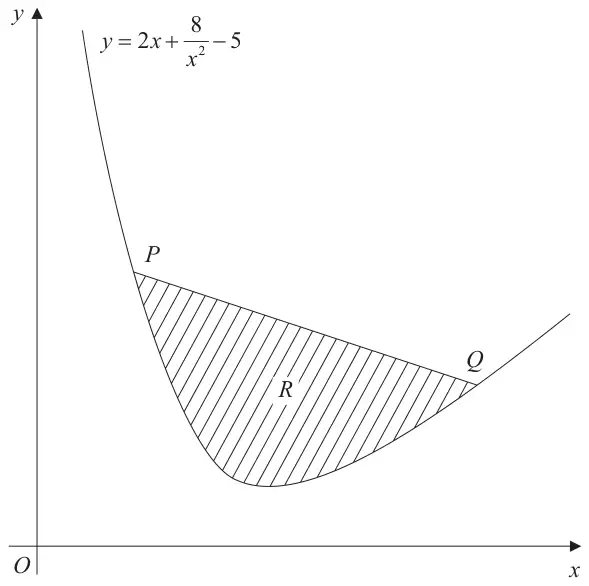
Figure 1 shows part of the curve \(C\) with equation \(y = 2x + \dfrac{8}{x^2} - 5,\ x \gt 0\).
The points \(P\) and \(Q\) lie on \(C\) and have \(x\)-coordinates 1 and 4 respectively. The region \(R\), shaded in Figure 1, is bounded by \(C\) and the straight line joining \(P\) and \(Q\).
| Scheme | Marks |
|---|---|
| \(\displaystyle\int\left(2x + 8x^{-2} - 5\right)\mathrm{d}x = x^2 + \frac{8x^{-1}}{-1} - 5x\) | M1 A1 A1 |
| \(\left[x^2 + \dfrac{8x^{-1}}{-1} - 5x\right]_1^4 = (16 - 2 - 20) - (1 - 8 - 5)\) \((= 6)\) | M1 |
| \(x = 1:\ y = 5\) and \(x = 4:\ y = 3.5\) | B1 |
| Area of trapezium \(= \dfrac{1}{2}(5 + 3.5)(4 - 1) \quad (= 12.75)\) | M1 |
| Shaded area \(= 12.75 - 6 = 6.75\) (M: Subtract either way round) | M1 A1 |
| (8) |
Notes
Integration: One term wrong M1 A1 A0; two terms wrong M1 A0 A0.
Limits: M1 for substituting limits 4 and 1 into a changed function, and subtracting the right way round.
Alternative
| \(x = 1:\ y = 5\) and \(x = 4:\ y = 3.5\) | B1 |
| Equation of line: \(y - 5 = -\dfrac{1}{2}(x - 1) \qquad y = \dfrac{11}{2} - \dfrac{1}{2}x\), subsequently used in integration with limits. | 3rd M1 |
| \(\left(\dfrac{11}{2} - \dfrac{1}{2}x\right) - \left(2x + \dfrac{8}{x^2} - 5\right)\) (M: Subtract either way round) | 4th M1 |
| \(\displaystyle\int\left(\frac{21}{2} - \frac{5x}{2} - 8x^{-2}\right)\mathrm{d}x = \frac{21x}{2} - \frac{5x^2}{4} - \frac{8x^{-1}}{-1}\) (Penalise integration mistakes, not algebra for the ft marks) | 1st M1 A1ft A1ft |
| \(\left[\dfrac{21x}{2} - \dfrac{5x^2}{4} - \dfrac{8x^{-1}}{-1}\right]_1^4 = (42 - 20 + 2) - \left(\dfrac{21}{2} - \dfrac{5}{4} + 8\right)\) (M: Right way round) | 2nd M1 |
| Shaded area \(= 6.75\) | A1 |
(The follow through marks are for the subtracted version, and again deduct an accuracy mark for a wrong term: One wrong M1 A1 A0; two wrong M1 A0 A0.)
| Scheme | Marks |
|---|---|
| \(\dfrac{\mathrm{d}y}{\mathrm{d}x} = 2 - 16x^{-3}\) | M1 A1 |
| (Increasing where) \(\dfrac{\mathrm{d}y}{\mathrm{d}x} \gt 0\); For \(x \gt 2,\ \dfrac{16}{x^3} \lt 2,\ \therefore \dfrac{\mathrm{d}y}{\mathrm{d}x} \gt 0\) (Allow \(\geqslant\)) | dM1; A1 |
| (4) | |
| (12 marks) |
Notes
Alternative for the last 2 marks in (b):
M1: Show that \(x = 2\) is a minimum, using, e.g., 2nd derivative.
A1: Conclusion showing understanding of “increasing”, with accurate working.