
C2 January 2005 Q9
9.
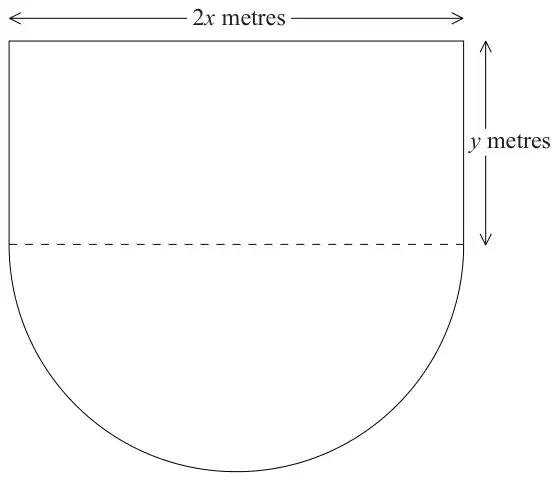
Figure 3 shows the plan of a stage in the shape of a rectangle joined to a semicircle. The length of the rectangular part is \(2x\) metres and the width is \(y\) metres. The diameter of the semicircular part is \(2x\) metres. The perimeter of the stage is 80 m.
(a) Show that the area, \(A\) m2, of the stage is given by\[A = 80x - \left(2 + \frac{\pi}{2}\right)x^2.\] (4)
(b) Use calculus to find the value of \(x\) at which \(A\) has a stationary value. (4)
(c) Prove that the value of \(x\) you found in part (b) gives the maximum value of \(A\). (2)
(d) Calculate, to the nearest m2, the maximum area of the stage. (2)
| Scheme | Marks |
|---|---|
| Perimeter \(\Rightarrow 2x + 2y + \pi x = 80\) | B1 |
| Area \(\to A = 2xy + \dfrac{1}{2}\pi x^2\) | B1 |
| \(y = \dfrac{80 - 2x - \pi x}{2}\) and sub in to \(A\) | M1 |
| \(\Rightarrow A = 80x - 2x^2 - \pi x^2 + \dfrac{1}{2}\pi x^2\) | |
| i.e. \(A = 80x - \left(2 + \dfrac{\pi}{2}\right)x^2\ *\) | A1 c.s.o |
| (4) |
| Scheme | Marks |
|---|---|
| \(\dfrac{dA}{dx} = 80 - 2\left(2 + \dfrac{\pi}{2}\right)x\) | M1, A1 |
| \(\dfrac{dA}{dx} = 0 \Rightarrow 40 = \left(2 + \dfrac{\pi}{2}\right)x\) so \(x =, \dfrac{40}{2 + \frac{\pi}{2}}\) or \(\dfrac{80}{4 + \pi}\) or Awrt 11.2 | M1, A1 |
| (4) |
Notes
2nd M1 for putting \(\dfrac{dA}{dx} = 0\) and attempting \(x = \cdots\)
| Scheme | Marks |
|---|---|
| \(\dfrac{d^2A}{dx^2} = -4 - \pi\) | M1 |
| \(\lt 0 \quad \therefore A\) is Max | A1 |
| (2) |
Notes
M1 for attempting \(\dfrac{d^2A}{dx^2}\) (or equivalent method)
A1 for a correct second derivative, \(\lt 0\) and comment
| Scheme | Marks |
|---|---|
| Max Area \(= 80(b) - \left(2 + \dfrac{\pi}{2}\right)(b)^2\) | M1 |
| \(= \underline{448\ (m^2)}\) | A1 cao |
| (2) | |
| (12 marks) |