
C1 June 2014 (R) Q11
11.
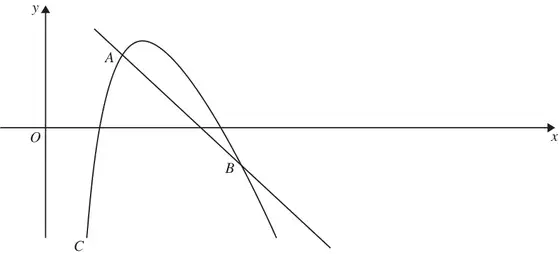
A sketch of part of the curve \(C\) with equation\[y = 20 - 4x - \frac{18}{x}, \qquad x > 0\]is shown in Figure 3.
Point \(A\) lies on \(C\) and has an \(x\) coordinate equal to 2
The normal to \(C\) at \(A\) meets \(C\) again at the point \(B\), as shown in Figure 3.
| Scheme | Marks |
|---|---|
| Substitutes \(x = 2\) into \(y = 20 - 4\times 2 - \tfrac{18}{2}\) and gets 3 | B1 |
| \(\dfrac{\mathrm{d}y}{\mathrm{d}x} = -4 + \dfrac{18}{x^2}\) | M1 A1 |
| Substitute \(x = 2 \Rightarrow \dfrac{\mathrm{d}y}{\mathrm{d}x} = \left(\dfrac{1}{2}\right)\) then finds negative reciprocal \((-2)\) | dM1 |
| Method 1: States or uses \(y - 3 = -2(x - 2)\) or \(y = -2x + c\) with their \((2, 3)\) Method 2: Or: Check that \((2, 3)\) lies on the line \(y = -2x + 7\) | dM1 |
| Method 1: to deduce that \(y = -2x + 7\) * Method 2: Deduce equation of normal as it has the same gradient and passes through a common point | A1* |
| (6) |
Notes
B1: Substitutes \(x = 2\) into expression for \(y\) and gets 3 cao (must be in part (a) and must use curve equation – not line equation) This must be seen to be substituted.
M1: For an attempt to differentiate the negative power with \(x^{-1} \to x^{-2}\).
A1: Correct expression for \(\dfrac{\mathrm{d}y}{\mathrm{d}x} = -4 + \dfrac{18}{x^2}\), accept equivalents
dM1: Dependent on first M1 Substitutes \(x = 2\) into their derivative to obtain a numerical gradient and find negative reciprocal or states that \(-2\times\tfrac{1}{2} = -1\)
(Method 1)
dM1: Dependent on first M1 Finds equation of line using changed gradient (not their ½ but -1/2, 2 or -2)
e.g. \(y - \text{"}3\text{"} = -\text{"}2\text{"}(x - 2)\) or \(y =\) “-2”\(x + c\) and use of (2, “3”) to find \(c =\)
A1*: CSO. This is a given answer \(y = -2x + 7\) obtained with no errors seen and equation should be stated
(Method 2)- checking given answer
dM1: Uses given equation of line and checks that \((2, 3)\) lies on the line
A1*: CSO. This is a given answer \(y = -2x + 7\) so statement that normal and line have the same gradient and pass through the same point must be stated
| Scheme | Marks |
|---|---|
| Put \(20 - 4x - \dfrac{18}{x} = -2x + 7\) and simplify to give \(2x^2 - 13x + 18 = 0\) Or put \(y = 20 - 4\left(\dfrac{7 - y}{2}\right) - \dfrac{18}{\left(\dfrac{7 - y}{2}\right)}\) to give \(y^2 - y - 6 = 0\) | M1 A1 |
| \((2x - 9)(x - 2) = 0\) so \(x =\) or \((y - 3)(y + 2) = 0\) so \(y =\) | dM1 |
| \(x = \dfrac{9}{2},\ y = -2\) | A1, A1 |
| (5) | |
| (11 marks) |
Notes
M1: Equate the two given expressions, collect terms and simplify to a 3TQ. There may be sign errors when collecting terms But putting for example \(20x - 4x^2 - 18 = -2x + 7\) is M0 here
A1: Correct 3TQ = 0 (need = 0 for A mark) \(2x^2 - 13x + 18 = 0\)
dM1: Attempt to solve an appropriate quadratic by factorisation, use of formula, or completion of the square (see general instructions).
A1: \(x = \dfrac{9}{2}\) oe or \(y = -2\) (allow second answers for this mark so ignore \(x = 2\) or \(y = 3\))
A1: Correct solution only so both \(x = \dfrac{9}{2},\ y = -2\) or \(\left(\dfrac{9}{2}, -2\right)\)
If \(x = 2\), \(y = 3\) is included as an answer and point \(B\) is not identified then last mark is A0
Answer only – with no working – send to review. The question stated “use algebra”