
C1 June 2014 Q9
9.
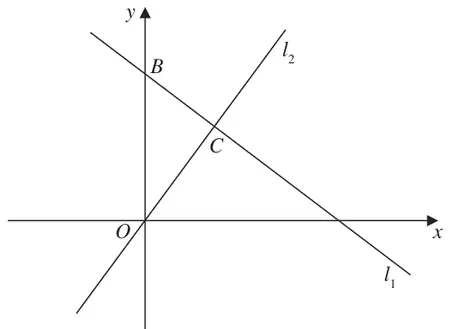
The line \(l_1\), shown in Figure 2 has equation \(2x + 3y = 26\)
The line \(l_2\) passes through the origin \(O\) and is perpendicular to \(l_1\)
The line \(l_2\) intersects the line \(l_1\) at the point \(C\).
Line \(l_1\) crosses the \(y\)-axis at the point \(B\) as shown in Figure 2.
Give your answer in the form \(\dfrac{a}{b}\), where \(a\) and \(b\) are integers to be determined. (6)
| Scheme | Marks |
|---|---|
| \(2x + 3y = 26 \Rightarrow 3y = 26 \pm 2x\) and attempt to find \(m\) from \(y = mx + c\) | M1 |
| \(\left(\Rightarrow y = \dfrac{26}{3} - \dfrac{2}{3}x\right)\) so gradient \(= -\dfrac{2}{3}\) | A1 |
| Gradient of perpendicular \(= \dfrac{-1}{\text{their gradient}}\) \(\left(= \dfrac{3}{2}\right)\) | M1 |
| Line goes through \((0,0)\) so \(y = \dfrac{3}{2}x\) | A1 |
| (4) |
Notes
M1: Complete method for finding gradient. (This may be implied by later correct answers.)
e.g. Rearranges \(2x + 3y = 26 \Rightarrow y = mx + c\) so \(m =\)
Or finds coordinates of two points on line and finds gradient e.g. \((13, 0)\) and \((1, 8)\) so \(m = \dfrac{8 - 0}{1 - 13}\)
A1: States or implies that gradient \(= -\dfrac{2}{3}\) – condone \(-\dfrac{2}{3}x\) if they continue correctly. Ignore errors in constant term in straight line equation
M1: Uses \(m_1\times m_2 = -1\) to find the gradient of \(l_2\). This can be implied by the use of \(\dfrac{-1}{\text{their gradient}}\)
A1: \(y = \dfrac{3}{2}x\) or \(2y - 3x = 0\) Allow \(y = \dfrac{3}{2}x + 0\) Also accept \(2y = 3x\), \(y = 39/26x\) or even \(y - 0 = \dfrac{3}{2}(x - 0)\) and isw
| Scheme | Marks |
|---|---|
| Solves their \(y = \dfrac{3}{2}x\) with their \(2x + 3y = 26\) to form equation in \(x\) or in \(y\) | M1 |
| Solves their equation in \(x\) or in \(y\) to obtain \(x =\) or \(y =\) | dM1 |
| \(x = 4\) or any equivalent e.g. 156/39 or \(y = 6\) o.a.e | A1 |
| \(B = \left(0, \dfrac{26}{3}\right)\) used or stated in (b) | B1 |
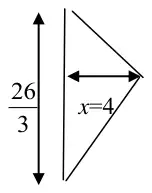 Area \(= \dfrac{1}{2}\times\text{"}4\text{"}\times\dfrac{\text{"}26\text{"}}{3}\) | dM1 |
| \(= \dfrac{52}{3}\) (oe with integer numerator and denominator) | A1 |
| (6) | |
| (10 marks) |
Notes
M1: Eliminates variable between their \(y = \dfrac{3}{2}x\) and their (possibly rearranged) \(2x + 3y = 26\) to form an equation in \(x\) or \(y\). (They may have made errors in their rearrangement)
dM1: (Depends on previous M mark) Attempts to solve their equation to find the value of \(x\) or \(y\)
A1: \(x = 4\) or equivalent or \(y = 6\) or equivalent
B1: \(y\) coordinate of \(B\) is \(\dfrac{26}{3}\) (stated or implied) – isw if written as \(\left(\dfrac{26}{3}, 0\right)\). Must be used or stated in (b)
dM1: (Depends on previous M mark) Complete method to find area of triangle \(OBC\) (using their values of \(x\) and/or \(y\) at point \(C\) and their 26/3)
A1: Cao \(\dfrac{52}{3}\) or \(\dfrac{104}{6}\) or \(\dfrac{1352}{78}\) o.e
Method 1:
Uses the area of a triangle formula \(\tfrac{1}{2}\times OB\times(x\text{ coordinate of }C)\)
Alternative methods: Several Methods are shown below. The only mark which differs from Method 1 is the last M mark and its use in each case is described below:
Method 2 in 9(b) using \(\dfrac{1}{2}\times BC\times OC\)
dM1 Uses the area of a triangle formula \(\tfrac{1}{2}\times BC\times OC\) Also finds OC \(\left(= \sqrt{52}\right)\) and BC= \(\left(\dfrac{4}{3}\sqrt{13}\right)\)
Method 3 in 9(b) using \(\dfrac{1}{2}\begin{vmatrix} 0 & 4 & 0 & 0 \\ 0 & 6 & \frac{26}{3} & 0 \end{vmatrix}\)
dM1 States the area of a triangle formula \(\dfrac{1}{2}\begin{vmatrix} 0 & 4 & 0 & 0 \\ 0 & 6 & \frac{26}{3} & 0 \end{vmatrix}\) or equivalent with their values
Method 4 in 9(b) using area of triangle \(OBX\) – area of triangle \(OCX\) where \(X\) is point \((13, 0)\)
dM1 Uses the correct subtraction \(\dfrac{1}{2}\times 13\times\text{"}\dfrac{26}{3}\text{"} - \dfrac{1}{2}\times 13\times\text{"}6\text{"}\)
Method 5 in 9(b) using area = ½ (6 × 4) + ½ (4 × 8/3) drawing a line from C parallel to the \(x\) axis and dividing triangle into two right angled triangles
dM1 for correct method area = ½ (“6” × “4”) + ½ (“4” × [“26/3”-“6”])
Method 6 Uses calculus
dM1 \(\displaystyle\int_0^4 \text{"}\frac{26}{3}\text{"} - \frac{2x}{3} - \frac{3x}{2}\,\mathrm{d}x = \left[\frac{26}{3}x - \frac{x^2}{3} - \frac{3x^2}{4}\right]_0^4\)