
C1 January 2012 Q5
5. The curve \(C\) has equation \(y = x(5 - x)\) and the line \(L\) has equation \(2y = 5x + 4\)
| Scheme | Marks |
|---|---|
| \(x(5 - x) = \dfrac{1}{2}(5x + 4)\) (o.e.) | M1 |
| \(2x^2 - 5x + 4\,(= 0)\) (o.e.) e.g. \(x^2 - 2.5x + 2\,(= 0)\) | A1 |
| \(b^2 - 4ac = (-5)^2 - 4\times 2\times 4\) | M1 |
| \(= 25 - 32 \quad < 0\), so no roots or no intersections or no solutions | A1 |
| (4) |
Notes
1st M1: for forming a suitable equation in one variable
1st A1: for a correct 3TQ equation. Allow missing “\(= 0\)” Accept \(2x^2 + 4 = 5x\) etc
2nd M1: for an attempt to evaluate discriminant for their 3TQ. Allow for \(b^2 > 4ac\) or \(b^2 < 4ac\)
Allow if it is part of a solution using the formula e.g. \((x =)\dfrac{5 \pm \sqrt{25 - 32}}{4}\)
Correct formula quoted and some correct substitution or a correct expression
False factorising is M0
2nd A1: for correct evaluation of discriminant for a correct 3TQ e.g. 25 – 32 (or better) and a comment indicating no roots or equivalent. For contradictory statements score A0
ALT
2nd M1: for attempt at completing the square \(a\left[\left(x \pm \tfrac{b}{2a}\right)^2 - q\right] + c\)
2nd A1: for \(\left(x - \tfrac{5}{4}\right)^2 = -\dfrac{7}{16}\) and a suitable comment
| Scheme | Marks |
|---|---|
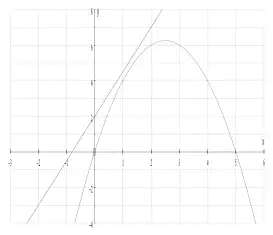
| Curve: \(\cap\) shape and passing through \((0, 0)\) | B1 |
| \(\phantom{\text{Curve: }}\cap\) shape and passing through \((5, 0)\) | B1 |
| Line: \(+\)ve gradient and no intersections with \(C\). If no \(C\) drawn score B0 | B1 |
| Line passing through \((0, 2)\) and \((-0.8, 0)\) marked on axes | B1 |
| (4) | |
| (8 marks) |
Notes
Coordinates must be seen on the diagram. Do not award if only in the body of the script.“Passing through” means not stopping at and not touching.
Allow \((0, x)\) and \((y, 0)\) if marked on the correct places on the correct axis.
1st B1: for correct shape and passing through origin. Can be assumed if it passes through the intersection of axes
2nd B1: for correct shape and 5 marked on \(x\)-axis
SC: for \(\cap\) shape stopping at both \((5, 0)\) and \((0, 0)\) award B0B1
3rd B1: for a line of positive gradient that (if extended) has no intersection with their \(C\) (possibly extended). Must have both graphs on same axes for this mark. If no \(C\) given score B0
4th B1: for straight line passing through \(-0.8\) on \(x\)-axis and 2 on \(y\)-axis
Accept exact fraction equivalents to \(-0.8\) or 2(e.g. \(\tfrac{4}{2}\))