
C1 January 2010 Q10
10.\[\mathrm{f}(x) = x^2 + 4kx + (3 + 11k), \qquad \text{where } k \text{ is a constant.}\]
Given that the equation \(\mathrm{f}(x) = 0\) has no real roots,
Given that \(k = 1\),
| Scheme | Marks |
|---|---|
| \((x + 2k)^2\) or \(\left(x + \dfrac{4k}{2}\right)^2\) | M1 |
| \((x \pm F)^2 \pm G \pm 3 \pm 11k\) (where \(F\) and \(G\) are any functions of \(k\), not involving \(x\)) | M1 |
| \((x + 2k)^2 - 4k^2 + (3 + 11k)\) Accept unsimplified equivalents such as \(\left(x + \dfrac{4k}{2}\right)^2 - \left(\dfrac{4k}{2}\right)^2 + 3 + 11k\), and i.s.w. if necessary. | A1 |
| (3) |
| Scheme | Marks |
|---|---|
| Accept part (b) solutions seen in part (a). | |
| “\(4k^2 - 11k - 3\)” \(= 0 \qquad (4k + 1)(k - 3) = 0 \qquad k = \ldots,\) [Or, ‘starting again’, \(b^2 - 4ac = (4k)^2 - 4(3 + 11k)\) and proceed to \(k = \ldots\)] | M1 |
| \(-\dfrac{1}{4}\) and 3 (Ignore any inequalities for the first 2 marks in (b)). | A1 |
| Using \(b^2 - 4ac < 0\) for no real roots, i.e. “\(4k^2 - 11k - 3\)” \(< 0\), to establish inequalities involving their two critical values \(m\) and \(n\) (even if the inequalities are wrong, e.g. \(k < m,\ k < n\)). | M1 |
| \(-\dfrac{1}{4} < k < 3\) (See conditions below) Follow through their critical values. The final A1ft is still scored if the answer \(m < k < n\) follows \(k < m,\ k < n\). Using \(x\) instead of \(k\) in the final answer loses only the 2nd A mark, (condone use of \(x\) in earlier working). | A1ft |
| (4) |
Notes
1st M: Forming and solving a 3-term quadratic in \(k\) (usual rules.. see general principles at end of scheme). The quadratic must come from “\(b^2 - 4ac\)”, or from the “\(q\)” in part (a).
Using wrong discriminant, e.g. “\(b^2 + 4ac\)” will score no marks in part (b).
2nd M: As defined in main scheme above.
2nd A1ft: \(m < k < n\), where \(m < n\), for their critical values \(m\) and \(n\).
Other possible forms of the answer (in each case \(m < n\)):
(i) \(n > k > m\)
(ii) \(k > m\) and \(k < n\)
In this case the word “and” must be seen (implying intersection).
(iii) \(k \in (m, n)\) (iv) \(\{k : k > m\} \cap \{k : k < n\}\)
Not just a number line.
Not just \(k > m,\ k < n\) (without the word “and”).
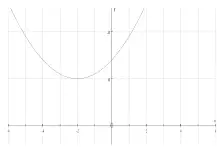
| Scheme | Marks |
|---|---|
Shape  (seen in (c)) | B1 |
| Minimum in correct quadrant, not touching the \(x\)-axis, not on the \(y\)-axis, and there must be no other minimum or maximum. | B1 |
| \((0, 14)\) or 14 on \(y\)-axis. Allow \((14, 0)\) marked on \(y\)-axis. | B1 |
| n.b. Minimum is at \((-2, 10)\), (but there is no mark for this). | |
| (3) | |
| (10 marks) |
Notes
Final B1 is dependent upon a sketch having been attempted in part (c).