
C1 January 2008 Q10
10. The curve \(C\) has equation\[y = (x + 3)(x - 1)^2.\]
There are two points on \(C\) where the gradient of the tangent to \(C\) is equal to 3.
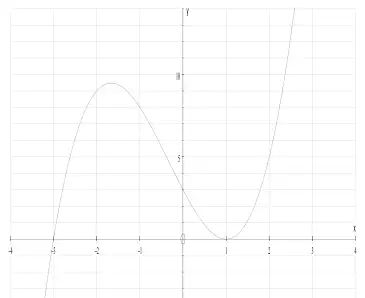
| Scheme | Marks |
|---|---|
Shape  | B1 |
| Minimum at (1, 0) (perhaps labelled 1 on \(x\)-axis) | B1 |
| \((-3, 0)\) (or \(-3\) shown on −ve \(x\)-axis) | B1 |
| \((0, 3)\) (or 3 shown on +ve \(y\)-axis) | B1 |
| N.B. The max. can be anywhere. | |
| (4) |
Notes
The individual marks are independent, but the 2nd, 3rd and 4th B’s are dependent upon a sketch having been attempted.
B marks for coordinates: Allow (0, 1), etc. (coordinates the wrong way round) if marked in the correct place on the sketch.
| Scheme | Marks |
|---|---|
| \(y = (x + 3)\left(x^2 - 2x + 1\right)\) [Marks can be awarded if this is seen in part (a)] | M1 |
| \(= x^3 + x^2 - 5x + 3 \qquad (k = 3)\) | A1cso |
| (2) |
Notes
M: Attempt to multiply out \((x - 1)^2\) and write as a product with \((x + 3)\), or attempt to multiply out \((x + 3)(x - 1)\) and write as a product with \((x - 1)\), or attempt to expand \((x + 3)(x - 1)(x - 1)\) directly (at least 7 terms).
The \((x - 1)^2\) or \((x + 3)(x - 1)\) expansion must have 3 (or 4) terms, so should not, for example, be just \(x^2 + 1\).
A: It is not necessary to state explicitly ‘\(k = 3\)’.
Condone missing brackets if the intention seems clear and a fully correct expansion is seen.
| Scheme | Marks |
|---|---|
| \(\dfrac{\mathrm{d}y}{\mathrm{d}x} = 3x^2 + 2x - 5\) | M1 A1 |
| \(3x^2 + 2x - 5 = 3\) or \(3x^2 + 2x - 8 = 0\) | M1 |
| \((3x - 4)(x + 2) = 0 \qquad x = \ldots\) | M1 |
| \(x = \dfrac{4}{3}\) (or exact equiv.) , \(x = -2\) | A1, A1 |
| (6) | |
| (12 marks) |
Notes
1st M: Attempt to differentiate (correct power of \(x\) in at least one term).
2nd M: Setting their derivative equal to 3.
3rd M: Attempt to solve a 3-term quadratic based on their derivative.
The equation could come from \(\dfrac{\mathrm{d}y}{\mathrm{d}x} = 0\).
N.B. After an incorrect \(k\) value in (b), full marks are still possible in (c).