
C1 January 2007 Q3
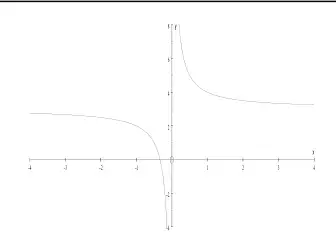
3. Given that\[\mathrm{f}(x) = \frac{1}{x}, \qquad x \neq 0,\]
| Scheme | Marks |
|---|---|
| Shape of \(\mathrm{f}(x)\) | B1 |
| Moved up \(\uparrow\) | M1 |
| Asymptotes: \(y = 3\) | B1 |
| \(x = 0\) (Allow “\(y\)-axis”) | B1 |
| (\(y \neq 3\) is B0, \(x \neq 0\) is B0). | |
| (4) |
Notes
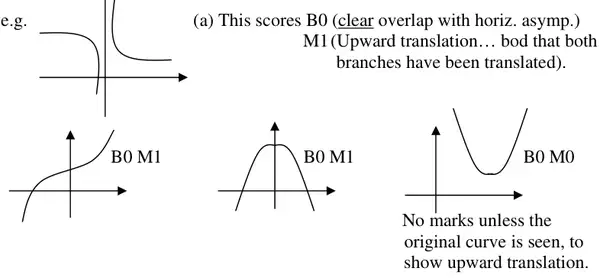
B1: Shape requires both branches and no obvious “overlap” with the asymptotes (see below), but otherwise this mark is awarded generously. The curve may, e.g., bend away from the asymptote a little at the end. Sufficient curve must be seen to suggest the asymptotic behaviour, both horizontal and vertical.
M1: Evidence of an upward translation parallel to the \(y\)-axis. The shape of the graph can be wrong, but the complete graph (both branches if they have 2 branches) must be translated upwards. This mark can be awarded generously by implication where the graph drawn is an upward translation of another standard curve (but not a straight line).
The B marks for asymptote equations are independent of the graph.
Ignore extra asymptote equations, if seen.
e.g.
| Scheme | Marks |
|---|---|
| \(\dfrac{1}{x} + 3 = 0\) No variations accepted. | M1 |
| \(x = -\dfrac{1}{3}\) (or \(-0.33\ldots\)) Decimal answer requires at least 2 d.p. | A1 |
| (2) | |
| (6 marks) |
Notes
Correct answer with no working scores both marks.
The answer may be seen on the sketch in part (a).
Ignore any attempts to find an intersection with the \(y\)-axis.