
C1 June 2006 Q9
9. Given that \(\mathrm{f}(x) = (x^2 - 6x)(x - 2) + 3x\),
| Scheme | Marks |
|---|---|
| \(\mathrm{f}(x) = x[(x - 6)(x - 2) + 3]\) or \(x^3 - 6x^2 - 2x^2 + 12x + 3x = x(\) | M1 |
| \(\mathrm{f}(x) = x(x^2 - 8x + 15)\) \(b = -8\) or \(c = 15\) | A1 |
| both and \(a = 1\) | A1 |
| (3) |
Notes
M1 for a correct method to get the factor of \(x\). \(x(\) as printed is the minimum.
1st A1 for \(b = -8\) or \(c = 15\).
\(-8\) comes from \(-6-2\) and must be coefficient of \(x\), and 15 from 6x2+3 and must have no \(x\)s.
2nd A1 for \(a = 1\), \(b = -8\) and \(c = 15\). Must have \(x(x^2 - 8x + 15)\).
| Scheme | Marks |
|---|---|
| \((x^2 - 8x + 15) = (x - 5)(x - 3)\) | M1 |
| \(\mathrm{f}(x) = x(x - 5)(x - 3)\) | A1 |
| (2) |
Notes
M1 for attempt to factorise their 3TQ from part (a).
A1 for all 3 terms correct. They must include the \(x\).
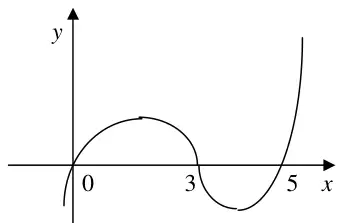
| Scheme | Marks |
|---|---|
| Shape | B1 |
| their 3 or their 5 | B1f.t. |
| both their 3 and their 5 and \((0, 0)\) by implication | B1f.t. |
| (3) | |
| (8 marks) |
Notes
For part (c) they must have at most 2 non-zero roots of their \(\mathrm{f}(x) = 0\) to ft their 3 and their 5.
1st B1 for correct shape (i.e. from bottom left to top right and two turning points.)
2nd B1f.t. for crossing at their 3 or their 5 indicated on graph or in text.
3rd B1f.t. if graph passes through \((0, 0)\) [needn’t be marked] and both their 3 and their 5.