
June 2022 Paper 2 Q12
12
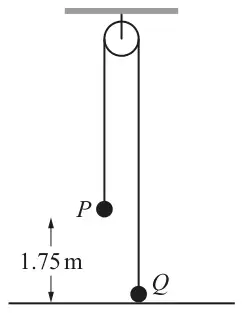
Particles \(P\) and \(Q\), of masses \(4\,\mathrm{kg}\) and \(6\,\mathrm{kg}\) respectively, are attached to the ends of a light inextensible string. The string passes over a smooth fixed pulley. The system is in equilibrium with \(P\) hanging \(1.75\,\mathrm{m}\) above a horizontal plane and \(Q\) resting on the plane. Both parts of the string below the pulley are vertical (see diagram).
The mass of \(P\) is doubled, and the system is released from rest. You may assume that in the subsequent motion \(Q\) does not reach the pulley.
When this motion is observed in practice, it is found that the total distance travelled by \(Q\) between the instant when the system is released and the instant when \(Q\) first comes momentarily to rest is less than the answer calculated in part (c).
| Scheme | Marks | AO |
|---|---|---|
| 19.6 (N) | B1 | 3.4 |
| [1] |
Notes
B1: cao oe \((2g)\)
| Scheme | Marks | AO |
|---|---|---|
| M1* | 3.3 | |
| \(8g - T = 8a\) \(T - 6g = 6a\) | A1 | 1.1 |
| \(a = \dfrac{1}{8}(8g - T) \Rightarrow T - 6g = \dfrac{3}{4}(8g - T)\) \((\Rightarrow 4T - 24g = 24g - 3T)\) | M1dep* | 3.4 |
| Magnitude of force exerted on pulley is \(2T\) | B1 | 3.1b |
| \(T = \dfrac{48}{7}g \Rightarrow F = 134.4\ (\mathrm{N})\) | A1 | 1.1 |
| [5] |
Notes
M1*: Attempt at N2L for either \(P\) or \(Q\) - correct number of terms. M0 if mass includes \(g\)
A1: Correct equations for the motion of \(P\) and \(Q\)
M1dep*: Eliminate \(a\). Or if find \(a\) first then award this mark for an equation involving \(T\) only
B1: Either stated (anywhere in solution) or if 2(their \(T\)) seen
A1: Awrt 134(N)
| Scheme | Marks | AO |
|---|---|---|
| \(a = 1.4\) | B1 | 1.1 |
| \(v^2 = 2(1.4)(1.75)\ \left(\Rightarrow v^2 = 4.9\right)\) | M1* | 3.4 |
| \(0 = \left(\sqrt{4.9}\right)^2 + 2(-9.8)s\ \ (\Rightarrow s = 0.25)\) | M1dep* | 3.4 |
| Total distance travelled by \(Q\) is \(0.25 + 1.75 = 2\ (\mathrm{m})\) | A1 | 3.2a |
| [4] |
Notes
B1: Correct \(a\). \(a = \dfrac{1}{7}g\)
M1*: Using \(v^2 = u^2 + 2as\) with \(u = 0\) to find speed of \(Q\) (or speed squared) after travelling 1.75
M1dep*: Using \(v^2 = u^2 + 2as\) with \(v = 0\) and \(a = \pm g\)
A1: cao. Condone awrt 2.0
| Scheme | Marks | AO |
|---|---|---|
| One factor could be the presence of air resistance | B1 | 3.5a |
| [1] |
Notes
B1: Any correct factor
B0 for ‘use a more accurate value of \(g\)’
If more than one factor given then B1 if all correct. B0 if not.
Friction
String is not light
String is not inextensible
\(P\) and \(Q\) are not particles
Wind speed