
June 2022 Paper 2 Q5
5
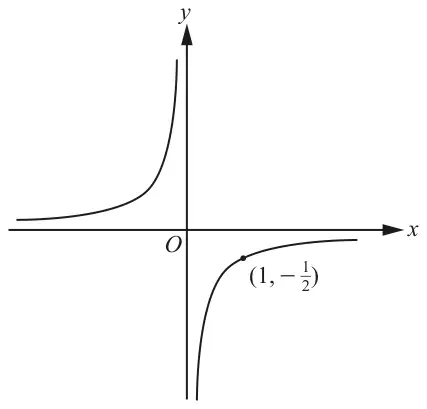
The diagram shows a curve \(C\) for which \(y\) is inversely proportional to \(x\). The curve passes through the point \(\left(1, -\frac{1}{2}\right)\).
State what feature of your sketch in part (a)(ii) corresponds to this. [1]
Find the equation of the curve after it has been translated. [2]
| Scheme | Marks | AO |
|---|---|---|
| (i) \(y = \dfrac{k}{x}\) | M1 | 2.1 |
| The curve passes through the point \(\left(1, -\frac{1}{2}\right)\) so \(k = -\dfrac{1}{2}\) or \(y = -\dfrac{1}{2x}\) | A1 | 1.1 |
| \(y = -\dfrac{1}{2x} \Rightarrow y' = \dfrac{1}{2x^2}\) | A1ft | 1.1 |
| [3] | ||
(ii) 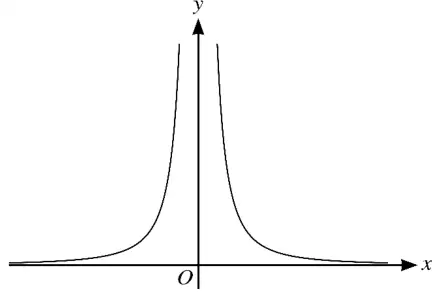 | B1ft | 1.1 |
| [1] |
Notes
(a)(i)
M1: Allow any letter, (except \(x\), \(y\)) or value, for \(k\)
A1: Allow this mark for just \(-\dfrac{1}{2x}\) oe
A1ft: Differentiating their \(\mathrm{f}(x)\) correctly. Need to see their value of \(k\) substituted. Need to see \(y' =\) or \(\mathrm{f}'(x) =\) or \(\dfrac{\mathrm{d}y}{\mathrm{d}x} =\)
(a)(ii)
B1ft: Excellent curve in 1st and 2nd quadrants only:
- Correct shape, symmetrical, not touching axis
- Asymptote clearly the axes
- Not finite
Allow slight movement away from asymptote at one end but not more
Follow through provided their curve is of the form \(y = \dfrac{k}{x^2}\) where \(k \gt 0\)
| Scheme | Marks | AO |
|---|---|---|
| C has no stationary points as indicated by the fact that the curve for the gradient function (seen in part (a)(ii)) does not intersect (or touch) the \(x\)-axis | B1 | 2.4 |
| [1] |
Notes
B1: Curve in 5(a)(ii) must be of the form \(y = \dfrac{k}{x^2}\)
Need to see idea of intersecting, touching, crossing etc \(x\)-axis only
| Scheme | Marks | AO |
|---|---|---|
| M1 | 1.1 | |
| \(y = -\dfrac{1}{2(x + 2)}\) | A1 | 2.2a |
| [2] |
Notes
M1: Their \(y = \mathrm{f}(x)\) with \(x\) replaced by \(x \pm 2\). May be \(y = \dfrac{k}{x}\)
A1: oe (e.g., \(y = -\dfrac{1}{2x + 4}\)). Must have \(y = \ldots\)