
October 2021 Paper 2 Q8
8
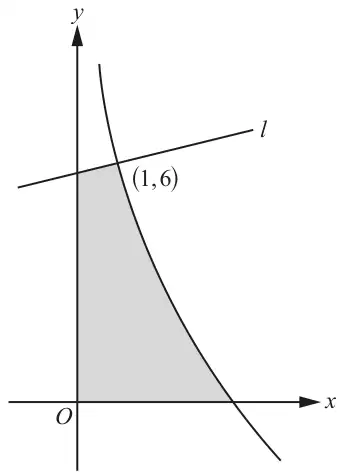
The diagram shows the curve \(y = 1 - x + \dfrac{6}{\sqrt{x}}\) and the line \(l\), which is the normal to the curve at the point \((1, 6)\).
\(ax + by = c\)
where \(a\), \(b\) and \(c\) are integers whose values are to be stated. [5]
Determine the exact area of the shaded region enclosed between \(l\), the curve, the \(x\)-axis and the \(y\)-axis. [5]
| Scheme | Marks | AO |
|---|---|---|
| \(y = 1 - x + \dfrac{6}{\sqrt{x}}\) leading to \(y' = \ldots\) | M1 | 2.1 |
| \(y' = -1 - 3x^{-\frac{3}{2}}\) | A1 | 1.1 |
| At \(x = 1,\ m_T = -4 \Rightarrow m_N = \frac{1}{4}\) | M1* | 1.2 |
| \(y - 6 = \frac{1}{4}(x - 1)\) | M1dep* | 1.1 |
| \(-x + 4y = 23\) | A1 | 1.1 |
| [5] |
Notes
M1: Derivative of the form \(-1 + kx^{-\frac{3}{2}}\)
M1*: Substitutes \(x = 1\) into their derivative and correct use of \(mm' = -1\)
M1dep*: Use of \(y - 6 = m_N(x - 1)\)
A1: oe
| Scheme | Marks | AO |
|---|---|---|
| \(x = 4,\ y = 1 - 4 + \dfrac{6}{\sqrt{4}} = 0\) | B1 | 1.1 |
| [1] |
Notes
B1: AG – must show sufficient working and must see \(= 0\)
| Scheme | Marks | AO |
|---|---|---|
| DR \(\displaystyle\int \left(1 - x + \frac{6}{\sqrt{x}}\right) \mathrm{d}x =\) | M1* | 2.1 |
| \(= x - \dfrac{1}{2}x^2 + 12\sqrt{x}\) | A1 | 1.1 |
| \(\left(4 - \dfrac{1}{2}\left(4^2\right) + 12\sqrt{4}\right) - \left(1 - \dfrac{1}{2} + 12\right) = \ldots\) | M1dep* | 1.1 |
| \(\dfrac{1}{2}\left(\dfrac{23}{4} + 6\right)(1)\) | B1ft | 3.1a |
| \(\dfrac{107}{8}\) | A1 | 2.2a |
| [5] |
Notes
M1*: Attempt to integrate with at least two terms correct
M1dep*: Use of correct limits (1 and 4)
If correct, then expect to see 7.5
B1ft: Any correct numerical expression for the area of the trapezium between \(x = 0\) and \(x = 1\) using their result from (a)
A1: Or exact equivalent (e.g. 13.375)