
June 2024 Paper 1 Q9
9 Two trains are travelling in the same direction on parallel straight tracks and train A overtakes train B. At time \(t\) seconds after the front of train A overtakes the front of train B the velocities of trains A and B are \(v_\text{A}\) \(\text{m s}^{-1}\) and \(v_\text{B}\) \(\text{m s}^{-1}\) respectively.
The velocity of train A is modelled by \(v_\text{A} = 25 - 0.6t\). The velocity-time graph of train A is shown below.
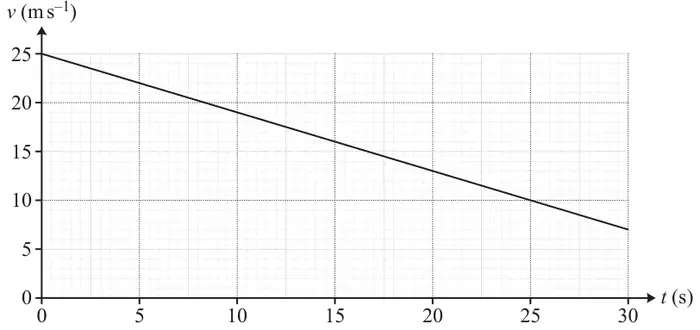
Comment on the validity of the student’s argument. [1]
Write down the equation for \(v_\text{B}\) in terms of \(t\) that models the velocity of train B. [1]
| Scheme | Marks | AO |
|---|---|---|
| The student has found the magnitude of the acceleration and not the actual acceleration which is negative. The argument is not valid. | B1 | 2.3 |
| [1] |
Notes
Must comment of the validity of the argument.
Allow for a comment that student is wrong which includes statement that the acceleration should be negative or similar.
| Scheme | Marks | AO |
|---|---|---|
| \(v_\text{B} = 10 + 0.15t\) | B1 | 3.3 |
| [1] |
Notes
Award if \(v = 10 + 0.15t\) seen
| Scheme | Marks | AO |
|---|---|---|
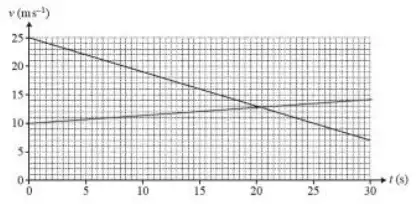 | B1 | 1.1 |
| [1] |
Notes
Line through coordinates (0,10) and (20,13)
FT their linear (b)
| Scheme | Marks | AO |
|---|---|---|
| Same speed when \(25 - 0.6t = 10 + 0.15t\), giving \(t = 20\) | B1 | 3.4 |
| Displacement of train A is 380 m Displacement of train B is 230 m | M1 | 3.4 |
| So distance between them is 150 m | A1 | 1.1 |
| [3] |
Notes
B1: Soi FT their (b)
M1: Attempt to use area or suvat equation(s) to find the displacement of at least one train at their value for \(t\)
A1: cao
Alternative for last 2 marks
| Scheme | Marks | AO |
|---|---|---|
| Area of the triangle between graphs is \(\frac{1}{2} \times (25 - 10) \times 20\) | M1 | |
| So distance between them is 150 m | A1 |
M1: Soi FT their (b)
A1: cao
| Scheme | Marks | AO |
|---|---|---|
| [Velocity is zero at 41.7 s.] For large values of \(t\), the model predicts that the velocity will be negative but the train will not go backwards as the trains are travelling in the same direction | B1 | 3.5b |
| [1] |
Notes
Must compare what happens in the model with what happens to the train. (See the exemplars below)
Appendix: exemplar responses for Q9(e)
| Response | Mark |
|---|---|
| “The velocity might be 0 and it doesn’t stop” | B0 |
| “The velocity would be negative” on its own | B0 |
| “The velocity would be negative which is impossible” | B0 |
| “The velocity would be negative and velocity can’t be negative” | B0 |
| “Because the model would represent the train going backwards” | B1 |
| “The velocity would be negative which means going backwards” | B1 |
| “The velocity would be negative which means going backwards which it can’t do” | B1 |
| “The velocity would be negative which means going backwards which it says it doesn’t do in this question” | B1 |
| “It would give an ever increasing negative velocity” | B0 |
| “The model predicts travelling infinitely fast which is not possible” | B1 |
| “The model predicts travelling infinitely fast in the opposite direction which is not possible” | B1 |