
October 2020 Mechanics Q1
1. At time \(t = 0\), a small ball is projected vertically upwards with speed \(U\ \mathrm{m\,s^{-1}}\) from a point \(A\) that is 16.8 m above horizontal ground.
The speed of the ball at the instant immediately before it hits the ground for the first time is \(19\ \mathrm{m\,s^{-1}}\)
The ball hits the ground for the first time at time \(t = T\) seconds.
The motion of the ball, from the instant it is projected until the instant just before it hits the ground for the first time, is modelled as that of a particle moving freely under gravity.
The acceleration due to gravity is modelled as having magnitude \(10\ \mathrm{m\,s^{-2}}\)
Using the model,
In a refinement of the model of the motion of the ball, the effect of air resistance on the ball is included and this refined model is now used to find the value of \(U\).
| Scheme | Marks | AO |
|---|---|---|
| \(19^2 = (-U)^2 + 2 \times 10 \times 16.8\) (Allow use of \(g = 9.8\) for this M mark) | M1 | 2.1 |
| \(U = 5\) * | A1* | 1.1b |
| (2) |
Notes
For consistent use of \(g = 9.8\) in parts (b), (c) and (d), treat as a MR.
i.e. max (b) M1A0 (c)M1A0M(A)0A1ft (d)B1B1ft
M1 Complete method to find \(U\), condone sign errors and use of \(g = 9.8\)
A1* \(U = 5\) cao correctly obtained – allow \(U^2\) instead of \((-U)^2\). Allow verification.
| Scheme | Marks | AO |
|---|---|---|
| \(19 = -5 + 10T\) OR \(16.8 = \dfrac{(-5 + 19)}{2}T\) OR \(16.8 = -5T + \dfrac{1}{2} \times 10T^2\) OR \(16.8 = 19T - \dfrac{1}{2} \times 10T^2\) | M1 | 2.1 |
| \(T = 2.4\) | A1 | 1.1b |
| (2) |
Notes
M1 Complete method to find \(T\), condone sign errors
A1 \(T = 2.4\)
| Scheme | Marks | AO |
|---|---|---|
| \(1.2 = -5t + \dfrac{1}{2} \times 10 \times t^2\) | M1 | 2.1 |
| \(5t^2 - 5t - 1.2 = 0\) | A1 M(A)1 | 1.1b 1.1b |
| \(t = 1.2\) (s) | A1 | 1.1b |
| (4) |
Notes
M1 Complete method to find \(t\), condone sign errors
A1 Correct equation with at most one error
(A)1 Correct equation
A1 \(t = 1.2\) (s)
| Scheme | Marks | AO |
|---|---|---|
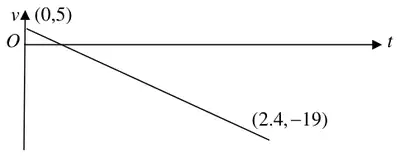 | B1 shape | 1.1b |
| \((0, 5)\) and \((2.4, -19)\) Allow these to be marked on the axes. | B1ft | 1.1b |
| (2) |
Notes
B1 Graph could be reflected in the \(t\)-axis.
B1ft Follow through on their \(T\) value.
If graph is reflected, \((0, -5)\) and \((2.4, 19)\)
| Scheme | Marks | AO |
|---|---|---|
| Greater since air resistance would slow the ball down. | B1 | 3.5a |
| (1) |
Notes
B1 Any similar appropriate comment
| Scheme | Marks | AO |
|---|---|---|
| Take into account: spin, wind effects, use a more accurate value of \(g\), not model the ball as a particle | B1 | 3.5c |
| (1) | ||
| (12 marks) |
Notes
B1 B0 if any incorrect extras e.g. weight/mass included