
June 2018 Mechanics Q9
9.
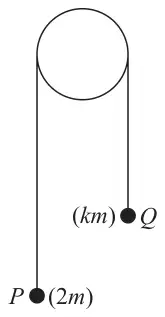
Two small balls, \(P\) and \(Q\), have masses \(2m\) and \(km\) respectively, where \(k \lt 2\).
The balls are attached to the ends of a string that passes over a fixed pulley.
The system is held at rest with the string taut and the hanging parts of the string vertical, as shown in Figure 1.
The system is released from rest and, in the subsequent motion, \(P\) moves downwards with an acceleration of magnitude \(\dfrac{5g}{7}\)
The balls are modelled as particles moving freely.
The string is modelled as being light and inextensible.
The pulley is modelled as being small and smooth.
Using the model,
| Scheme | Marks | AO |
|---|---|---|
| Equation of motion for \(P\) | M1 | 3.3 |
| \(2mg - T = 2m \times \dfrac{5g}{7}\) | A1 | 1.1b |
| \(T = \dfrac{4mg}{7}\) | A1 | 1.1b |
| (3) |
Notes
Condone both equations of motion appearing in (a) if used in (c)
M1: Resolving vertically for \(P\) with usual rules, correct no. of terms but condone sign errors and \(a\) does not need to be substituted (N.B. inconsistent omission of \(m\) is M0). Allow \(ma\) on RHS for M1
A1: A correct equation (allow if they use 7 instead of \(\dfrac{5g}{7}\))
A1: A correct answer of form \(cmg\), where \(c = \dfrac{4}{7}\) oe or 0.57 or better
| Scheme | Marks | AO |
|---|---|---|
| Since the string is modelled as being inextensible | B1 | 3.4 |
| (1) |
Notes
B1: String is inextensible. N.B. B0 if any extras (wrong or irrelevant) given
| Scheme | Marks | AO |
|---|---|---|
| Equation of motion for \(Q\) OR for whole system | M1 | 3.3 |
| \(T - kmg = km \times \dfrac{5g}{7}\) OR \(2mg - kmg = (km + 2m)\dfrac{5g}{7}\) | A1 | 1.1b |
| \(\dfrac{4mg}{7} - kmg = km \times \dfrac{5g}{7}\) oe and solve for \(k\) | DM1 | 1.1b |
| \(k = \dfrac{1}{3}\) or 0.333 or better | A1 | 1.1b |
| (4) |
Notes
Condone both equations of motion appearing in (a) if used in (c)
M1: Resolving vertically for \(Q\) or for a whole system equation, with usual rules, correct no. of terms but condone sign errors and neither \(T\) nor \(a\) does need to be substituted
(N.B. inconsistent omission of \(m\) is M0 and M0 if \(k\) is omitted from LHS or RHS or both.)
A1: A correct equation (allow if they use 7 instead of \(\dfrac{5g}{7}\))
DM1: Sub for \(T\) using their answer from (a), if necessary, and solve to give a numerical value of \(k\) (i.e. \(m\)’s must cancel)
A1: \(k = \dfrac{1}{3}\) or 0.333 or better.
| Scheme | Marks | AO |
|---|---|---|
| e.g The model does not take account of the mass of the string (SEE BELOW for alternatives) | B1 | 3.5b |
| (1) | ||
| (9 marks) |
Notes
B1: e.g. Pulley may not be smooth
Pulley may not be light
Particles may not be moving freely e.g. air resistance
Balls may not be particles
String may not be light
String may not be inextensible
(but allow converses in all cases e.g. ‘pulley smooth’)
N.B. B0 if any extra incorrect answer is given BUT ignore incorrect consequence of a correct answer.
Also note: B0 : Use of a more accurate value of \(g\)