
June 2022 Paper 1 Q10
10.
In this question you must show all stages of your working.
Solutions relying on calculator technology are not acceptable.
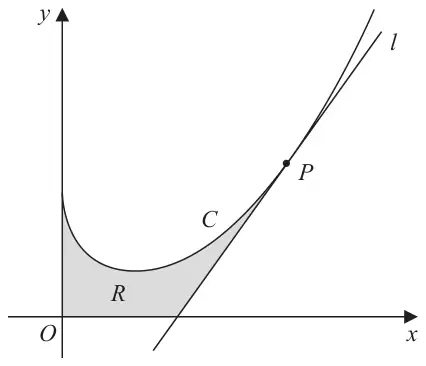
Figure 2 shows a sketch of part of the curve \(C\) with equation
\[y = \frac{1}{3}x^2 - 2\sqrt{x} + 3 \qquad x \geqslant 0\]The point \(P\) lies on \(C\) and has \(x\) coordinate 4
The line \(l\) is the tangent to \(C\) at \(P\).
The region \(R\), shown shaded in Figure 2, is bounded by the \(y\)-axis, the curve \(C\), the line \(l\) and the \(x\)-axis.
| Scheme | Marks | AO |
|---|---|---|
| \(y = \dfrac{1}{3}x^2 - 2\sqrt{x} + 3 \Rightarrow \dfrac{\mathrm{d}y}{\mathrm{d}x} = \dfrac{2}{3}x - x^{-\frac{1}{2}}\) | M1 A1 | 1.1b 1.1b |
| \(x = 4 \Rightarrow y = \dfrac{13}{3}\) | B1 | 1.1b |
| \(\left(\dfrac{\mathrm{d}y}{\mathrm{d}x}\right)_{x=4} = \dfrac{2}{3} \times 4 - 4^{-\frac{1}{2}} \left(= \dfrac{13}{6}\right) \quad \therefore y - \dfrac{13}{3} = \dfrac{13}{6}(x - 4)\) | M1 | 2.1 |
| \(13x - 6y - 26 = 0\) * | A1* | 1.1b |
| (5) |
Notes
Calculators: If no algebraic differentiation seen then maximum in a) is M0A0B1M1A0*
M1: \(x^n \to x^{n-1}\) seen at least once \(\ldots x^2 \to \ldots x^1,\ \ldots x^{\frac{1}{2}} \to \ldots x^{-\frac{1}{2}},\ 3 \to 0\).
Also accept on sight of eg \(\ldots x^{\frac{1}{2}} \to \ldots x^{\frac{1}{2} - 1}\)
A1: \(\dfrac{2}{3}x - x^{-\frac{1}{2}}\) or any unsimplified equivalent (indices must be processed) accept the use of \(0.\dot{6}x\) but not rounded or ambiguous values eg \(0.6x\) or eg \(0.66\ldots x\)
B1: Correct \(y\) coordinate of \(P\). May be seen embedded in an attempt of the equation of \(l\)
M1: Fully correct strategy for an equation for \(l\). Look for \(y - \text{``}\dfrac{13}{3}\text{''} = \text{``}\dfrac{13}{6}\text{''}(x - 4)\) where their \(\dfrac{13}{6}\) is from differentiating the equation of the curve and substituting in \(x = 4\) into their \(\dfrac{\mathrm{d}y}{\mathrm{d}x}\) and the \(y\) coordinate is from substituting \(x = 4\) into the given equation.
If they use \(y = mx + c\) they must proceed as far as \(c = \ldots\) to score this mark.
Do not allow this mark if they use a perpendicular gradient.
A1*: Obtains the printed answer with no errors.
| Scheme | Marks | AO |
|---|---|---|
| \(\displaystyle\int\left(\frac{x^2}{3} - 2\sqrt{x} + 3\right)\mathrm{d}x = \frac{x^3}{9} - \frac{4}{3}x^{\frac{3}{2}} + 3x\ (+c)\) | M1 A1 | 1.1b 1.1b |
| \(y = 0 \Rightarrow x = 2\) | B1 | 2.2a |
| Area of \(R\) is \(\left[\dfrac{x^3}{9} - \dfrac{4}{3}x^{\frac{3}{2}} + 3x\right]_0^4 - \dfrac{1}{2} \times (4 - \text{``}2\text{''}) \times \text{``}\dfrac{13}{3}\text{''} = \dfrac{76}{9} - \dfrac{13}{3}\) | M1 | 3.1a |
| \(= \dfrac{37}{9}\) | A1 | 1.1b |
| (5) | ||
| (10 marks) |
Notes
Calculators: If no algebraic integration seen then maximum in b) is M0A0B1M1A0
M1: \(x^n \to x^{n+1}\) seen at least once. Eg \(\ldots x^2 \to \ldots x^3,\ \ldots x^{\frac{1}{2}} \to \ldots x^{\frac{3}{2}},\ 3 \to 3x^1\). Allow eg \(\ldots x^2 \to \ldots x^{2+1}\) The \(+c\) is not a valid term for this mark.
A1: \(\dfrac{x^3}{9} - \dfrac{4}{3}x^{\frac{3}{2}} + 3x\) or any unsimplified equivalent (indices must be processed) accept the use of exact decimals for \(\dfrac{1}{9}\) \((0.\dot{1})\) and \(-\dfrac{4}{3}\) \((-1.\dot{3})\) but not rounded or ambiguous values.
B1: Deduces the correct value for \(x\) for the intersection of \(l\) with the \(x\)-axis. May be seen indicated on Figure 2.
M1: Fully correct strategy for the area. This needs to include
- a correct attempt at the area of the triangle using their values (could use integration)
- a correct attempt at the area under the curve using 0 and 4 in their integrated expression
- the two values subtracted.
A1: \(\dfrac{37}{9}\) or exact equivalent eg \(4\dfrac{1}{9}\) or \(4.\dot{1}\) but not \(4.111\ldots\) isw after a correct answer
Be aware of other strategies to find the area \(R\)
eg Finding the area under the curve between 0 and 2 and then the difference between the curve and the straight line between 2 and 4:\[\int_0^2 \frac{x^2}{3} - 2\sqrt{x} + 3\ \mathrm{d}x + \int_2^4 \frac{x^2}{3} - 2\sqrt{x} - \frac{13}{6}x + \frac{22}{3}\ \mathrm{d}x\]
M1 \(x^n \to x^{n+1}\) seen at least once on either integral (or on the equation of the line \(y = \dfrac{1}{3}x + 3\))
A1 for correct integration of either integral \(\dfrac{x^3}{9} - \dfrac{4}{3}x^{\frac{3}{2}} + 3x\) or \(\dfrac{x^3}{9} - \dfrac{4}{3}x^{\frac{3}{2}} - \dfrac{13}{12}x^2 + \dfrac{22}{3}x\) (may be unsimplified/uncollected terms but the indices must be processed with/without the \(+C\))
B1 Correct value for \(x\) can be seen from the top of the first integral (or bottom value of the second integral)
M1 Correct strategy for the area eg.\[\left[\dfrac{x^3}{9} - \dfrac{4}{3}x^{\frac{3}{2}} + 3x\right]_0^2 + \left[\dfrac{x^3}{9} - \dfrac{4}{3}x^{\frac{3}{2}} - \dfrac{13}{12}x^2 + \dfrac{22}{3}x\right]_2^4 = \frac{62}{9} - \frac{4}{3}(2)^{\frac{3}{2}} + \frac{76}{9} - \frac{101}{9} + \frac{4}{3}(2)^{\frac{3}{2}}\]
A1: \(\dfrac{37}{9}\) or exact equivalent eg \(4\dfrac{1}{9}\) or \(4.\dot{1}\) but not 4.1 or \(4.111\ldots\)
You could also see use of the area of a trapezium and/or the use of the line \(y = \dfrac{1}{3}x + 3\) to find other areas which could be combined or used as part of the strategy to find \(R\). Ignore areas which are not used. The marks should still be able to be applied as per the scheme
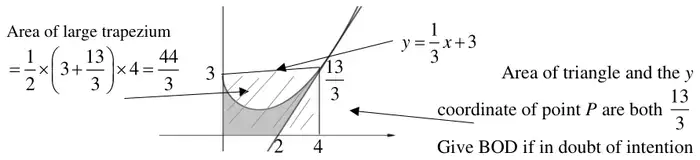
Area of trapezium – (Area between \(y = \dfrac{1}{3}x + 3\) and curve \(C\) + area of triangle)\[= \frac{44}{3} - \frac{56}{9} - \frac{13}{3} = \frac{37}{9}\]