
June 2019 Paper 1 Q13
13.
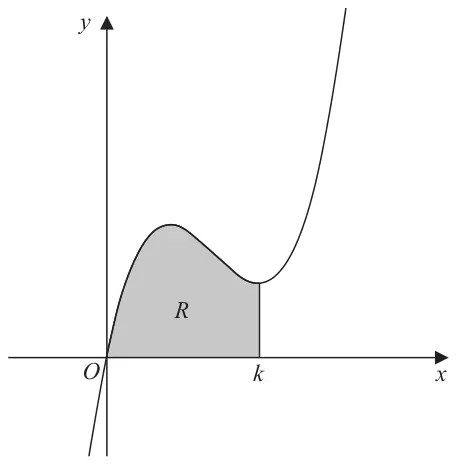
Figure 3 shows a sketch of part of the curve with equation\[y = 2x^3 - 17x^2 + 40x\]
The curve has a minimum turning point at \(x = k\).
The region \(R\), shown shaded in Figure 3, is bounded by the curve, the \(x\)-axis and the line with equation \(x = k\).
Show that the area of \(R\) is \(\dfrac{256}{3}\)
(Solutions based entirely on graphical or numerical methods are not acceptable.) (7)
| Scheme | Marks | AO |
|---|---|---|
| The overall method of finding the \(x\) coordinate of the minimum point (\(x = k\)). | M1 | 3.1a |
| \(y = 2x^3 - 17x^2 + 40x \Rightarrow \dfrac{\mathrm{d}y}{\mathrm{d}x} = 6x^2 - 34x + 40\) | B1 | 1.1b |
| \(\dfrac{\mathrm{d}y}{\mathrm{d}x} = 0 \Rightarrow 6x^2 - 34x + 40 = 0 \Rightarrow 2(3x - 5)(x - 4) = 0 \Rightarrow x = \ldots\) | M1 | 1.1b |
| Chooses \(x = 4\) \(\quad \cancel{x = \dfrac{5}{3}}\) | A1 | 3.2a |
| \(\displaystyle\int 2x^3 - 17x^2 + 40x\,\mathrm{d}x = \left[\frac{1}{2}x^4 - \frac{17}{3}x^3 + 20x^2\right]\) | B1 | 1.1b |
| Area \(= \dfrac{1}{2}(4)^4 - \dfrac{17}{3}(4)^3 + 20(4)^2\) | M1 | 1.1b |
| \(= \dfrac{256}{3}\) * | A1* | 2.1 |
| (7) | ||
| (7 marks) |
Notes
M1: An overall problem -solving method mark to find the minimum point. To score this you need to see
- an attempt to differentiate with at least two correct terms
- an attempt to set their \(\dfrac{\mathrm{d}y}{\mathrm{d}x} = 0\) and then solve to find \(x\). Don’t be overly concerned by the mechanics of this solution
(corrected from the printed mark scheme: the scheme says “the \(x\) coordinate of \(A\)”, but there is no point \(A\) in this question; it means the minimum point at \(x = k\))
B1: \(\left(\dfrac{\mathrm{d}y}{\mathrm{d}x} =\right) 6x^2 - 34x + 40\) which may be unsimplified
M1: Sets their \(\dfrac{\mathrm{d}y}{\mathrm{d}x} = 0\), which must be a 3TQ in \(x\), and attempts to solve via factorisation, formula or calculator. If a calculator is used to find the roots, they must be correct for their quadratic.
If \(\dfrac{\mathrm{d}y}{\mathrm{d}x}\) is correct allow them to just choose the root 4 for M1 A1. Condone \((x - 4)\left(x - \dfrac{5}{3}\right)\)
A1: Chooses \(x = 4\) This may be awarded from the upper limit in their integral
B1: \(\displaystyle\int 2x^3 - 17x^2 + 40x\,\mathrm{d}x = \left[\frac{1}{2}x^4 - \frac{17}{3}x^3 + 20x^2\right]\) which may be unsimplified
M1: Correct attempt at area. There may be slips on the integration but expect two correct terms
The upper limit used must be their larger solution of \(\dfrac{\mathrm{d}y}{\mathrm{d}x} = 0\) and the lower limit used must be 0.
So if their roots are 6 and 10, then they must use 10 and 0. If only one value is found then the limits must be 0 to that value.
Expect to see embedded or calculated values.
Don’t accept \(\displaystyle\int_0^4 2x^3 - 17x^2 + 40x\,\mathrm{d}x = \frac{256}{3}\) without seeing the integration and the embedded or calculated values
A1*: Area \(= \dfrac{256}{3}\) with correct notation and no errors. Note that this is a given answer.
For correct notation expect to see
- \(\dfrac{\mathrm{d}y}{\mathrm{d}x}\) or \(\dfrac{\mathrm{d}}{\mathrm{d}x}\) used correctly at least once. If \(\mathrm{f}(x)\) is used accept \(\mathrm{f}^{\prime}(x)\). Condone \(y^{\prime}\)
- \(\displaystyle\int 2x^3 - 17x^2 + 40x\,\mathrm{d}x\) used correctly at least once with or without the limits.