
June 2019 Paper 1 Q11
11.\[\mathrm{f}(x) = 2x^3 - 13x^2 + 8x + 48\]
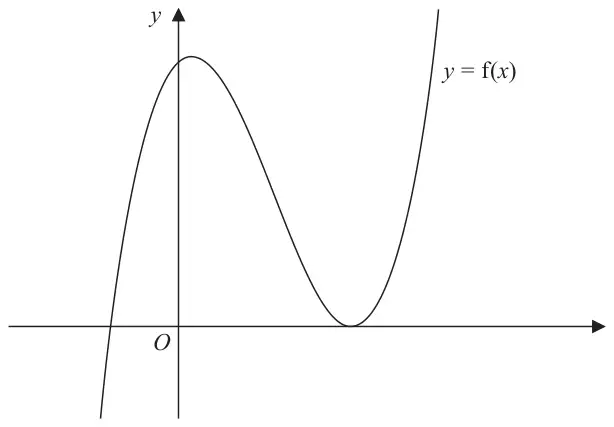
Figure 2 shows a sketch of part of the curve with equation \(y = \mathrm{f}(x)\).
Given that \(k\) is a constant and the curve with equation \(y = \mathrm{f}(x + k)\) passes through the origin,
| Scheme | Marks | AO |
|---|---|---|
| Attempts \(\mathrm{f}(4) = 2 \times 4^3 - 13 \times 4^2 + 8 \times 4 + 48\) | M1 | 1.1b |
| \(\mathrm{f}(4) = 0 \Rightarrow (x - 4)\) is a factor | A1 | 1.1b |
| (2) |
Notes
M1: Attempts to calculate \(\mathrm{f}(4)\).
Do not accept \(\mathrm{f}(4) = 0\) without sight of embedded values or calculations.
If values are not embedded look for two correct terms from \(\mathrm{f}(4) = 128 - 208 + 32 + 48\)
Alternatively attempts to divide by \((x - 4)\). Accept via long division or inspection.
See below for awarding these marks.
A1: Correct reason with conclusion. Accept \(\mathrm{f}(4) = 0\), hence factor as long as M1 has been scored.
This should really be stated on one line after having performed a correct calculation. It could appear as a preamble if the candidate states "If \(\mathrm{f}(4) = 0\), then \((x - 4)\) is a factor before doing the calculation and then writing hence proven or ✓ oe.
If division/inspection is attempted it must be correct and there must be some attempt to explain why they have shown that \((x - 4)\) is a factor. Eg Via division they must state that there is no remainder, hence factor
| Scheme | Marks | AO |
|---|---|---|
| \(2x^3 - 13x^2 + 8x + 48 = (x - 4)\left(2x^2 \ldots x - 12\right)\) | M1 | 2.1 |
| \(= (x - 4)\left(2x^2 - 5x - 12\right)\) | A1 | 1.1b |
| Attempts to factorise quadratic factor or solve quadratic eqn | dM1 | 1.1b |
| \(\mathrm{f}(x) = (x - 4)^2(2x + 3) \Rightarrow \mathrm{f}(x) = 0\) has only two roots, 4 and \(-1.5\) | A1 | 2.4 |
| (4) |
Notes
M1: Attempts to find the quadratic factor by inspection (correct first and last terms) or by division (correct first two terms)
So for inspection award for \(2x^3 - 13x^2 + 8x + 48 = (x - 4)\left(2x^2 \ldots x \pm 12\right)\)
For division look for
A1: Correct quadratic factor \(\left(2x^2 - 5x - 12\right)\) For division award for sight of this "in the correct place" You don’t have to see it paired with the \((x - 4)\) for this mark.
If a student has used division in part (a) they can score the M1 A1 in (b) as soon as they start attempting to factorise their \(\left(2x^2 - 5x - 12\right)\).
dM1: Correct attempt to solve or factorise their \(\left(2x^2 - 5x - 12\right)\) including use of formula
Apply the usual rules \(\left(2x^2 - 5x - 12\right) = (ax + b)(cx + d)\) where \(ac = \pm 2\) and \(bd = \pm 12\)
Allow the candidate to move from \((x - 4)\left(2x^2 - 5x - 12\right)\) to \((x - 4)^2(2x + 3)\) for this mark.
A1: Via factorisation
Factorises twice to \(\mathrm{f}(x) = (x - 4)(2x + 3)(x - 4)\) or \(\mathrm{f}(x) = (x - 4)^2(2x + 3)\) or \(\mathrm{f}(x) = 2(x - 4)^2\left(x + \dfrac{3}{2}\right)\) followed by a valid explanation why there are only two roots.
The explanation can be as simple as
- hence \(x = 4\) and \(-\dfrac{3}{2}\) (only). The roots must be correct
- only two distinct roots as 4 is a repeated root
There must be some understanding between roots and factors.
E.g. \(\mathrm{f}(x) = (x - 4)^2(2x + 3)\) with arrows pointing to the two factors and the comment “only two distinct roots” is insufficient.
This would require two distinct factors, so there are two distinct roots.
Via solving.
Factorsises to \((x - 4)\left(2x^2 - 5x - 12\right)\) and solves \(2x^2 - 5x - 12 = 0 \Rightarrow x = 4, -\dfrac{3}{2}\) followed by an explanation that the roots are \(4, 4, -\dfrac{3}{2}\) so only two distinct roots.
Note that this question asks the candidate to use algebra so you cannot accept any attempt to use their calculators to produce the answers.
| Scheme | Marks | AO |
|---|---|---|
| Deduces either three roots or deduces that \(\mathrm{f}(x)\) is moved down two units | M1 | 2.2a |
| States three roots, as when \(\mathrm{f}(x)\) is moved down two units there will be three points of intersection (with the \(x\)-axis) | A1 | 2.4 |
| (2) |
Notes
M1: For a valid deduction.
Accept either there are 3 roots or states that it is a solution of \(\mathrm{f}(x) = 2\) or \(\mathrm{f}(x) - 2 = 0\)
A1: Fully explains:
Eg. States three roots, as \(\mathrm{f}(x)\) is moved down by two units (giving three points of intersection with the \(x\)-axis)
Eg. States three roots, as it is where \(\mathrm{f}(x) = 2\) (You may see \(y = 2\) drawn on the diagram)
| Scheme | Marks | AO |
|---|---|---|
| For sight of \(k = \pm 4, \pm\dfrac{3}{2}\) | M1 | 1.1b |
| \(k = 4, -\dfrac{3}{2}\) | A1ft | 1.1b |
| (2) | ||
| (10 marks) |
Notes
M1: For sight of \(\pm 4\) and \(\pm\dfrac{3}{2}\) Follow through on \(\pm\) their roots.
A1ft: \(k = 4, -\dfrac{3}{2}\) Follow through on their roots. Accept \(4, -\dfrac{3}{2}\) but not \(x = 4, -\dfrac{3}{2}\)