
June 2019 Paper 1 Q7
7. The curve \(C\) has equation\[y = \frac{k^2}{x} + 1 \qquad x \in \mathbb{R},\ x \neq 0\]where \(k\) is a constant.
The line \(l\) has equation \(y = -2x + 5\)
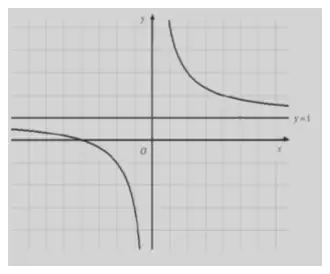
| Scheme | Marks | AO |
|---|---|---|
| \(\dfrac{1}{x}\) shape in 1st quadrant | M1 | 1.1b |
| Correct | A1 | 1.1b |
| Asymptote \(y = 1\) | B1 | 1.2 |
| (3) |
Notes
M1: For the shape of a \(\dfrac{1}{x}\) type curve in Quadrant 1. It must not cross either axis and have acceptable curvature. Look for a negative gradient changing from \(-\infty\) to 0 condoning "slips of the pencil". (See Practice and Qualification for clarification)
A1: Correct shape and position for both branches.
It must lie in Quadrants 1, 2 and 3 and have the correct curvature including asymptotic behaviour
B1: Asymptote given as \(y = 1\). This could appear on the diagram or within the text.
Note that the curve does not need to be asymptotic at \(y = 1\) but this must be the only horizontal asymptote offered by the candidate.
| Scheme | Marks | AO |
|---|---|---|
| Combines equations \(\Rightarrow \dfrac{k^2}{x} + 1 = -2x + 5\) | M1 | 1.1b |
| \((\times x) \Rightarrow k^2 + 1x = -2x^2 + 5x \Rightarrow 2x^2 - 4x + k^2 = 0\) * | A1* | 2.1 |
| (2) |
Notes
M1: Attempts to combine \(y = \dfrac{k^2}{x} + 1\) with \(y = -2x + 5\) to form an equation in just \(x\)
A1*: Multiplies by \(x\) (the processed line must be seen) and proceeds to given answer with no slips.
Condone if the order of the terms are different \(2x^2 + k^2 - 4x = 0\)
| Scheme | Marks | AO |
|---|---|---|
| Attempts to set \(b^2 - 4ac = 0\) | M1 | 3.1a |
| \(8k^2 = 16\) | A1 | 1.1b |
| \(k = \pm\sqrt{2}\) | A1 | 1.1b |
| (3) | ||
| (8 marks) |
Notes
M1: Deduces that \(b^2 - 4ac = 0\) or equivalent for the given equation.
If \(a\), \(b\) and \(c\) are stated only accept \(a = 2, b = \pm 4, c = k^2\) so \(4^2 - 4 \times 2 \times k^2 = 0\)
Alternatively completes the square \(x^2 - 2x + \dfrac{1}{2}k^2 = 0 \Rightarrow (x - 1)^2 = 1 - \dfrac{1}{2}k^2 \Rightarrow \text{``}1 - \dfrac{1}{2}k^2\text{''} = 0\)
A1: \(8k^2 = 16\) or exact simplified equivalent. Eg \(8k^2 - 16 = 0\)
If \(a\), \(b\) and \(c\) are stated they must be correct. Note that \(b^2\) appearing as \(4^2\) is correct
A1: \(k = \pm\sqrt{2}\) and following correct \(a\), \(b\) and \(c\) if stated
A solution via differentiation would be awarded as follows
M1: Sets the gradient of the curve \(= -2 \Rightarrow -\dfrac{k^2}{x^2} = -2 \Rightarrow x = (\pm)\dfrac{k}{\sqrt{2}}\) oe and attempts to substitute into \(2x^2 - 4x + k^2 = 0\)
A1: \(2k^2 = (\pm)2\sqrt{2}k\) oe
A1: \(k = \pm\sqrt{2}\)