
June 2024 Paper 1 Q8
8.
In this question you must show all stages of your working.
Solutions relying entirely on calculator technology are not acceptable.
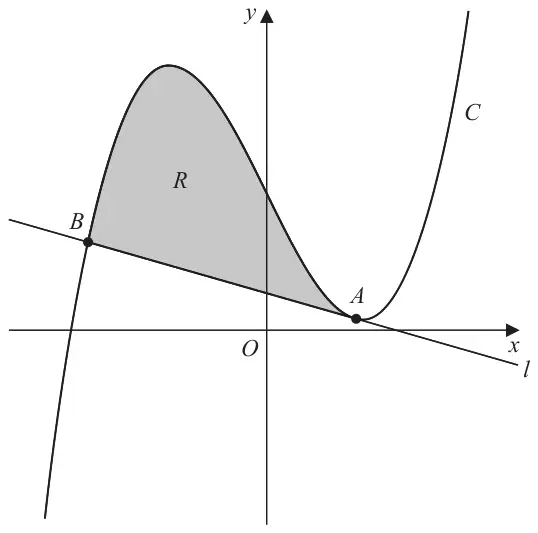
Figure 3 shows a sketch of the curve \(C\) with equation\[y = x^3 - 14x + 23\]
The line \(l\) is the tangent to \(C\) at the point \(A\), also shown in Figure 3.
Given that \(l\) has equation \(y = -2x + 7\)
The line \(l\) cuts \(C\) again at the point \(B\).
The finite region, \(R\), shown shaded in Figure 3, is bounded by \(C\) and \(l\).
Using algebraic integration,
| Scheme | Marks | AO |
|---|---|---|
| \(\left(\dfrac{\mathrm{d}y}{\mathrm{d}x} =\right) 3x^2 - 14 = -2\) or \(\dfrac{\mathrm{d}}{\mathrm{d}x}(\pm(\text{curve} - \text{line})) = \pm(3x^2 - 12) = 0\) | M1 | 3.1a |
| e.g. \(3x^2 - 14 = -2 \Rightarrow 3x^2 = 12 \Rightarrow x = \ldots\) | dM1 | 1.1b |
| \(x = 2\) only * | A1* | 2.2a |
| (3) |
Notes
(a) On EPEN this is M1A1A1* we are marking this as M1dM1A1*
M1: Differentiates the cubic to achieve \(px^2 + q\) and sets equal to \(-2\). Note setting the linear and cubic equations equal to each other and solving is M0 (no use of calculus) but, they may differentiate \(\pm(\text{cubic} - \text{line})\) to achieve \(px^2 + q\) and set equal to 0 which is M1.
Alternatively, in either approach, differentiates to achieve \(px^2 + q\) and substitutes in \(x = 2\)
dM1: Proceeds from their equation to find a real value for \(x\) with at least one intermediate stage of working. e.g. \(px^2 = -q \Rightarrow x = \ldots\) or e.g. via factorisation
\((3)(x + 2)(x - 2) = 0 \Rightarrow x = \ldots\) Accept proceeding directly to \(x = \sqrt{\dfrac{14 - 2}{3}}\) or \(\pm 2\)
In the alternative, it is for substituting in 2 into their \(3(2)^2 - 14 = \ldots\) or \(3(2)^2 - 12 = \ldots\)
A1*: 2 only (the solution of \(-2\) does not need to be found) \(\pm 2\) without selecting 2/ rejecting -2 is A0*. In the alternative they conclude that \(x = 2\).
| Scheme | Marks | AO |
|---|---|---|
| e.g. Substitutes \(x = -4\) into \(y = x^3 - 14x + 23\) and \(y = -2x + 7\) | M1 | 1.1b |
| Correct solution + conclusion * (see notes) | A1* | 2.4 |
| (2) |
Notes
Work may be seen in (a) but must be used in (b) to score
M1: Mark the general method / do not be concerned by slips in their working. Either e.g.
- substitutes \(x = -4\) into \(y = x^3 - 14x + 23\) and \(y = -2x + 7\). Sight of \(-4\) embedded in the equations is sufficient.
- substitutes \(x = -4\) into one equation to find \(y\) and then uses this value to find \(x\) in the other equation.
- equates the cubic and the linear expressions, rearranges (= 0) and then
- substitutes \(x = -4\) into the equation or expression
- factorises using \((x - 2)^2\) to find a linear factor (e.g. inspection / division)
- algebraically divides by \((x + 4)\) at some point to get a remainder of 0
- factorises using \((x - 2)\) to find a quadratic factor which they attempt to factorise
A1*: A correct solution with conclusion but allow recovery of missing/invisible brackets.
Either
- finds \(y = 15\) when \(x = -4\) for both equations
- finds \(y = 15\) using one equation and uses this to find that \(x = -4\) for the other
- verifies that \(x = -4\) is a solution of the cubic – linear = 0 with no errors seen.
- solves cubic – linear = 0 and finds the linear factor \((x + 4)\) leading to the root \(x = -4\)
There must be a conclusion: if they find \(x = -4\) then a tick, QED, underline, proven. If they find e.g. \(y = 15\) for both they must state \(x = -4\) e.g.“(same \(y\) values so) \(x = -4\)”
Note that stating the coordinates \((-4,\ 15)\) is insufficient.
SC: \(-2x + 7 = x^3 - 14x + 23 \Rightarrow x^3 - 12x + 16\ (= 0) \Rightarrow x = -4,\ 2\) so \(x = -4\) scores M1A0*
| Scheme | Marks | AO |
|---|---|---|
| \(\displaystyle\int \left(x^3 - 14x + 23\right)\mathrm{d}x = \frac{x^4}{4} - 7x^2 + 23x\ \ (+c)\) | M1 A1 | 1.1b 1.1b |
| \(\displaystyle = \left(\frac{2^4}{4} - 7 \times 2^2 + 23 \times 2\right) - \left(\frac{(-4)^4}{4} - 7(-4)^2 + 23(-4)\right)\) | dM1 | 1.1b |
| \(\displaystyle \text{Area} = \int_{-4}^{2} \left(x^3 - 14x + 23\right)\mathrm{d}x - \frac{1}{2} \times (15 + 3) \times (2 - -4)\) \(\displaystyle = \left(\frac{2^4}{4} - 7 \times 2^2 + 23 \times 2\right) - \left(\frac{(-4)^4}{4} - 7(-4)^2 + 23(-4)\right) - 54\) | dM1 | 3.1a |
| Area \(= 108\ *\) | A1* | 2.1 |
| (5) | ||
| (10 marks) |
Notes
Alt (c)
| Scheme | Marks | AO |
|---|---|---|
| \(\displaystyle\int \left(x^3 - 14x + 23\right) - (-2x + 7)\,\mathrm{d}x = \int \left(x^3 - 12x + 16\right)\mathrm{d}x\) | M1 | 3.1a |
| \(\displaystyle = \frac{x^4}{4} - 6x^2 + 16x\ \ (+c)\) | A1 | 1.1b |
| \(\displaystyle \text{Area} = \left(\frac{2^4}{4} - 6 \times 2^2 + 16 \times 2\right) - \left(\frac{(-4)^4}{4} - 6(-4)^2 + 16(-4)\right)\) | dM1 dM1 | 1.1b 1.1b |
| Area \(= 108\ *\) | A1* | 2.1 |
No integration seen (using the integration button on a calculator) will score 0 marks
M1: Integrates the equation of the curve or in the alternative method it is for integrating curve-line and achieving at least two terms with a correct index out of \(\ldots x^4 \pm \ldots x^2 \pm \ldots x\)
Also look out for a transformation approach translating the cubic down 3 units and integrating \(\displaystyle\int \left(x^3 - 14x + 20\right)\mathrm{d}x = \frac{x^4}{4} - 7x^2 + 20x\)
A1: \(\dfrac{x^4}{4} - 7x^2 + 23x\) or \(\dfrac{x^4}{4} - 6x^2 + 16x\) (ignore any constant of integration). Allow unsimplified but the indices must be processed. Look out for \(\dfrac{x^4}{4} - 7x^2 + 20x\) if the cubic has been translated down 3 units. Do not penalise poor notation for this mark.
dM1: Correct limits of 2 and \(-4\) used for their integral (which may be for the line or curve). It is dependent on the previous method mark. Evidence of substituting in 2 and \(-4\) into their integrated expression must be seen. (e.g. \(22 - (-140)\)). In the alternative method the dM1 (and next dM1) are scored at the same time for substituting in the correct limits.
dM1: Correct strategy to find the shaded area. It is dependent on the first method mark only but the limits must be correct. In the alternative method this mark is scored for sight of 2 and \(-4\) for their integral which do not have to be substituted in.
The method to find any areas e.g. trapezium, rectangle, triangle must be correct and the method of adding or subtracting to find the shaded area must be correct. Condone slips in evaluating. Note using the transformation approach they will need to subtract the area of the triangle \(0.5 \times 6 \times (15 - 3)\)
A1*: 108 following from a rigorous argument showing all stages and correct notation used when integrating (the integral sign and the d\(x\) either side of their expression seen at least once and should not be present after integration has been completed)