
June 2024 Paper 1 Q5
5. The curve \(C_1\) has equation\[y = \frac{6}{x} + 3\]
The curve \(C_2\) has equation\[y = 3x^2 - 4x - 10\]
Given that the \(x\) coordinate of one of the points of intersection is \(-\dfrac{2}{3}\)
(Solutions relying on calculator technology are not acceptable.) (4)
| Scheme | Marks | AO |
|---|---|---|
(i)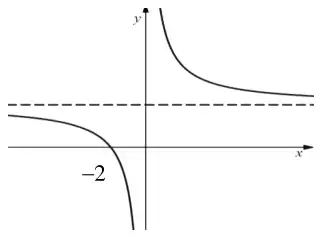 | M1 A1 | 1.1b 1.1b |
| (ii) Asymptotes: \(y = 3,\quad x = 0\) | B1 | 1.1b |
| (3) |
Notes
(i) M1: Either
- A correct positive reciprocal graph shape with both branches anywhere on a set of axes (ignore any dashed lines / scale and just look at the graph shape drawn)
- \(x = -2\) is the only point of intersection of their graph with the axes. Condone labelled as \((0,\ -2)\). Allow if they state the coordinates \((-2,\ 0)\) next to the graph instead but not just \(x = -2\)
Condone poor curvature provided there is not an intention to draw a maximum or minimum for either of the branches. Condone where the branches approach an undrawn horizontal asymptote if the left-hand branch is slightly above the right-hand branch as long as it does not appear intentional.
A1: Fully correct graph with an intersection labelled at \(x = -2\) on the graph (condone labelled as \((0,\ -2)\)). If two horizontal or vertical asymptotes are drawn or a vertical asymptote which is not the \(y\)-axis then this mark cannot be scored. (unless the vertical asymptote is labelled as 0 or \(x = 0\)) Allow if they state the coordinates \((-2,\ 0)\) next to the graph instead but not just \(x = -2\)
e.g. this scores M1A1
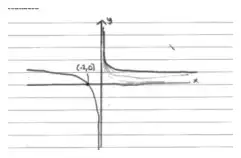
e.g. this scores M1A0
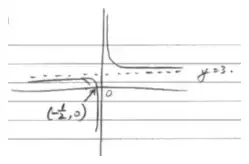
e.g. this scores M1A0
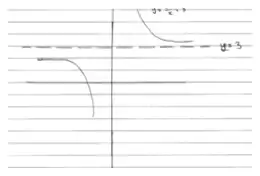
e.g. this scores M1A1
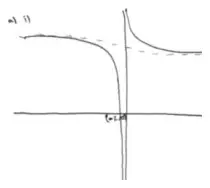
e.g. this scores M1A1 (condone the vertical asymptote drawn as it is labelled as 0 (for \(x = 0\)))
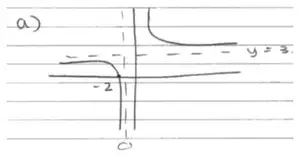
(ii) If no graph is drawn then this mark cannot be scored
B1: \(y = 3,\quad x = 0\) cao (not \(x \neq 0\)) which must be correct for their graph. Check by the question but if there is a contradiction then the equations stated in (ii) of the work takes precedence. Cannot be for just stating 0 underneath the \(y\) axis and 3 on a dashed horizontal line if present.
| Scheme | Marks | AO |
|---|---|---|
| e.g. \(\dfrac{6}{x} + 3 = 3x^2 - 4x - 10 \Rightarrow 6 + 3x = 3x^3 - 4x^2 - 10x\) | M1 | 1.1b |
| \(3x^3 - 4x^2 - 13x - 6 = 0\ *\) | A1* | 1.1b |
| (2) |
Notes
M1: Sets \(\dfrac{6}{x} + 3 = 3x^2 - 4x - 10\) and rearranges to form a cubic equation. Terms do not need to be collected or all on one side.
A1*: \(3x^3 - 4x^2 - 13x - 6 = 0\) with no errors seen. There must be at least one stage of intermediate working before achieving the given answer.
e.g. \(\dfrac{6}{x} + 3 = 3x^2 - 4x - 10 \Rightarrow 3x^3 - 4x^2 - 13x - 6 = 0\) is M1A0*
e.g. \(\dfrac{6}{x} + 3 = 3x^2 - 4x - 10 \Rightarrow 6 + 3x = 3x^3 - 4x^2 - 10x \Rightarrow 3x^3 - 4x^2 - 13x - 6 = 0\) is M1A1*
| Scheme | Marks | AO |
|---|---|---|
| e.g. \(\begin{array}{rl} & x^2 - 2x \pm \ldots \\ 3x + 2\,\big) & \overline{3x^3 - 4x^2 - 13x - 6} \end{array}\) | M1 | 3.1a |
| \(x^2 - 2x - 3\ (= 0)\) or \(3x^2 - 6x - 9\ (= 0)\) | A1 | 1.1b |
| e.g. \((3x + 2)(x - 3)(x + 1) = 0 \Rightarrow x = \ldots\) | dM1 | 1.1b |
| \(x = -1,\ x = 3\) | A1cso | 1.1b |
| (4) | ||
| (9 marks) |
Notes
Note that proceeding to three linear factors with no working is M0A0dM0A0. A quadratic factor is required first.
M1: Attempts to algebraically divide \(3x^3 - 4x^2 - 13x - 6\) by \(3x + 2\) or compare coefficients to achieve \((x^2 - 2x \pm \ldots)\) or \((x^2 \pm \ldots x - 3)\) (or via inspection)
Alternatively, attempts to algebraically divide \(3x^3 - 4x^2 - 13x - 6\) by \(x + \dfrac{2}{3}\) or compare coefficients to achieve \((3x^2 - 6x \pm \ldots)\) or \((3x^2 \pm \ldots x - 9)\) (or via inspection)
May use the grid method so they must proceed as far as the diagonal for \(x^2\) being correct and achieving \(x^2 - 2x\) on the top. (They should reach the same point if dividing by \(x + \dfrac{2}{3}\))
| \(x^2\) | \(-2x\) | |
|---|---|---|
| \(3x\) | \(3x^3\) | \(-6x^2\) |
| \(2\) | \(2x^2\) |
Any attempts to use \((x + 1)\) or \((x - 3)\) rather than \((3x + 2)\) from the given root please send to review.
A1: \(x^2 - 2x - 3\ (= 0)\) or \(3x^2 - 6x - 9\ (= 0)\)
dM1: Attempts to solve their resulting quadratic by factorising, using the formula or completing the square. Usual rules apply for solving a quadratic by either of these methods. They cannot simply write down the roots. It is dependent on the previous method mark.
Note \((3x^2 - 6x - 9) \Rightarrow (x - 3)(x + 1) \Rightarrow x = \ldots\) is dM0A0
A1cso: \(x = -1,\ x = 3\) only (ignore any reference to \(x = -\dfrac{2}{3}\)) Condone invisible brackets if recovered or implied by further work. Withhold this mark if they reject one of the two solutions.