
Numeracy Intermediate November 2016 Unit 1 Q10
10.
| Stylish computer desk Made of laminate wood. Non-scratch top. Length is exactly 2000 mm |
Luc wants this new desk for his bedroom.
The desk is to fit on the straight wall between his wardrobe and his bookcase.
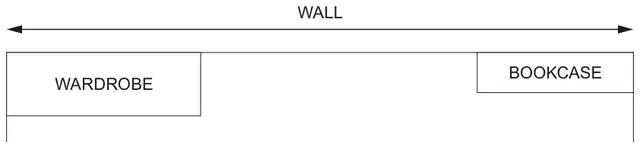
Diagram not drawn to scale
Luc has measured the length of
- the wall, which is 600 cm, correct to the nearest 10 cm,
- the bookcase, which is 147 cm, correct to the nearest 1 cm,
- the wardrobe, which is 250 cm, correct to the nearest 1 cm.
(a) What is the greatest possible length of the wall?
Circle your answer. [1]
Circle your answer. [1]
600 cm 605 cm 645 cm 610 cm 650 cm
(b) What is the least possible length of the wardrobe?
Circle your answer. [1]
Circle your answer. [1]
249 cm 249·45 cm 249·49 cm 249·5 cm 250 cm
(c) Can Luc be certain that this desk will fit in the space available?
You must
- show all your calculations,
- give the greatest or least bounds of any measurements used in calculations or comparisons,
- give a reason for your answer. [5]
| Scheme | Marks | Comments |
|---|---|---|
| 605 cm | B1 |
| Scheme | Marks | Comments |
|---|---|---|
| 249.5 cm | B1 |
| Scheme | Marks | Comments |
|---|---|---|
| Consistent use of units for comparison, e.g. desk 200cm if another measure is given in cm | B1 | Penalise -1 only the use of the ‘their desk’ ≠ 200 Accept comparison with one other length, e.g. sight of 2000mm = 200cm is sufficient if any other working seen in cm (irrespective of use of bounds) |
| Use of 147.5 (cm) or 250.5 (cm) or 595(cm) | B2 | ‘Use of’ can be any of these values used within a length calculation (including the bookcase, the wardrobe and either the wall or the desk), or 595(cm) used in the interpretation within a conclusion Allow \(147.4\dot{9}\)(cm) or \(250.4\dot{9}\)(cm) respectively throughout (Otherwise award:) B1 for sight of 147.5 (cm), 250.5 (cm) or 595(cm) |
| Correctly evaluated calculation which could be interpreted to show the desk (200cm) would not fit, i.e. a counter example showing the desk can not fit | B1 | Interpretation is not required for this B1, it is a calculation (showing that the wall or the gap is of insufficient length, i.e.) with an answer >595(cm) or <200(cm) as appropriate Examples (In cm, but working in m or mm is also accepted) Giving an answer >595: 147.5 + 250.5 + 200 = 598, or 147 + 250 + 200 = 597, or 146.5 + 249.5 + 200 = 596 OR Giving an answer <200: 595 – 250.5 – 147.5 = 197, or 595 – 250 – 147 = 198, or 595 – 249.5 – 146.5 = 199 i.e. working with lengths in the inclusive ranges 146.5 to 147.5 and 249.5 to 250.5 is accepted, condoning mix of upper and lower bounds provided the calculation leads to >595 or <200 appropriately |
| Conclusion from a correct interpretation of a correctly evaluated calculation, e.g. ‘no, not certain as greater than the least length of the wall which is 595(cm)’, 'no, 197(cm) is less than the length of the desk which is 200(cm)', ‘no, 598(cm) > 595(cm)’ | E1 | This E1 depends on the award of the previous B1 Sight of 200(cm) or 595(cm) as appropriate for the comparison is required, i.e. ‘no, not certain as greater than the least length of the wall’ or 'no, 197 cm is less than the length of the desk’ would only be awarded E1 if 595(cm) or 200(cm) respectively, has been seen previously |