
Numeracy Higher November 2016 Unit 1 Q4
4.
140 girls were asked how long they spent revising for their GCSE examinations.
The cumulative frequency diagram shows the results.
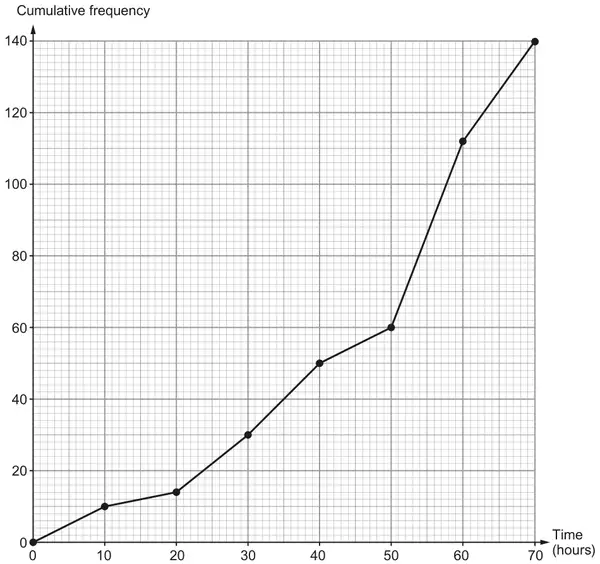
Estimate the median time the girls spent revising.
Circle your answer. [1]
35 hours 40 hours 48 hours 52 hours 70 hours
Calculate the number of girls who spent between 40 and 50 hours revising.
Circle your answer. [1]
0 girls 5 girls 10 girls 15 girls 20 girls
Circle either TRUE or FALSE for each of the following statements. [2]
| 25 girls spent between 30 and 50 hours revising. | TRUE | FALSE |
| No girls spent more than 80 hours revising. | TRUE | FALSE |
| The modal group is between 50 and 60 hours spent revising. | TRUE | FALSE |
| 20 girls spent more than 60 hours revising. | TRUE | FALSE |
140 boys were asked how long they spent revising for their GCSE examinations.
The cumulative frequency diagram below shows the results.
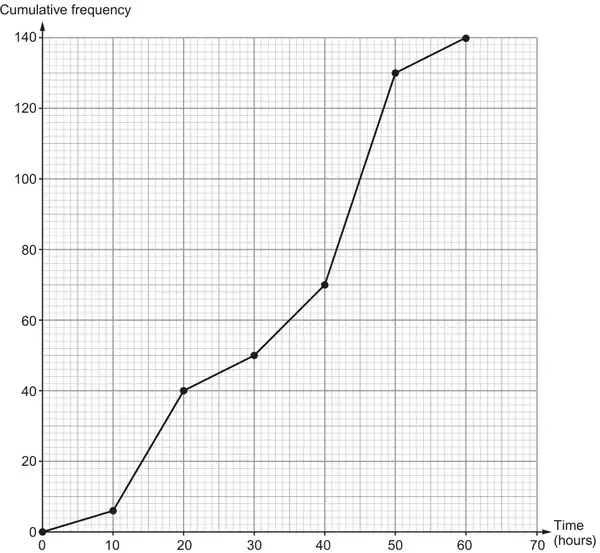
Trefor makes two statements.
2. On average, boys spent more time revising.
Are both Trefor’s statements correct?
Show calculations and give reasons to support your answers. [4]
Statement 1: ……………
Statement 2: ……………
| Scheme | Marks | Comments |
|---|---|---|
| (i) 52 hours | B1 | |
| (ii) 10 girls | B1 | |
| (iii) FALSE TRUE TRUE FALSE | B2 | B1 for any 3 correct answers If no marks, award SC1 for an answer TRUE, TRUE, TRUE, TRUE (as it is a repeat misunderstanding/error) |
| Scheme | Marks | Comments |
|---|---|---|
| Statement 1: Complete method to calculate the interquartile range | M1 | Based on sight of method for either boys or girls, or either IQR correct provided not clearly from incorrect working |
| Girls’ IQR (59 or 58 - 33 or 32 =) 25 to 27 AND Boys’ IQR (46 or 45 – 19 or 18 =) 26 to 28 AND Trefor correct if IQR boys > IQR girls or Trefor incorrect if IQR boys \(\leqslant\) IQR girls | A2 | A1 for either IQR correct Ignore incorrect time notation, e.g. ‘26.30 hours’ for 26.5 hours |
| Statement 2: Conclusion, e.g. ‘Incorrect, as the median for the boys is 40 hours which is lower than girls median (52 hours)' | E1 | Conclusion must include statement that ‘boys’ median is 40 hours’ FT for a reason based on 'their 52 hours', (a)(i) and 40 hours. Accept responses based on comparisons of the modal groups 50 to 60 hours (with 52) girls and 40 to 50 hours (with 60) boys Accept comparisons of the estimated means, boys 33·8(571…hours) and girls 45·2(857…hours) |