
Intermediate June 2018 Unit 2 Q17
17. The diagrams below show two similar shapes, \(ABCD\) and \(PQRS\).
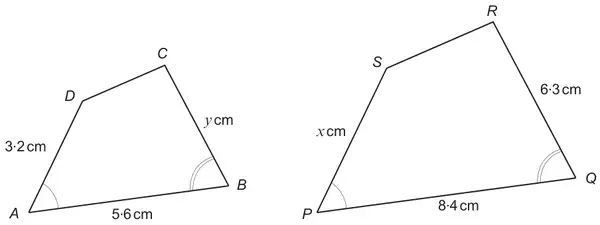
Diagrams not drawn to scale
(a) Calculate the value of \(x\). [2]
(b) Calculate the value of \(y\). [2]
(c) Explain clearly why the following statement cannot be true. [2]
‘The length of CD is 3·9 cm and the length of RS is 6·5 cm’.
| Scheme | Marks | Comments |
|---|---|---|
| \(x = 3{\cdot}2 \times \dfrac{8{\cdot}4}{5{\cdot}6}\) OR \(\dfrac{x}{3{\cdot}2} = \dfrac{8{\cdot}4}{5{\cdot}6}\) or equivalent. | M1 | M1 for correct use of linear ratio. |
| x = 4·8 | A1 |
| Scheme | Marks | Comments |
|---|---|---|
| \(y = 6{\cdot}3 \times \dfrac{5{\cdot}6}{8{\cdot}4}\) OR \(\dfrac{y}{6{\cdot}3} = \dfrac{5{\cdot}6}{8{\cdot}4}\) or equivalent. | M1 | M1 for correct use of linear ratio. |
| y = 4·2 | A1 | FT a slip in the calculation (not a misuse) of the scale factor in part (a) if used again in (b). |
| Scheme | Marks | Comments |
|---|---|---|
| Correct strategy of comparing corresponding ratio of lengths. | S1 | Sight of 3·9 / 6·5 (or 6·5 / 3·9) along with any pair of corresponding lengths or scale factor used (or corresponding FT lengths from their answers in 17(a) or 17(b)). |
| Indicates that \(\dfrac{3{\cdot}9}{6{\cdot}5}\) (= 0·6) is not equal to \(\dfrac{5{\cdot}6}{8{\cdot}4}\) (= 0·666…) or equivalent. | B1 | Allow using FT values from 17(a) or 17(b). |
Alternative method 1
| Scheme | Marks | Comments |
|---|---|---|
| (If CD = 3·9 then) RS = 3·9 × 1·5 | S1 | |
| = ‘5·85 (cm)’ or/and ‘which is not 6·5’ | B1 |
Alternative method 2
| Scheme | Marks | Comments |
|---|---|---|
| (If RS = 6·5 then) CD = 6·5 × 2/3 | S1 | |
| = ‘4·3… (cm)’ or/and ‘which is not 3·9’ | B1 |