
Higher November 2023 Unit 2 Q17
17. Three children, Gizella (G), Dilys (D) and Hanako (H), stand in a triangle, as shown below.
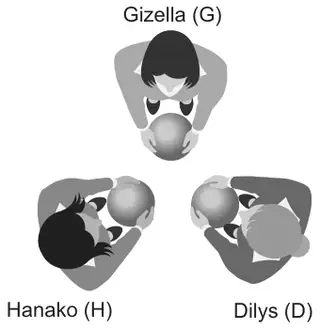
Each child holds a ball.
They must choose to pass their ball to the child on their left or the child on their right.
All 3 children pass their ball at the same time.
The probability that they pass it to their left is shown in the table below.
| Name of child | Probability of passing to the left |
|---|---|
| Gizella | \(\dfrac{1}{5}\) |
| Dilys | \(\dfrac{2}{7}\) |
| Hanako | \(\dfrac{3}{8}\) |
(a) Calculate the probability that every child passes their ball to the left. [2]
(b) Calculate the probability that one of the three children does not receive a ball. [3]
| Scheme | Marks | Comments |
|---|---|---|
| \(\tfrac{1}{5} \times \tfrac{2}{7} \times \tfrac{3}{8}\) | M1 | |
| \(= \tfrac{6}{280}\left(\tfrac{3}{140}\right)\) ISW | A1 | Accept a decimal answer of 0·021(4…). Allow an answer of 0.02 from correct working. |
| Scheme | Marks | Comments |
|---|---|---|
| [1–‘all pass to the left’–‘all pass to the right’] \(1 - \left(\tfrac{1}{5} \times \tfrac{2}{7} \times \tfrac{3}{8}\right) - \left(\tfrac{4}{5} \times \tfrac{5}{7} \times \tfrac{5}{8}\right)\) | M2 | Award only M1 if further incorrect work seen. FT from part (a) provided <1. M1 for any one of the following: \(1 - \left(\tfrac{1}{5} \times \tfrac{2}{7} \times \tfrac{3}{8}\right) \; \left[= \tfrac{137}{140}\right]\) \(1 - \left(\tfrac{4}{5} \times \tfrac{5}{7} \times \tfrac{5}{8}\right) \; \left[= \tfrac{9}{14}\right]\) \(\left(\tfrac{1}{5} \times \tfrac{2}{7} \times \tfrac{3}{8}\right) + \left(\tfrac{4}{5} \times \tfrac{5}{7} \times \tfrac{5}{8}\right) \; \left[= \tfrac{53}{140}\right]\) |
| \(= \tfrac{174}{280}\left(\tfrac{87}{140}\right)\) ISW | A1 | CAO Accept a decimal answer of 0·62(1…) |
17.(b) Alternative method 1
| Scheme | Marks | Comments |
|---|---|---|
| [‘2 pass left and 1 right’+‘2 pass right and 1 left’] \(\left(\tfrac{1}{5} \times \tfrac{2}{7} \times \tfrac{5}{8}\right) + \left(\tfrac{1}{5} \times \tfrac{5}{7} \times \tfrac{3}{8}\right) + \left(\tfrac{4}{5} \times \tfrac{2}{7} \times \tfrac{3}{8}\right)\) \(+ \left(\tfrac{4}{5} \times \tfrac{5}{7} \times \tfrac{3}{8}\right) + \left(\tfrac{4}{5} \times \tfrac{2}{7} \times \tfrac{5}{8}\right) + \left(\tfrac{1}{5} \times \tfrac{5}{7} \times \tfrac{5}{8}\right)\) | M2 | Award only M1 if further incorrect work seen. M1 for any one of the following: \(\left(\tfrac{1}{5} \times \tfrac{2}{7} \times \tfrac{5}{8}\right) + \left(\tfrac{1}{5} \times \tfrac{5}{7} \times \tfrac{3}{8}\right) + \left(\tfrac{4}{5} \times \tfrac{2}{7} \times \tfrac{3}{8}\right) \; \left[= \tfrac{7}{40}\right]\) \(\left(\tfrac{4}{5} \times \tfrac{5}{7} \times \tfrac{3}{8}\right) + \left(\tfrac{4}{5} \times \tfrac{2}{7} \times \tfrac{5}{8}\right) + \left(\tfrac{1}{5} \times \tfrac{5}{7} \times \tfrac{5}{8}\right) \; \left[= \tfrac{125}{280}\right]\) |
| \(= \tfrac{174}{280}\left(\tfrac{87}{140}\right)\) ISW | A1 | CAO Accept a decimal answer of 0·62(1…) |
17.(b) Alternative method 2
| Scheme | Marks | Comments |
|---|---|---|
| [G no ball + D no ball + H no ball] P(G no ball) + P(D no ball) + P(H no ball) = \(\left(\tfrac{1}{5} \times \tfrac{2}{7} \times \tfrac{5}{8}\right) + \left(\tfrac{4}{5} \times \tfrac{2}{7} \times \tfrac{5}{8}\right)\) \(+ \left(\tfrac{4}{5} \times \tfrac{2}{7} \times \tfrac{3}{8}\right) + \left(\tfrac{4}{5} \times \tfrac{5}{7} \times \tfrac{3}{8}\right)\) \(+ \left(\tfrac{1}{5} \times \tfrac{5}{7} \times \tfrac{3}{8}\right) + \left(\tfrac{1}{5} \times \tfrac{5}{7} \times \tfrac{5}{8}\right)\) | M2 | Award only M1 if further incorrect work seen. M1 for any one of the following: P(G no ball)=\(\left(\tfrac{1}{5} \times \tfrac{2}{7} \times \tfrac{5}{8}\right) + \left(\tfrac{4}{5} \times \tfrac{2}{7} \times \tfrac{5}{8}\right) \text{ or } \left(\tfrac{2}{7} \times \tfrac{5}{8}\right) \; \left[= \tfrac{5}{28}\right]\) P(D no ball)=\(\left(\tfrac{4}{5} \times \tfrac{2}{7} \times \tfrac{3}{8}\right) + \left(\tfrac{4}{5} \times \tfrac{5}{7} \times \tfrac{3}{8}\right) \text{ or } \left(\tfrac{4}{5} \times \tfrac{3}{8}\right) \; \left[= \tfrac{3}{10}\right]\) P(H no ball)=\(\left(\tfrac{1}{5} \times \tfrac{5}{7} \times \tfrac{3}{8}\right) + \left(\tfrac{1}{5} \times \tfrac{5}{7} \times \tfrac{5}{8}\right) \text{ or } \left(\tfrac{1}{5} \times \tfrac{5}{7}\right) \; \left[= \tfrac{1}{7}\right]\) |
| \(= \tfrac{174}{280}\left(\tfrac{87}{140}\right)\) ISW | A1 | CAO Accept a decimal answer of 0·62(1…) |
17.(b) Alternative method 3
| Scheme | Marks | Comments |
|---|---|---|
| [G receives 2 balls + D receives 2 balls + H receives 2 balls] P(H left, D right)+P(G left, H right)+P(D left, G right) = \(\left(\tfrac{3}{8} \times \tfrac{5}{7}\right) + \left(\tfrac{1}{5} \times \tfrac{5}{8}\right) + \left(\tfrac{2}{7} \times \tfrac{4}{5}\right)\) | M2 | Award only M1 if further incorrect work seen. M1 for any one of the following: P(H left, D right) = \(\left(\tfrac{3}{8} \times \tfrac{5}{7}\right) \; \left[= \tfrac{15}{56}\right]\) P(G left, H right) = \(\left(\tfrac{1}{5} \times \tfrac{5}{8}\right) \; \left[= \tfrac{1}{8}\right]\) P(D left, G right) = \(\left(\tfrac{2}{7} \times \tfrac{4}{5}\right) \; \left[= \tfrac{8}{35}\right]\) |
| \(= \tfrac{174}{280}\left(\tfrac{87}{140}\right)\) ISW | A1 | CAO Accept a decimal answer of 0·62(1…) |