
Higher June 2025 Unit 2 Q17
17. The diagram shows a quadrilateral \(EFGH\).
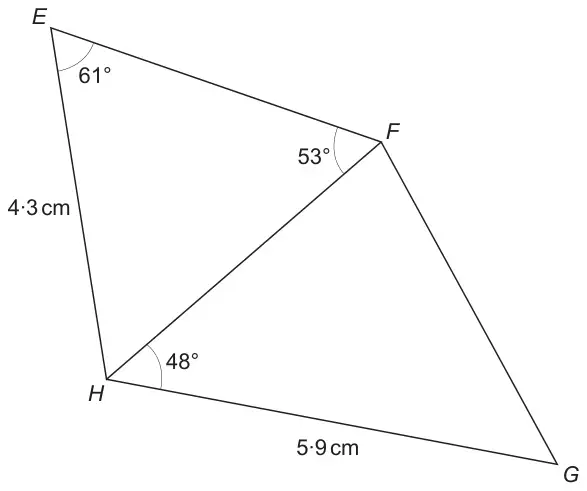
Diagram not drawn to scale
Calculate the area of triangle \(FGH\). [6]
From the formula list: In any triangle \(ABC\): Sine rule \(\dfrac{a}{\sin A} = \dfrac{b}{\sin B} = \dfrac{c}{\sin C}\); Cosine rule \(a^2 = b^2 + c^2 - 2bc\cos A\); Area of triangle \(= \dfrac{1}{2}ab\sin C\)
| Scheme | Marks | Comments |
|---|---|---|
| Use of sine rule followed by ‘Area = ½ ab sin C’. | S1 | Award S1 for an equivalent full method attempted e.g. angle \(EHF\) = 66(°), followed by finding \(EF\) (using sine rule) followed by finding \(FH\) (using cosine rule) followed by ‘Area = ½ ab sin C’. |
| \(FH = \dfrac{4{\cdot}3 \times \sin 61(^\circ)}{\sin 53(^\circ)}\) | M2 | M1 for \(\dfrac{FH}{\sin 61(^\circ)} = \dfrac{4{\cdot}3}{\sin 53(^\circ)}\) or equivalent (correct equation without isolating \(FH\)) |
| \(FH\) = 4·7(09… cm) or 4·71 (cm) | A1 | May be implied by further working. Award M2A1 if correct answer seen, and no further marks awarded, but award M2A0 if an incorrect value is used in further work and at least a further M1 is awarded. Radians = −10·492…(cm) Gradians = 4·756…(cm) |
| (Area of triangle \(FGH\) =) ½ × 4·709… × 5·9 × sin 48(°) | M1 | FT ‘their derived \(FH\)’. |
| = 10·3(….) (cm2) | A1 | Mark final answer, but ignore further work involving the addition of area of triangle \(EFH\). Allow 10(cm2) if 10·3(cm2) previously seen. Radians = 23·780…(cm2) Gradians = 9·605…(cm2) |