
Higher November 2019 Unit 1 Q16
16. The graph of \(y = 16 - x^2\) has been drawn below, for values of \(x\) from \(x = 0\) to \(x = 4\).
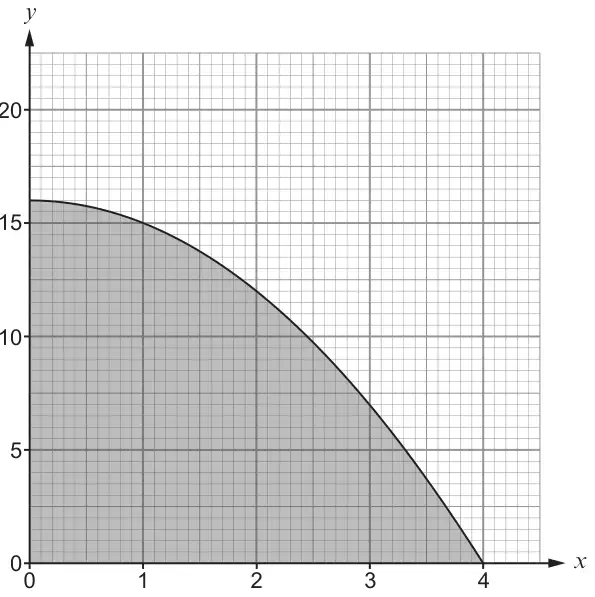
(a) Use the trapezium rule, with the ordinates \(x = 0\), \(x = 1\), \(x = 2\), \(x = 3\) and \(x = 4\), to estimate the area of the shaded region shown above. [3]
(b) The area can be estimated again, using ordinates at every half unit, namely \(x = 0\), \(x = 0{\cdot}5\), \(x = 1\), \(x = 1{\cdot}5\), \(x = 2\), \(x = 2{\cdot}5\), \(x = 3\), \(x = 3{\cdot}5\) and \(x = 4\).
Without calculating the new area, tick one of the following boxes.
The new area will be equal to the estimated area found in part (a). ☐
The new area will be greater than the estimated area found in part (a). ☐
The new area will be less than the estimated area found in part (a). ☐
From the formula list: Area of trapezium \(= \dfrac{1}{2}(a+b)h\)
| Scheme | Marks | Comments |
|---|---|---|
| (Area=) ½×1×[16+0+2(15+12+7)] or equivalent | M2 | Award M1 if only one y-value incorrect. |
| = 42 | A1 | F.T. from M1. If no marks, SC1 for an answer of 420 (from mis-reading horizontal scale). |
Alternative method
| Scheme | Marks | Comments |
|---|---|---|
| \(\dfrac{(16+15)}{2} + \dfrac{(15+12)}{2} + \dfrac{(12+7)}{2} + \dfrac{(7+0)}{2}\) | M2 | Individual areas are: 15·5, 13·5, 9·5, 3·5. M1 if only one y-value incorrect or M1 for any 2 (out of 4) correctly evaluated areas (of a complete ‘strip’). (Each area of a trapezium may be seen as the sum of the area of a rectangle and a triangle.) |
| = 42 | A1 | F.T. from M1 (provided 4 ‘strips’ considered). If no marks, SC1 for an answer of 420 (from mis-reading horizontal scale). |
| Scheme | Marks | Comments |
|---|---|---|
| ‘Greater than’ WITH valid reason e.g. trapezium rule gives an underestimate in this case and increasing the number of strips improves accuracy; less (shaded area) left out; more of the area (under curve) included; tops of strips are closer to the curve. | E1 | Allow e.g. increasing the number of strips improves accuracy. |